
The outsourcing of application development appears to be at a crossroads. The demand for applications is constantly increasing due to digital transformation, and qualified app developers are in limited supply. The increase in mobile applications, as well as increased use of artificial intelligence, machine learning, and big data, puts a premium not only on finding qualified developers but also making sure their skill sets continue to evolve. This would seem to be a recipe for growing demand for application development service providers.
But recent decreases in the rate of outsourcing show it is not as simple as that. When certain skills are in high demand and expensive, we find that technology and new practices often emerge to mitigate the need for those skills. Several trends have emerged that may be a sign that demand for highly paid application developers (and therefore outsourcing to access them) may be decreasing in the near future.
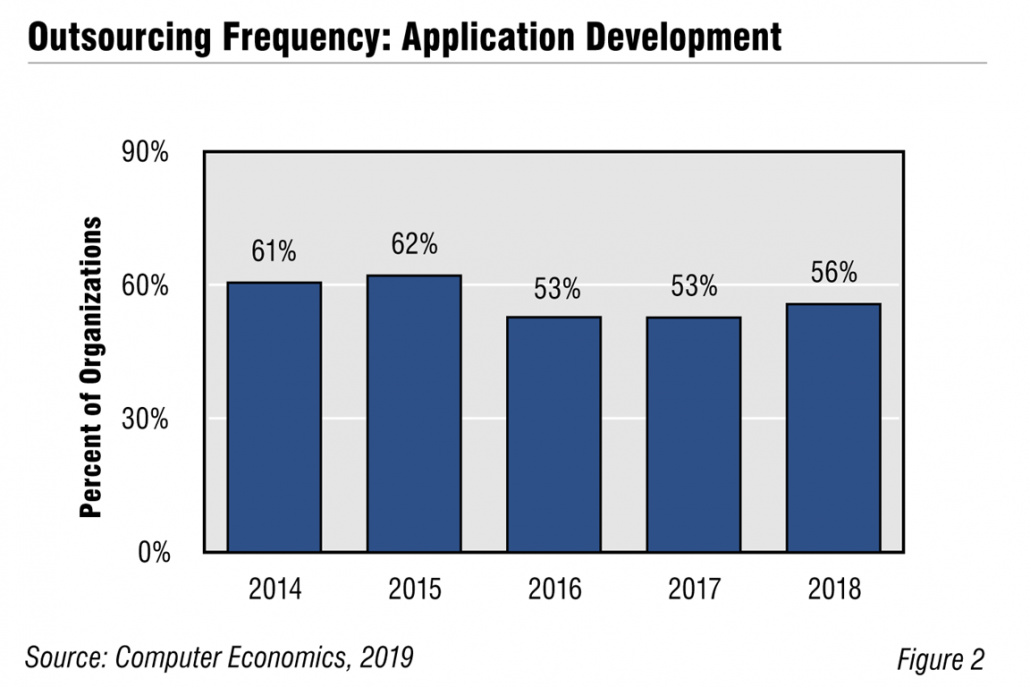
As seen in Figure 2 from our full report, Application Development Outsourcing Trends and Customer Experience, the percentage of organizations utilizing outside service providers for application development is 56%. Prior to this year, this function was flat at 53% in 2016 and 2017. For some perspective, the frequency of application development outsourcing hit a high of 66% in 2012. Whether 2018 is the beginning of a rebound toward the 2012 mark or just a blip depends on how quickly companies look to adopt some new technology and best practices, including public cloud infrastructure, software as a service (SaaS), and the no-code/low-code movement.
For more than 10 years, SaaS providers have introduced a plethora of applications to meet specific business needs, whereas in earlier years custom development might have been the natural choice. Platform-as-a-service (PaaS) providers also give in-house application developers easier ways to build and deploy new systems, making those developers, and in some cases, power users, more productive. This mitigates one source of demand for application development service providers. And speaking of faster ways to build applications, the no-code/low-code movement is gaining steam.
“No-code/low-code environments use graphical interfaces to create user applications, minimizing or even eliminating the need for more senior developers,” said Tom Dunlap, director of research at Irvine, Calif.-based Computer Economics. “This puts the power into the hands of the end user and reduces the need for expensive developers. This is a powerful combination many organizations won’t pass up. Still, professional software development isn’t going away any time soon, and companies will always have a need to tap into experienced developers both in-house and through outsourcing.”
We define IT outsourcing as contracting with a service provider to perform an IT function that is commonly performed in-house. This report does not use the term “outsourcing” as a synonym for “offshoring.” In fact, most outsourcing is done with domestic service providers. From the point of view of the IT organization, any function that is not performed by its IT staff is outsourced, regardless of whether the outsourcing is onshore, near-shore, or offshore.
This full report examines adoption trends and customer experience with application development outsourcing. We report on the percentage of organizations outsourcing it (frequency), the average amount of work outsourced (level), and the change in the amount of work being outsourced (trend). We also present data on cost and service experience and on how these trends differ by organization size and sector. We conclude with guidelines to consider when outsourcing application development.
This Research Byte is based on our report on this subject, Application Development Outsourcing Trends and Customer Experience. The full report is available at no charge for Avasant Research subscribers, or it may be purchased by non-subscribers directly from our website (click for pricing).