
As we all know, the amount of data that IT organizations need to manage is growing year after year, with no end in sight. Whether it be sensor data from IoT devices, social networking data, online advertising and e-commerce transactions, or multimedia files, the complexity of data to be managed is continually increasing. It is no wonder, then, that the data management function is growing within enterprise IT organizations.
This function now represents 5.9% of the IT staff, up from 5.1% last year, as shown in Figure 1 from our full report, Data Management Staffing Ratios. Prior to 2019, despite the growth in data, data management staffing as a percentage of the IT staff was essentially flat. Do these sudden increases represent a paradigm shift where growth will continue apace with the growth of data? Or will the growth reach an equilibrium?
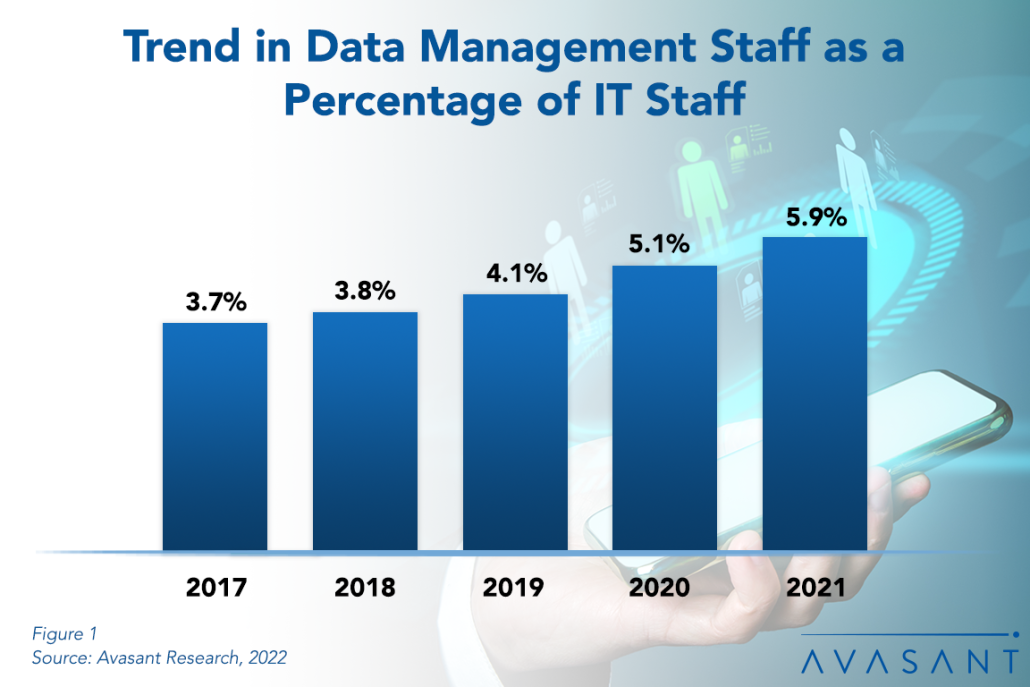
To answer that, it helps to look at what held back growth in data management staffing for several years. It is likely that the tools in the hands of data management personnel were making them more productive. These include cloud-based business analysis and reporting tools. Moreover, analytical tools embedded within application systems, such as ERP, CRM, and HCM, along with more powerful self-service reporting tools directly in the hands of users, were reducing the reliance on data management staff for routine reporting.
“With the explosion in data over the past 20 years, we were wondering why we didn’t see an increase in the demand for data management prior to 2019,” said Reneece Sterling, a research analyst for Computer Economics, a service or Avasant Research, based in Los Angles. “Now we’ve finally reached a tipping point where the data management tools can just do so much before you need to add staff.”
We define the data management staff as those individuals who design, develop, architect, and model data schemas and databases for the organization. They also may design the organization’s data warehouse and business intelligence systems and analyze information maintained by such systems. This category does not include database administrators, who reside in the database administration category. A complete listing of our IT staffing categories is in the Appendix of the PDF version of the full report.
To examine this important IT staffing question, the full report uses four benchmarks to assess data management staffing levels: data management staff as a percentage of the IT staff, data management staff as a percentage of the Application Group, users per data management staff member, and applications per data management staff member.
This Research Byte is a brief overview of our report on this subject, Data Management Staffing Ratios. The full report is available at no charge for subscribers, or it may be purchased by non-clients directly from our website (click for pricing).