
The share of the typical IT staff devoted to applications maintenance declined this year. However, this metric is not yet showing a trend and is fluctuating as organizations grapple with expanding software portfolios at the same time they are converting some of their portfolios to SaaS.
As shown in Figure 1 from our full report, Application Maintenance Staffing Ratios, application maintenance staffing as a percentage of the total IT headcount declined from 11.3% in 2017 to 10.6% in 2018. The 2018 number is nearly identical to the 2016 number of 10.5%. The historic data only encompasses three years at this point because we previously did not separate application programmers into maintenance and developer roles.
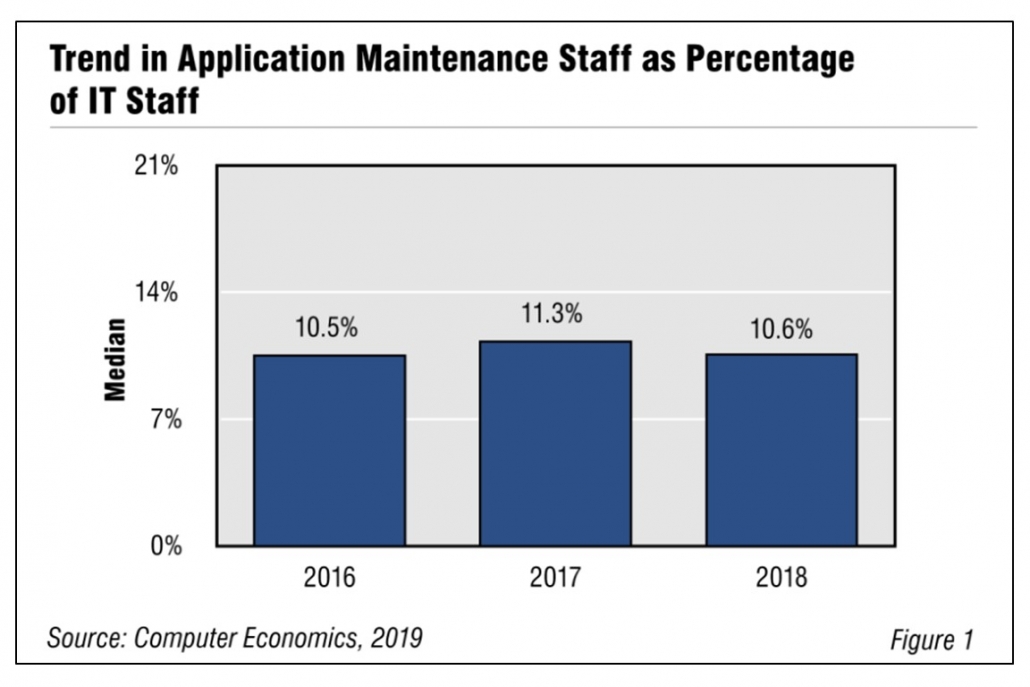
Largely because of SaaS, in the long term we would expect the decline of application maintenance staff to continue. But because the footprint of business applications is becoming wider, we would not expect a smooth ride. Fluctuations will continue as organizations attempt to meet the challenges of digital transformation. Organizations are automating more business processes, connecting with customers and suppliers, and analyzing increasing volumes of business data. Mobile devices add another dimension and an increased set of requirements. All of these drive the need for new business systems and application maintenance personnel to support them.
“One of the big benefits of SaaS is that it relieves IT organizations of much of the burden of applications maintenance, including routine upgrades and patches,” said David Wagner, vice president of research at Computer Economics, an IT analyst firm based in Irvine., Calif. “On the other hand, IT organizations often invest those time-savings into new applications development, such as new line of business apps or systems of competitive advantage, which then require ongoing support. So, for now, you have a push and a pull on the maintenance staff.”
How do we define application maintenance and support? These job functions include application programmers who troubleshoot, debug, and make routine changes and version upgrades to applications. This category also includes application-specific support specialists. It does not include business analysts, database administrators, or application developers, who belong in their respective categories. The category also excludes managers who oversee development activity, and it specifically excludes personnel who fall into related but separate categories as defined by our IT staffing categorization framework. These include quality assurance and testing personnel, business analysts, and project managers.
To determine what the typical staffing level is today, the full report uses three metrics: application maintenance personnel as a percentage of the IT staff, users per application maintenance staff member, and applications per application maintenance staff member. We provide benchmarks for the composite sample, by organization size, and by sector. We also provide a benchmark for the larger Application Group, which includes personnel engaged in application development, web/e-commerce support, quality assurance and testing, data management, and business systems analysis. We conclude with practical recommendations for optimizing the productivity of application maintenance personnel.
This Research Byte is based on our report on this subject, Application Maintenance Staffing Trends. The full report is available at no charge for Avasant Research subscribers, or it may be purchased by non-subscribers directly from our website (click for pricing).