
The data explosion is finally making an impact on data management staffing. Through the middle of the 2010s, data management head count plateaued at around 3.8% of the total IT staff despite the fact that organizations of all sizes were making more use of data for business intelligence and analytics.
The function now represents 5.1% of the IT staff, up from 4.1% last year, as shown in Figure 1 from our full report, Data Management Staffing Ratios. Prior to that, despite the growth in data, data management staffing as a percentage of the IT staff basically remained flat. Does this sudden increase represent a paradigm shift where growth will continue apace with the growth of data? Or will the growth level off?
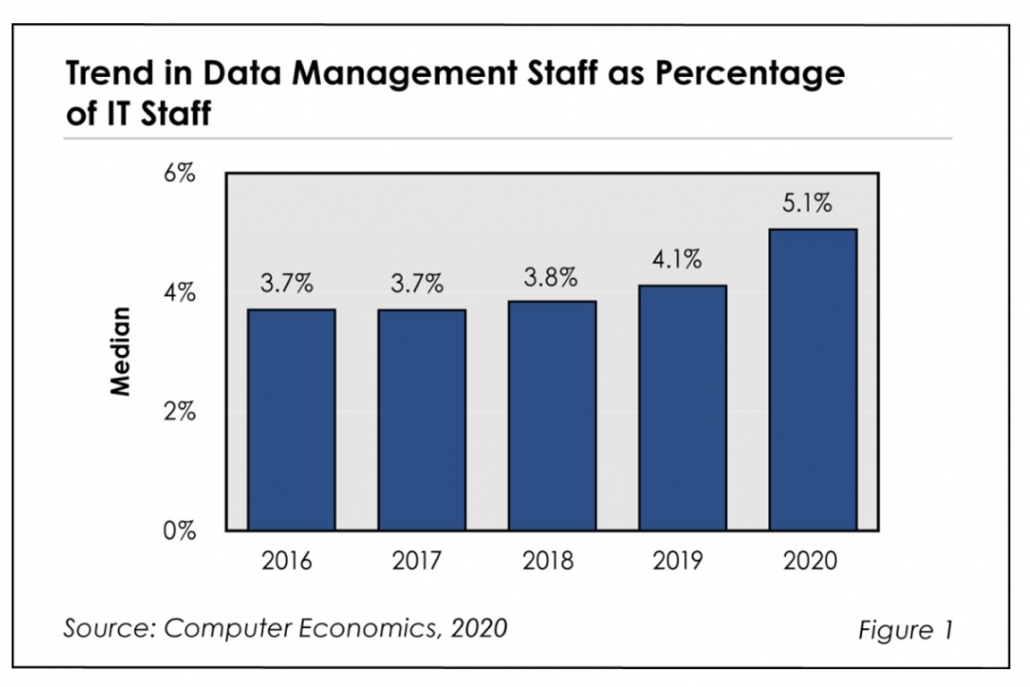
To answer that, it helps to look at what held back growth in data management staffing for several years. It is likely that the tools in the hands of data management staff were making them more productive. These include cloud-based business analysis and reporting tools. Moreover, analytical tools embedded within application systems, such as ERP, CRM, and HCM, and more powerful self-service reporting tools directly in the hands of users were reducing the reliance on data management staff for routine reporting.
“It isn’t like these tools are going away,” said David Wagner, senior director of research for Computer Economics, a service of Avasant Research, based in Los Angeles. “In fact, AI and machine learning are likely to only make them better. It is unlikely that data management staffing will grow unchecked. But given the unending thirst for data, data management staffing is likely to grow over time.”
We define the data management staff as those individuals who design, develop, architect, and model data schemas and databases for the organization. They also may design the organization’s data warehouse and business intelligence systems and analyze information maintained by such systems. This category does not include database administrators, who reside in the database administration category. A complete listing of our IT staffing categories is in the Appendix of the PDF version of this report.
To examine this important IT staffing question, the full report uses four benchmarks to assess data management staffing levels: data management staff as a percentage of the IT staff, data management staff as a percentage of the Application Group, users per data management staff member, and applications per data management staff member.