
For many companies, e-commerce systems are not a nice-to-have but essential to their survival in the digital world. But while ROI and TCO are positive for e-commerce systems, customer satisfaction for them still lags, showing that these systems can be complex and difficult to deploy.
E-commerce is a mature technology, with about half (54%) of companies that completed our annual Technology Trends survey using some form of an e-commerce system. Moreover, e-commerce is an area of continued build-out: Forty-seven percent of our respondents indicate that they are investing in new e-commerce capabilities.
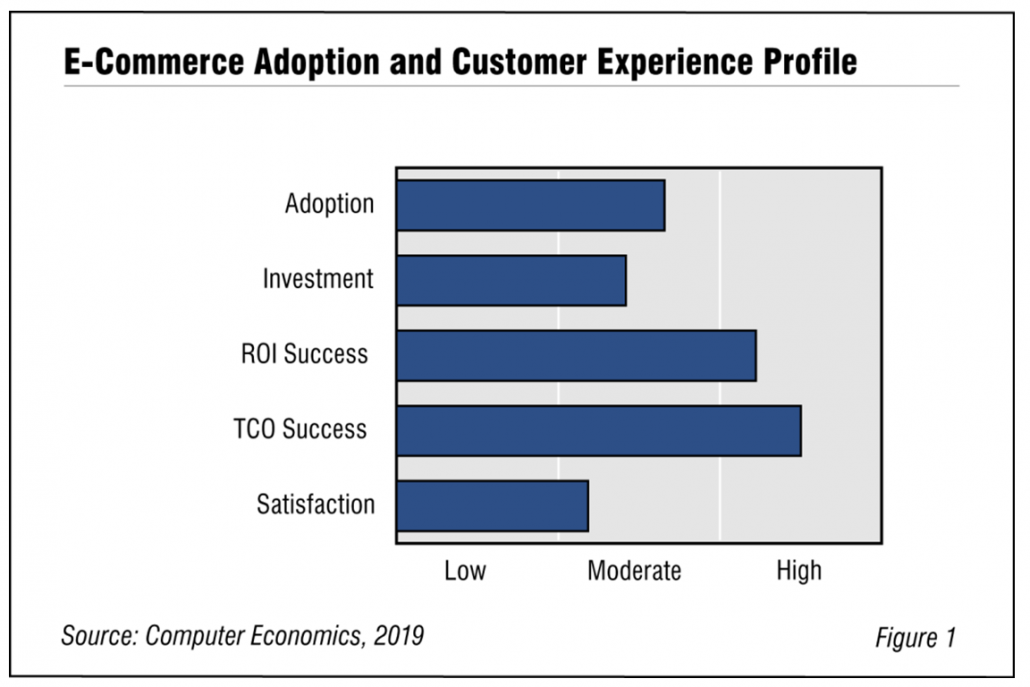
Nevertheless, as shown in Figure 1 from the full report, E-Commerce Adoption Trends and Customer Experience, the customer experience for e-commerce systems is mixed. Compared with other technologies, we classify e-commerce systems as offering a high ROI success rate and a high TCO success rate. However, satisfaction with e-commerce systems is only moderate.
E-commerce systems are exactly as the name implies: systems that enable organizations to transact business electronically, primarily through the internet. Although the internet can and should be used in countless ways to develop and enrich the customer experience, it is business transactions that are the defining characteristic of e-commerce.
Nevertheless, e-commerce has become increasingly complex as its use has boomed. Moving beyond stand-alone web storefronts, e-commerce systems interface with CRM systems, supply chain management systems, and ERP to provide real-time data for managing inventory and forecasting customer demand. E-commerce systems also include the use of web APIs that allow buyer and seller systems to communicate directly. At the same time, older electronic data interchange (EDI) systems continue to be deployed and extended in B2B commerce. All of these—website commerce, web APIs, and EDI systems—fall under our definition of e-commerce systems.
“The fact that e-commerce systems have been on the scene for a while does not necessarily mean they have gotten easier to deploy,” said Tom Dunlap, director of research for Computer Economics, based in Irvine, Calif. “One reason is that it’s often difficult to set up the integration with back-end systems, such as inventory, order management, or customer service. When that happens, it’s not just users that are frustrated but customers as well.”
Starting in the retail industry, e-commerce today is deployed by companies in virtually all sectors to do business with customers. Banks use it for online banking. Healthcare providers use it not only for billing, but for appointments, scheduling, and patient workflow. Governments use it to allow citizens to pay taxes. Charities and nonprofits use it to collect donations. There is scarcely a business transaction that cannot be performed today using e-commerce.
The full report provides an overview of e-commerce adoption and investment trends, providing data on how many organizations have the technology in place, how many are in the process of implementing it, and how many are expanding implementations. We also look at the return on investment experience, total cost of ownership experience, and considered or planned uses for new e-commerce investment. We conclude with important principles to apply in planning and implementing e-commerce systems.
This Research Byte is a brief overview of our report on this subject, E-Commerce Adoption Trends and Customer Experience. The full report is available at no charge for Avasant Research subscribers, or it may be purchased by non-subscribers directly from our website (click for pricing).