
An effective change management discipline is arguably the most critical requirement of a successful IT organization. Basically, change management is a set of standardized processes designed to administer all changes to the IT production environment. The ultimate goal of this discipline is to minimize the impact of change-related incidents on IT service levels. Ensuring this goal is achieved can help lower the total cost of IT while increasing the value of IT to the organization.
While the need for IT change management has long been understood in many organizations–most notably in legacy mainframe environments–the growing acceptance of ITIL as a set of management best practices is now introducing the benefits of change management to IT organizations of all sizes and technical environments. However, despite heightened awareness of the criticality of this discipline, many companies continue to struggle with high levels of IT incidents and problems arising from improperly implemented changes to the production infrastructure.
This article will look at the effectiveness of change management practices in IT organizations. Additionally, we will consider the impact of staffing levels on the overall quality of this function. Finally, we will briefly examine the issues that may arise by failing to adequately develop and staff an IT change management function.
Change Management as a Management Discipline
As mentioned earlier, despite the fact that the majority of IT professionals view change management as a critical discipline, many IT executives continue to report that this function is not optimally utilized in their organizations.
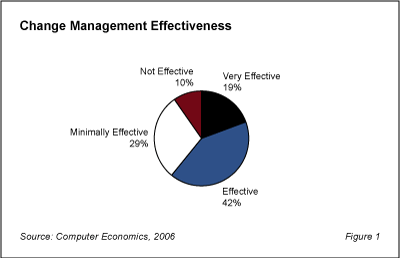
In a 2005 survey, Computer Economics interviewed nearly 200 senior IT managers regarding the effectiveness of their change management processes. As shown in Figure 1, 29% of senior managers rated their change management discipline as “minimally effective,” and 10% rated theirs “not effective” at all. In other words, nearly 40% of senior managers feel their ability to manage this critical function is sub-par.
Although 42% of the respondents consider their IT change management strategy “effective,” this may not be something to get excited about. The reason is simply that change management may be too important for organizations to settle for anything but a “highly effective” rating. In other words, an “effective” rating in this discipline probably translates to a C+, so organizations below this level are receiving a failing grade.
Staffing Levels: The Smoking Gun?
Recently, our partner, Metrics Based Assessments (MBA), provided some statistics regarding the percentage of data center staff (full-time equivalents) assigned to change management based on benchmarks collected over approximately the past 12 months. The survey broke down staffing levels by four hardware platforms, as shown in Figure 2.
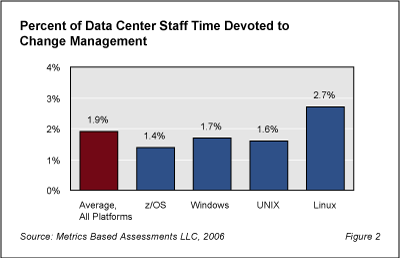
Figure 2 shows that the percent of IT staff devoted to change management does vary by hardware platform. According to the data, mainframe environments devote the smallest percentage of staff while Linux environments utilize the largest. This may indicate that the farther an IT organization moves from a traditional and mature infrastructure, the higher the percentage of personnel required to effectively administer change management becomes. The higher level of staffing for Linux most likely occurs because such environments tend to concentrate on newly installed applications and systems, and are therefore subject to a greater number of changes than an older, more mature environment such as a mainframe shop.
Regardless of platform type, the key metric here is that on average, the percentage of data center staff assigned specifically to change management is 1.9%. The question is simply whether this level of staffing is adequate to support the change management function in most IT organizations. It is common knowledge that most incidents and problems in the data center have as their root cause some change that was introduced in the environment. Evidently, many data centers are not devoting adequate time and attention to change management.
Change management in most data centers is treated in two extremes. On one extreme, the change management process is informal and poorly controlled. In such environments, changes are applied in a haphazard fashion, without adequate impact analysis, testing, or communication.
On the other extreme, the process is so formalized, rigid, and slow that most changes are treated as emergencies so that they can be applied in a timely manner. The result is the same: inadequate analysis, testing, and communication, with data center staff operating in fire-fighting mode as a way of life.
Recommendations
As we have seen, the change management function is a core discipline in the IT organization, and it is a primary driver in the cost and quality of service. Computer Economics, therefore, recommends the following:
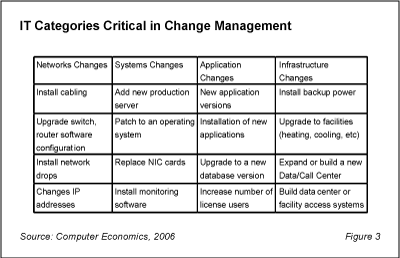
Once the change management process is well designed, the IT organization can better understand the staff required to support it. If change management is as important as we have seen, it deserves a greater level of staffing than it currently has in most organizations. Well-designed change management processes with adequate staffing and well-defined roles and responsibilities will deliver major paybacks in terms of reduced costs and improved quality of service for the IT organization.
Figure 2 statistics in this article were provided by Mark Levin, a Partner at Metrics Based Assessments, LLC, from data collected from data center benchmarking studies conducted over the past 12 months.
Current benchmark data is available in Levin’s book, Best Practices and Benchmarks in the Data Center, which may be purchased from the Computer Economics website (click for pricing).