
In the rapidly evolving digital landscape, assessing inherent and separation risks in IT during a divestiture is critical. Effective IT due diligence is vital to identify and mitigate hindrances to value creation. It ensures IT aligns with business strategy, supports processes, enhances customer experiences, and drives growth. Poor IT management can disrupt operations, waste resources, and prevent innovation, making robust due diligence essential. An effective IT Due Diligence process can help identify risk comprehensively, and estimate the size and spend on IT.
Avasant recently conducted IT due diligence for a global PE firm looking to carve-out a subsidiary from a globally run company.
Our assessment was based on a thorough analysis of information shared by the management, inputs from our experts in the industry and relevant regions, and Avasant’s proprietary benchmarks. Avasant used the following framework to assess the target’s IT environment comprehensively. The framework evaluated the suitability of IT strategy, IT financials, applications and platforms, IT Infrastructure, IT processes and security, and people for Day 1 operations. Avasant also gathered input from internal IT stakeholders (or customers), external vendors, and partners.
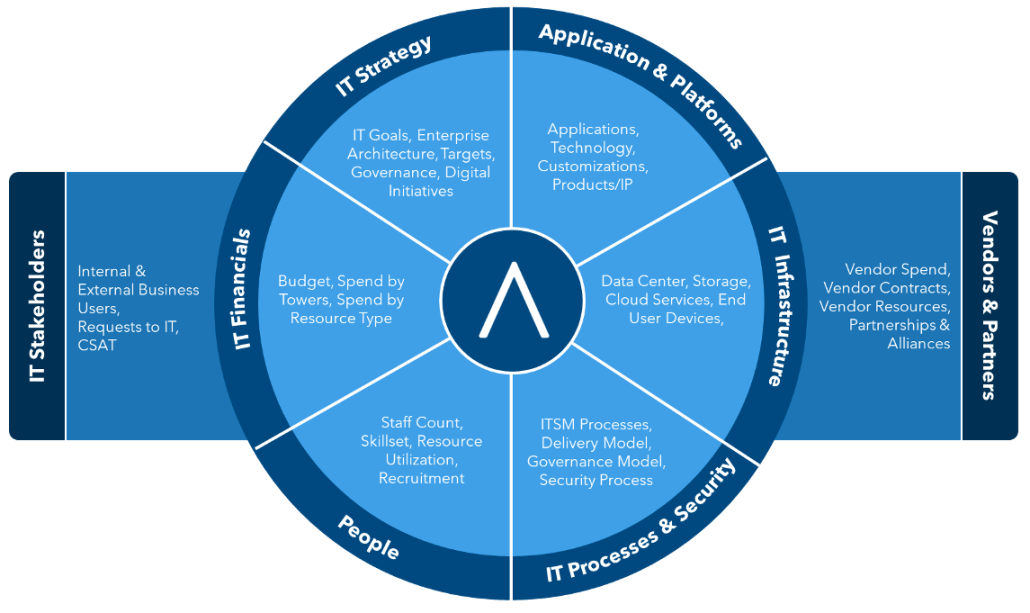
Our Private Equity client gained a comprehensive view of Target’s IT risks, estimated IT costing, and best-practice-based ideal operating model to ensure maximum value. Based on the insights, the client was able to qualify the target for investment ahead of the deal timeline.
Our engagement highlighted that inherent risks often stem from outdated technology, lack of skilled personnel, and inefficient processes. Separation risks arise from the degree of integration between the acquiring and target companies, as well as the ability of management to maintain control during the transition.
The organizational structure we recommended went through a few iterations to ensure it blended into the business context, including diversification in the application ecosystem and distribution of business/manufacturing sites. Also, the iterations focused on adjusting for the degree of outsourcing possible for the target.
While estimating the costs, we laid emphasis on costs for migrating and splitting ERP platforms, efforts required to replace or implement custom-built applications as well as opportunities that could emerge from rationalizing vendors and applications.
Performing IT due diligence during a divestiture is a critical process that offers numerous advantages. It provides a comprehensive understanding of the technological assets involved in the transaction, which is essential for accurately valuing these assets and ensuring a fair and transparent deal. This process involves thoroughly examining the IT infrastructure, systems, and data of the divested business, which helps identify any potential risks and vulnerabilities. These could include security posture, system inefficiencies, or data compliance issues. By identifying these risks early in the divestiture process, companies can take steps to mitigate them, thereby preventing any future legal or financial complications. IT due diligence also gives the buyer confidence in the value and potential of the acquired assets, facilitating a smoother transaction.
Furthermore, IT due diligence assesses critical performance metrics and examines data redundancy measures. This information can highlight areas that may require optimization or additional investment, providing both the buyer and seller with valuable insights for strategic planning post-divestiture.
In the digital transformation era, where technology plays a pivotal role in business operations, IT due diligence has become an indispensable part of the divestiture process. It not only ensures a successful transaction but also lays the foundation for the future success of both the divested business and the acquiring company, making IT due diligence a critical step in achieving a successful divestiture.
IT due diligence during a divestiture is a complex process that requires careful planning and execution. Here are some best practices to ensure a successful outcome:
Buyers should ensure that IT due diligence contributes to a successful divestiture, maximizes the value of the transaction, and lays the foundation for future success. In the digital transformation era, IT due diligence is not just an optional extra – it’s a critical component of any divestiture process.
IT due diligence is critical during a divestiture. It requires a comprehensive understanding of technological assets, the identification of potential risks and vulnerabilities, and the assessment of critical performance metrics and data redundancy measures. IT due diligence is indispensable in the digital transformation era, ensuring a successful transaction and laying the foundation for future success. To ensure successful IT due diligence, early involvement of IT experts, comprehensive assessment, leveraging an established framework, risk identification, structured and actionable recommendations, clear communication, and post-divestiture support is essential. These practices contribute to a successful divestiture, maximizing the value of the transaction and laying the groundwork for the continued success of both the divested business and the buyer.
By Chirag Rawat, Senior Director