With over 70 jurisdictions racing to regulate Artificial Intelligence (AI) systems, procurement leaders face a compliance minefield that could derail innovation and vendor agility. The European Union’s AI Act spans over 140 pages. The U.S. Executive Order on “Safe, Secure, and Trustworthy AI” adds over 30 pages. Brazil, China, Canada, Singapore, and numerous others are releasing their own legislation — creating a rapidly diversifying global mandate.
For sourcing and procurement professionals, particularly those engaged in technology acquisition, the implications are substantial. Vendor selection and contract design must now account not only for performance and cost, but for an expanding body of compliance requirements that vary by jurisdiction, risk level, and AI function.
To address this complexity, this article distils the world’s most demanding AI rules into a single, sourcing-ready framework: a Global AI Governance Decalogue. Each point is rooted in binding or authoritative guidance from the strictest jurisdictions and is designed to be embedded directly into AI-related contracts, RFPs, and due diligence frameworks.
The Regulatory Patchwork
The following national and supranational instruments form the foundation of today’s most stringent AI obligations (note that while this selection highlights the most influential and widely referenced regulatory frameworks, it does not encompass the full scope of AI legislation globally):
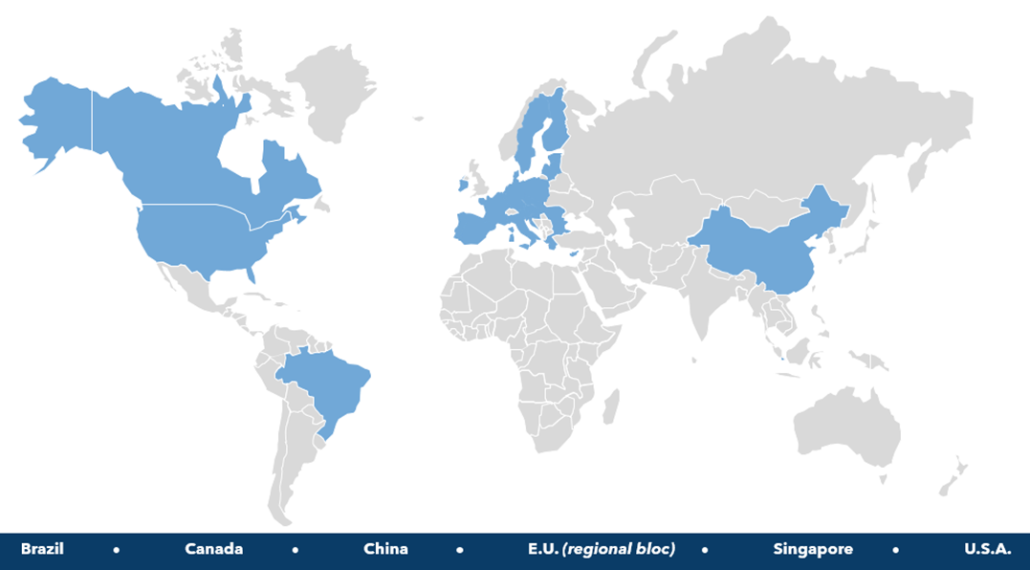
Despite sharing a commitment to AI governance, the frameworks of each jurisdiction reflects markedly different regulatory temperaments shaped by national values and policy priorities: the EU adopts a privacy‑forward, protective posture; the U.S. favors flexibility and innovation; Brazil strives for responsible and human‑centered regulation but remains more exploratory and less prescriptive; China enforces a politically guided model balancing rapid rollout with ideological oversight; Canada treads a balanced, risk‑based path that seeks to merge protection and innovation within a democratic governance ethos; and Singapore opts for a more pragmatic, voluntary checklist rather than coercive mandates.
Even with these jurisdictional differences, four regulatory themes recur: safety, fairness, transparency, and accountability.
Procurement and sourcing teams are often the first line of exposure when enterprise functions engage with AI vendors. A harmonized, jurisdiction-agnostic governance framework yields three strategic advantages:
As AI becomes a core enabler of enterprise transformation — from ERP platforms to customer analytics — procurement must evolve from price-focused negotiation to governance-oriented value creation.
The Decalogue should be implemented by procurement teams gradually, with priority given to high-risk systems and new vendor engagements. Recommended actions include:
This approach supports both compliance and resilience — ensuring that the enterprise remains adaptable as regulations evolve, without compromising on innovation or vendor agility.
Building on this foundation of compliance and resilience, Avasant’s research reports — including the Governance, Risk, and Compliance Services 2024 Market Insights and the Responsible AI Platforms RadarView — underscore the urgency for enterprises to adopt integrated governance frameworks and responsible AI practices. These reports cite challenges such as fragmented regulatory landscapes, the rise of Gen AI risks like hallucinations and data misuse, and the increasing enterprise investment in responsible AI initiatives. Together, these insights validate the Decalogue’s strategic relevance and reinforce its role in helping procurement teams navigate evolving compliance demands.
(Each point names the strictest sources so it can be cited during negotiations)
| # | Title | Brief Description | Reference |
| 1 | Risk Classification and Tiered Obligations | AI systems must undergo preliminary risk assessments and be classified into categories (e.g., prohibited, high-, limited-, or minimal-risk), with stricter obligations for higher-risk systems. | · AI EU Act, Recital 26 and Chapter III |
| 2 | Prohibition of Unacceptable AI Practices | Certain AI applications — such as subliminal manipulation, social scoring, and discriminatory biometric categorization — are explicitly banned. | · AI EU Act, Chapter II |
| 3 | Bias Testing and Fairness Audits | High-risk AI systems must be trained and tested using high-quality, representative datasets to prevent discriminatory outcomes and ensure fairness. | · AI EU Act, Recital 67 |
| 4 | Transparency and Explainability | AI systems must provide users and affected individuals with clear and accessible information regarding their purpose — including the objectives of the AI and the nature of data collection — as well as their underlying logic and limitations. | · AI EU Act, Article 50 |
| 5 | Human Oversight and Intervention | High-risk AI systems must include mechanisms for meaningful human oversight to ensure accountability and prevent automation bias. | · AI EU Act, Recital 27 and Article 14 |
| 6 | Privacy by Design and Data Minimization | AI systems must integrate privacy protections from the outset and limit data collection by using only what is strictly necessary. | · Canada C-27, Sections 12 and 13 |
| 7 | Incident Reporting and Disclosure | Organizations must notify authorities of incidents involving material harm or risks arising from AI system use. | · Canada C-27, Section 58 |
| 8 | Security and Robustness | AI systems must be tested for robustness against misuse, adversarial attacks, and vulnerabilities. Post-deployment monitoring should also be included. | · US EO 14110, Sec. 4 and 10.1 (b) (iv) |
| 9 | Enable Independent Audits and Red-Teaming | Vendors must allow for independent audits and red teaming to test for vulnerabilities, including bias, safety, and misuse risks. | · US EO 14110, Section 10.1(b)(viii)(A) |
| 10 | Accountability and Governance Structures | Organizations must designate responsible officers and maintain governance structures to oversee AI compliance and risk management. | · Canada C-27, Section 8 |
Taken together, the Decalogue converts fragmented global AI mandates into a unified compliance and sourcing playbook. By embedding these ten principles into procurement workflows, organizations are positioned to meet regulatory demands while shaping responsible, future-ready AI adoption; a foundation for strategic leadership.
As AI rapidly becomes embedded across enterprise systems, its governance cannot be deferred. For sourcing and procurement leaders, the challenge is twofold: ensuring alignment with evolving global regulation and maintaining contractual flexibility amid technological uncertainty.
A global AI governance framework — rooted in the world’s strictest obligations — offers a practical and strategic response. By distilling safety, fairness, transparency, and accountability into ten enforceable provisions, procurement can lead in shaping responsible AI adoption across the enterprise.
The Global AI Decalogue is not merely a legal safeguard. It is a blueprint for sourcing integrity in the AI era.
By Julen Del Arco, Senior Consultant