
The press release is out. The deal is done. But for procurement teams, the real challenge is just beginning. In one recent merger, a global enterprise discovered that over 30% of its inherited supplier contracts were noncompliant with local data privacy laws, just weeks before integration. This isn’t unusual—if anything, it serves as an early heads-up. When it comes to post-merger compliance, unanticipated issues can quietly become bigger challenges if left unchecked.
This real-world example underscores a broader truth: post-merger procurement isn’t just operational—it’s regulatory, strategic, and high-stakes. Mergers and acquisitions are inherently disruptive, bringing together different systems, cultures, and operational frameworks. But perhaps the most overlooked challenge is regulatory compliance in procurement. The process extends beyond consolidating supplier databases or revisiting contract terms. It’s about ensuring that every contract, whether IT services, logistics, or facilities management, meets the legal and regulatory standards of the new, unified entity.
Post-merger, procurement teams are often faced with a patchwork of contracts governed by different laws, negotiated under different risk appetites, and executed with varying levels of rigor. The risk is noncompliance, which may result in fines, litigation, or, in the most serious cases, the collapse of the deal. While the compliance landscape is complex, many organizations mistakenly believe that pre-merger due diligence is enough to mitigate the risks.
Most M&A playbooks emphasize pre-merger due diligence. And rightly so. It’s the phase where red flags are identified, liabilities are assessed, and strategic fit is evaluated. But what happens after the deal closes?
According to Avasant’s procurement services, post-merger compliance requires a structured approach that includes legal and financial due diligence, contract assignability assessments, and a comprehensive review of supplier obligations. It’s not enough to know what you’re inheriting—you need a plan to bring it all into compliance.
Once the deal is signed, the real work begins as procurement teams focus on aligning inherited contracts. Contract harmonization is pivotal in mitigating risk and ensuring operational continuity. While due diligence helps identify risks, harmonization is how those risks are resolved in practice.
One of the most effective strategies for post-merger compliance is contract harmonization. This involves aligning disparate contracts across the merged entities to ensure consistency, eliminate redundancies, and maintain operational continuity.
Avasant’s procurement services team supported a global telecom merger involving just under 100 IT supplier contracts. These contracts spanned 12 jurisdictions, each with unique data privacy, labor, and tax compliance requirements. Using AI-powered contract analytics, the team identified:
By prioritizing high-risk contracts and renegotiating terms with key suppliers, the client avoided potential fines exceeding $8 million and achieved full compliance within 90 days. Achieving harmonization at scale relies on the right mix of technology and human insight. With manual reviews, fading, integrated tools now deliver faster, more accurate, and client-focused outcomes.
Technology is no longer a nice-to-have in post-merger compliance—it’s a necessity. AI tools can scan contracts for non-compliant clauses, suggest standardized language, and even predict potential regulatory pitfalls based on historical data.
However, technology must be complemented by human expertise to ensure comprehensive compliance. Post-merger, procurement teams often face uncertainty, shifting priorities, and new reporting lines. Clear communication, defined roles, and ongoing training are essential to keeping everyone aligned.
Successful compliance also requires a centralized contract repository, clear ownership of the harmonization process, and ongoing stakeholder engagement. Achieving compliance requires a strategic balance between automation and human oversight, leveraging technology for efficiency while ensuring that expert judgment guides critical decisions. For example, Avasant deployed an AI tool that scanned over 1,000 pages of supplier agreements in under 48 hours. The tool flagged:
These insights enabled the legal team to proactively amend contracts before integration, reducing legal review time by 40%. However, AI is not infallible—it may miss nuanced legal language or jurisdiction-specific clauses. That’s why human oversight remains critical. Even the most advanced tools can’t replace human judgment, and that’s where the human factor becomes indispensable.
Avasant’s experience is that success depends not only on AI but also on the right combination of procurement, legal, IT, and compliance specialists working together. This strategic blend of expertise makes all the difference.
Even with the right tools and teams in place, knowing where to focus compliance efforts is critical. That’s where regulatory hotspots come into play. Not all contracts are created equal. Some carry more regulatory weight than others. Here are a few areas where compliance scrutiny tends to be highest:
For multinational mergers, compliance complexity multiplies. Consider these jurisdictional contrasts in Table 1:
| Regulation | Region | Key Difference |
| GDPR vs. CCPA | EU vs. California | Consent and data retention rules |
| India’s Labour Code vs. UK TUPE | India vs. UK | Supplier transition obligations |
| Brazil’s LGPD vs. Singapore’s PDPA | Brazil vs. Singapore | Data breach notification timelines |
A global compliance map can help teams prioritize high-risk jurisdictions and tailor contract language accordingly. Ignoring these hotspots can lead to serious consequences—blocked transactions, fines, or reputational damage.
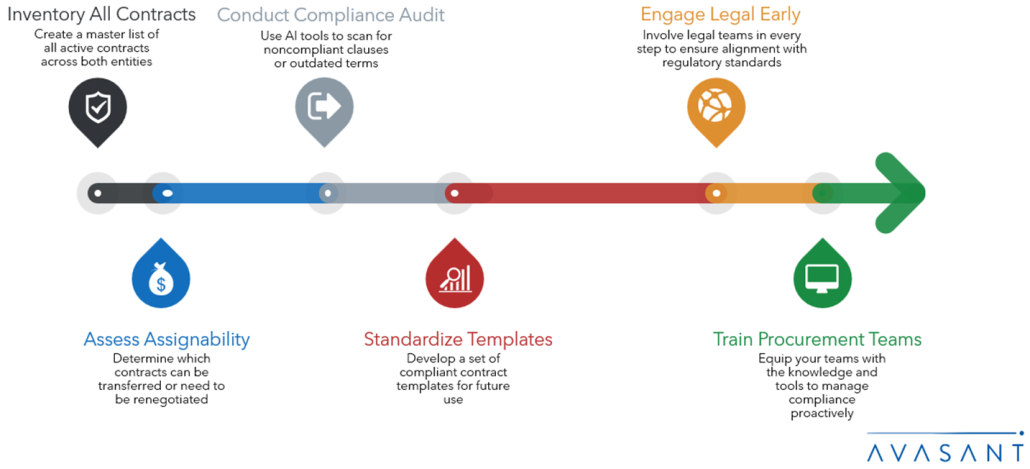
With these regulatory hotspots in mind, organizations need a structured roadmap to navigate the compliance terrain effectively. So, how do you get it right? Start with a framework. Figure 1 illustrates a simplified road map.
In Figure 2, Avasant recommends ten (10) compliance checks for procurement teams post-merger.
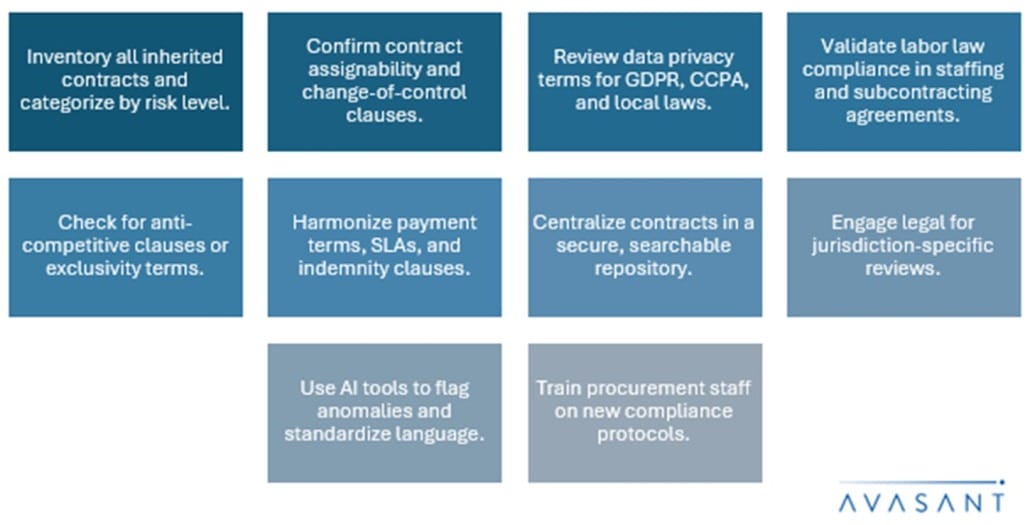
These steps form the foundation of a resilient compliance strategy. But beyond frameworks and tools, there’s a deeper story worth remembering. Post-merger procurement compliance is a multi-dimensional challenge—legal, operational, and cultural. But with the right tools, team, and roadmap, it’s a challenge that can be met head-on.
Regulatory compliance in M&A isn’t glamorous. It doesn’t make headlines. But it’s the glue that holds the deal together after the press releases fade. It’s what turns a signed agreement into a functioning, compliant, and future-ready organization.
When evaluating the success of a major merger, it is essential to look beyond financial metrics and consider the operational underpinnings that ensure long-term viability. Think about the contracts. Think about the procurement teams working behind the scenes. And think about the quiet, meticulous work of compliance—the unsung hero of every successful merger.
By Tracell Frederick, Procurement Manager