Quantum computing, once seen as a long-term scientific goal, is rapidly becoming a commercial reality. Unlike classical computers that use binary bits (0 or 1), quantum systems use qubits, which can exist in a superposition of both states simultaneously. This allows for massively parallel computation, unlocking possibilities in optimization, simulation, cryptography, and more. However, this promise comes with complex challenges. Qubits are extremely sensitive to environmental disturbances, making them prone to decoherence and requiring complex error correction techniques. These challenges create significant barriers to scalability, including the need for costly infrastructure such as cryogenic systems.
Despite these challenges, recent breakthroughs suggest that the quantum tipping point for enterprises is approaching faster than expected.
-
- IBM has announced a road map for a fault-tolerant quantum computer with 2,000 logical qubits to be built by 2029, targeting a one billion operation benchmark.
- Google demonstrated the ability to factor a 2048-bit RSA key using fewer than a million noisy qubits, highlighting the need to urgently adopt post-quantum cryptography.
- In the field of sensing, researchers at the University of Colorado Boulder have developed a device capable of measuring 3D acceleration using ultracold atoms, previously thought to be nearly impossible.
These are not theoretical advances; they are tangible milestones, signalling a paradigm shift across quantum sensing, security, and computation. Yet, despite this momentum, most enterprises remain in “watch mode.” The reasons are familiar: unclear timelines, high costs, and uncertain ROI. But in this moment of hesitation lies a massive opportunity, and service providers are uniquely positioned to lead the charge.
What Most Providers Are Doing Today
-
- Selective workforce enablement: Providers have trained small cohorts of employees on quantum platforms, such as IBM’s Qiskit, but these efforts remain limited. As enterprise demand for quantum skills remains sporadic, many firms have prioritized AI certifications, diverting investment from quantum training.
- Client education via demonstrations: Several firms are delivering quantum technology demonstrations, highlighting potential applications, through globally distributed innovation labs. These efforts focus on raising client awareness around the opportunities and risks associated with quantum technologies.
- Internal quantum evangelism: Most providers have established special interest groups or CoEs dedicated to quantum or emerging technologies. These groups aim to build internal momentum, facilitate cross-functional knowledge sharing, and track ecosystem developments.
- Use case discovery workshops: This is a standard offering that includes two-day client workshops to identify low-hanging quantum use cases and prototype potential solutions. However, adoption remains limited—only a handful (5–6 workshops per provider) have been conducted to date, indicating early-stage traction.
What Only a Few Visionary Providers Are Doing
-
- Academic collaborations: Forward-looking providers are collaborating with academic institutions to deepen quantum capabilities. For instance, HCL has partnered with Sydney Quantum Academy to grow the quantum ecosystem in Australia. Similarly, Mphasis has joined hands with IIT Madras to set up a center for applied research and quantum-ready talent development.
- National and global consortium participation: Select providers are contributing to quantum missions and consortiums such as the National Mission on Quantum Technologies & Applications, and the Chicago Quantum Exchange. For instance, TCS, in collaboration with IBM and the Andhra Pradesh government, is setting up the Quantum Valley Tech Park, a first of its kind in India. Similarly, Unisys has joined the Chicago Quantum Exchange to explore industry-specific use cases.
- Strategic investments: Some providers are backing quantum-focused startups through venture arms. For instance, Accenture Ventures has invested in QuSecure, a quantum-safe cybersecurity firm. Similarly, Infosys has made a strategic investment in Pasqal, a leading French quantum computing company.
- Startup ecosystem engagement: A few providers are building integrated quantum offerings through partnerships with startups or cohosting client outreach programs with them to demonstrate practical use cases. These alliances accelerate innovation and build ecosystem trust.
Call to Action for Service Providers
Providers today say they are ready—they have the right experts, built simulations, early prototypes, and a decent grasp of use cases where quantum applies. But in truth, only a handful have truly begun to operationalize quantum capabilities at enterprise scale. Why? Because readiness in quantum is not just about understanding the tech, it is about knowing where, when, and how to apply it for real business impact. As enterprises begin asking deeper questions about quantum-enabled logistics, drug discovery, or cybersecurity, providers must step in with answers beyond surface-level familiarity. To support clients meaningfully, providers should assess and strengthen their quantum readiness across several critical dimensions.
While the quantum services ecosystem is maturing, most providers remain in an early awareness and prototyping phase. Only a select few have embraced deeper engagement via startup partnerships, academic co-innovation, and national mission alignment. Based on Avasant’s ongoing conversations with leading service providers, several common challenges are pertinent, and addressing these will be essential for any provider seeking true quantum readiness.
-
- Lack of algorithmic clarity: Providers struggle to determine which business problems are best addressed by quantum as opposed to classical algorithms, especially in hybrid models where quantum-classical trade-offs are not yet well defined.
- Translating business problems into quantum models: Even if a relevant use case is identified, reframing the problem in a format that quantum machines can process is challenging. The shortage of professionals possessing both domain expertise and quantum proficiency further compounds the challenge.
- Data portability and cloud security concerns: Many providers hesitate to move sensitive client data into quantum cloud environments, such as Amazon Braket and Azure Quantum, due to privacy and security concerns. Given that quantum itself poses a threat to cryptography, there is growing caution around using it for enterprise workloads without robust safeguards.
- Narrow focus on computing and communication: Most providers are focusing primarily on quantum computing (for instance, the focus is on simulations and optimization) and quantum communication. Only the visionaries are exploring the synergy between quantum and AI, particularly in areas such as error correction, system optimization, and quantum circuit design. In fact, AI may be the catalyst that brings practical quantum computing closer to reality by helping overcome some of its most persistent technical barriers.
How Service Providers Can Prepare for the Quantum Opportunity
While many Tier 1 and Tier 2 service providers have started laying the foundation for quantum computing and adjacent technologies, progress remains inconsistent, and most are still in the early stages of true readiness. At Avasant, we recognize that service providers often require strategic guidance in navigating this complex and rapidly evolving space, particularly in understanding enterprise expectations and aligning capabilities accordingly.
Drawing on deep client interactions and insights into enterprise aspirations across AI and quantum, Avasant has developed a comprehensive framework for service providers to build and assess quantum readiness. This framework spans four critical dimensions: practice capabilities, talent development, ecosystem partnerships, and investment priorities. It also incorporates key decision-making principles that enterprises are using to evaluate and select providers for their quantum journey.
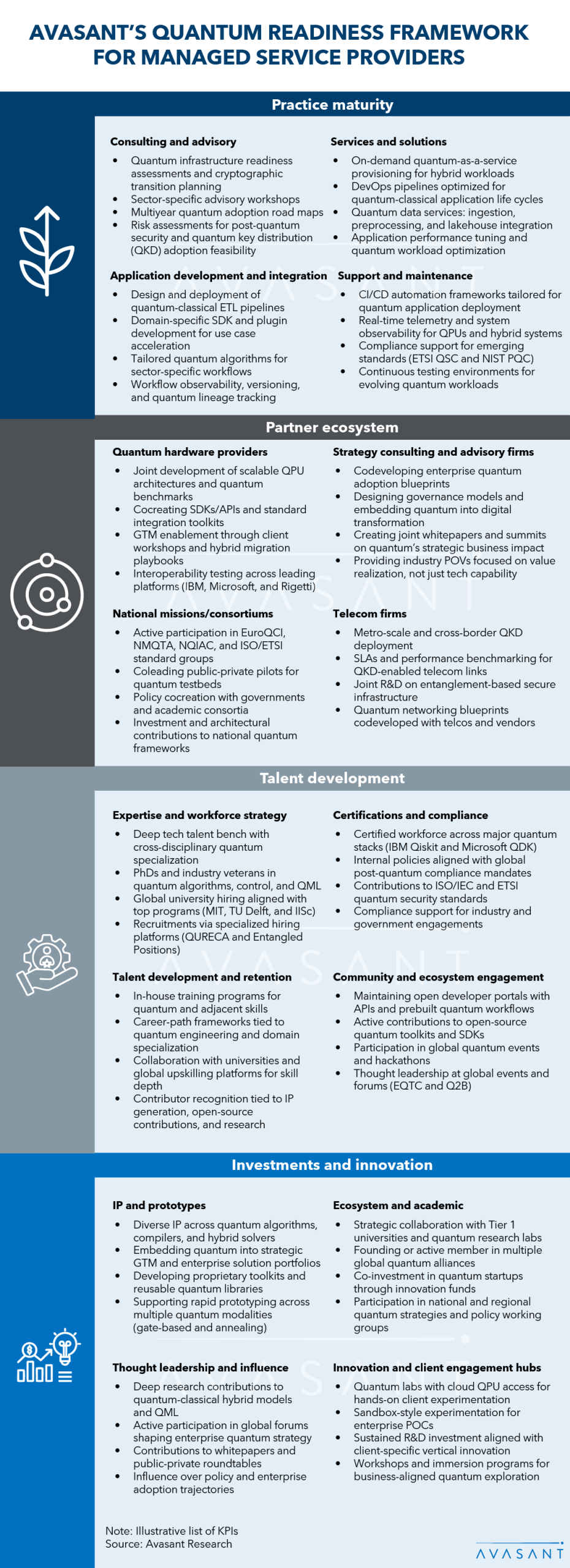
For more information or to explore how your organization can accelerate its quantum preparedness, please contact research@avasant.com.
By Chandrika Dutt, Research Director, Akshay Khanna, Managing Partner, and Vaibhav Kumar, Research Intern