
When a global consumer goods company divested its plastics-heavy packaging division last year, the move wasn’t just about cutting costs—it was about cutting carbon. This wasn’t just a business decision; it was a bold statement about priorities. In the fast-changing world of corporate strategy, ESG-driven divestitures are flipping the script, proving that letting go of the wrong assets can mean holding on to what really matters.
Divestitures have long been used as a financial lever—streamlining operations, unlocking shareholder value, and exiting underperforming markets. But the rise of ESG has introduced a new dimension to portfolio strategy. Today, companies are not only divesting for ethical alignment but also for economic advantage. ESG-driven divestitures are increasingly seen as a way to reduce regulatory exposure, improve access to capital, and enhance brand equity in a market where sustainability is rewarded. This dual motivation—values and value—is reshaping how firms evaluate their portfolios.
This shift is far from abstract. Increasingly, ESG misalignment is becoming a decisive factor in divestiture strategies. Divesting assets with high carbon emissions or those tied to unethical supply chains is now viewed as a strategic necessity for companies aiming to uphold their sustainability commitments. The growing scrutiny from investors, regulators, and socially conscious consumers is driving firms to not only prioritize financial performance but also demonstrate responsible corporate behavior. As illustrated in Figure 1, there are numerous real-world examples that underscore how ESG alignment can unlock significant value and reshape corporate portfolios. At the same time, growing regulatory scrutiny and financial risk are making ESG misalignment a material concern for companies seeking to future-proof their portfolios.
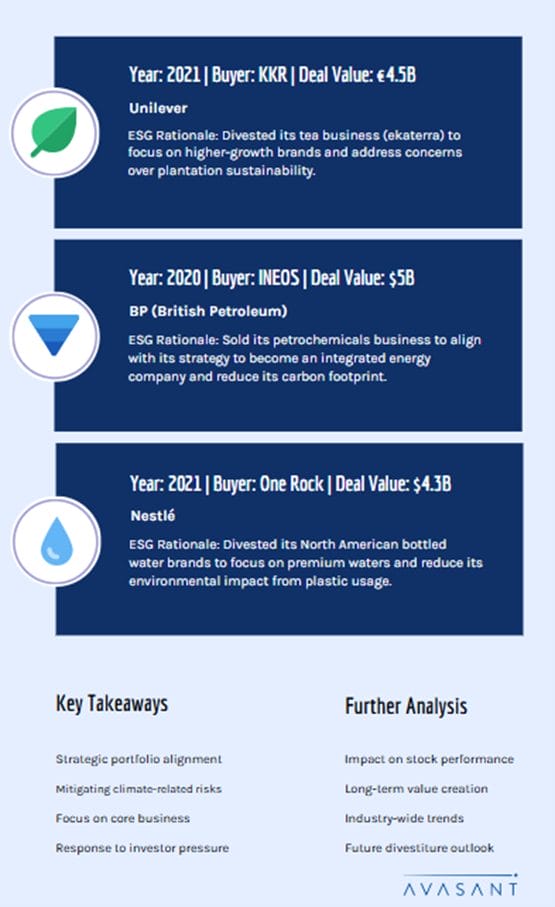
Divesting ESG-incompatible assets is not merely a defensive move—it can be a powerful value creation strategy. Companies that proactively align their portfolios with ESG principles often enjoy enhanced brand equity, greater investor confidence, and improved access to capital. ESG transparency is increasingly factored into M&A premiums, and firms with strong ESG credentials often command higher valuation multiples.
Avasant’s research underscores this shift. Service Provider ESG Maturity Index 2023-2024 (ESG Report) shows that enterprises now assess ESG maturity as a key criterion when awarding contracts. This scrutiny is only intensifying as regulators move toward mandatory ESG disclosures and investors demand more granular ESG data. But companies are also investing in green technologies to not just meet regulatory requirements but also unlock new markets and revenue streams. This trend is accelerating the adoption of ESG-driven divestitures.
Executing an ESG-driven divestiture requires more than good intentions. It demands a structured, disciplined approach that integrates ESG into every phase of the deal lifecycle. This approach ensures that ESG considerations are not an afterthought but a core component of strategic decision-making.
The process begins with ESG due diligence. Companies must assess the environmental and social footprint of the asset in question, identifying risks such as carbon intensity, labor rights violations, or governance lapses. To benchmark performance and ensure consistency, organizations increasingly rely on globally recognized frameworks such as the Sustainability Accounting Standards Board (SASB), which provides industry-specific ESG metrics; the Task Force on Climate-related Financial Disclosures (TCFD), which guides climate-related risk disclosures; and the Global Reporting Initiative (GRI), which offers comprehensive sustainability reporting standards.
Following due diligence, stakeholder mapping becomes essential. This involves identifying all parties affected by the divestiture—employees, local communities, suppliers, and customers—and developing mitigation plans to ensure a just and equitable transition. For example, a company divesting a manufacturing plant with high emissions might also invest in reskilling programs for displaced workers or support local economic development initiatives.
Impact assessments are another critical step. These assessments help forecast the ESG implications of the divestiture on both the parent company and the divested entity. They also inform communication strategies, ensuring transparency with investors and regulators. According to Avasant Research, ESG Report, 68% of enterprises now include ESG impact assessments in their M&A playbooks, up from just 42% in 2022.
To support these efforts, companies are increasingly turning to digital tools. Artificial intelligence and predictive analytics are being used to model ESG scenarios and identify hidden risks, while blockchain is emerging as a tool for ensuring traceability and authenticity in ESG reporting. These technologies not only enhance the accuracy of ESG assessments but also help companies meet growing demands for real-time, auditable disclosures.
Several macro-trends are converging to accelerate the adoption of ESG-driven divestitures. These trends are not only reshaping how companies think about portfolio strategy but also redefining the capabilities required to execute successful carve-outs.
Despite the growing momentum behind ESG-driven divestitures, executing them effectively is not without its challenges. One of the most pressing risks is greenwashing—the practice of making superficial or misleading ESG claims without substantive action. This can severely damage a company’s credibility, erode stakeholder trust, and invite regulatory scrutiny. According to a 2024 report by the European Commission, over 50% of green claims made by companies were found to be vague, misleading, or unsubstantiated, prompting the EU to propose stricter rules on environmental marketing.
Another significant hurdle is the lack of consistent and reliable ESG data. ESG metrics often vary across industries and geographies, making it difficult to benchmark performance or track progress over time. This inconsistency can hinder due diligence efforts and complicate post-divestiture reporting. Avasant’s ESG Report notes that only 38% of service providers surveyed had fully integrated ESG data governance frameworks, highlighting a widespread gap in data readiness. To overcome this, companies must invest in robust ESG data infrastructure, including standardized reporting systems, third-party verification, and real-time monitoring tools.
A third challenge lies in balancing short-term financial performance with long-term ESG objectives. Divesting a profitable but ESG-incompatible unit may negatively impact quarterly earnings, even if it strengthens the company’s strategic position and brand reputation in the long run[2]. This tension requires executive teams to adopt a long-term view and communicate the strategic rationale clearly to investors. Companies that embed ESG into their M&A playbooks are better positioned to navigate this trade-off, as they can articulate a clear value narrative to investors and regulators alike—underscoring the value of patience and purpose in ESG-aligned decision-making.
Together, these challenges underscore the need for a thoughtful, transparent, and data-driven approach to ESG-driven divestitures. Companies that can navigate these complexities will be better positioned to unlock sustainable value and lead in an increasingly purpose-driven economy.
To succeed, as stated earlier, companies must embed ESG into their M&A playbooks. This means integrating ESG criteria into portfolio reviews, deal screening, due diligence, and post-deal integration. It also means building cross-functional teams that include sustainability, finance, legal, and operations. By working together, these teams can ensure that ESG considerations are thoroughly evaluated and integrated into the company’s overall strategy.
To achieve this, companies need to ensure that ESG considerations are not just an afterthought but are integrated into every stage of the M&A process. This involves conducting thorough ESG due diligence to identify potential risks and opportunities and incorporating ESG metrics into the valuation and decision-making processes. Additionally, post-deal integration should focus on aligning the acquired company’s ESG practices with those of the parent company, ensuring a seamless transition and long-term value creation.
Each stage is essential for ensuring that ESG criteria are embedded throughout the divestiture process, from initial planning to post-deal evaluation. By following this structured approach, companies can effectively manage ESG risks and opportunities, ultimately driving long-term value creation and sustainability.
In a world where stakeholders demand transparency, regulators demand accountability, and markets reward sustainability, ESG-driven divestitures are no longer optional—they are essential. They allow companies to shed not just financial baggage, but reputational and ethical liabilities. And in doing so, they create space for growth, innovation, and impact.
It’s time to move beyond the balance sheet. ESG-driven divestitures are not just about what we leave behind—they’re about the future we choose to build.
[1] Reformulating legacy products to meet ESG standards is often complex and costly, especially in sectors with multi-tiered supply chains. Companies like Nestlé and Unilever may find divesting ESG-incompatible product lines more strategic, as it reduces ESG risk, simplifies compliance, and allows capital reallocation to sustainable growth segments.
[2] Some companies may opt for spin-offs or partial divestitures to distance ESG-sensitive units while retaining financial interest—a strategy that raises questions about transparency and long-term alignment.
By Tracell Frederick, Procurement Manager