VMware customers worldwide are facing unprecedented cost escalations, ranging from 200% to over 1,200%, as Broadcom transitions VMware to a subscription-only model. For many enterprises, this shift has upended long-standing budgeting structures and forced a rethink of their virtualization strategies. Small and medium businesses (SMBs), universities, and public-sector institutions, once reliant on perpetual licenses for predictable CAPEX, are now facing sharp price hikes, constrained license flexibility, and reduced channel accessibility. What began as a routine corporate acquisition has rapidly evolved into a global inflection point in the economics of enterprise virtualization.
For over two decades, VMware has been synonymous with enterprise virtualization, supporting hybrid and private cloud infrastructures worldwide. Prior to its acquisition by Broadcom in 2023, VMware commanded an estimated 80% of virtualized workloads globally. Its innovations—vMotion, NSX, and Tanzu—cemented its leadership by enabling enterprises to consolidate infrastructure, improve agility, and run mission-critical workloads securely and cost-effectively.
vSphere served as the flagship virtualization platform; NSX enabled network virtualization and micro-segmentation; Tanzu facilitated container and Kubernetes management; and vSAN delivered hyperconverged storage capabilities. Enterprises benefited from VMware’s perpetual licensing model, paying upfront for indefinite software access, supplemented by optional support and subscription (SnS) contracts for updates, security patches, and technical support, while academic institutions leveraged the same model for teaching and research environments. This structure allowed predictable CAPEX planning and long-term cost control.
Since Broadcom’s $69 billion acquisition of VMware in November 2023 (including $8 billion in assumed debt), the enterprise virtualization landscape has entered a new phase. Broadcom, known for transforming mature enterprise software portfolios such as CA Technologies (2018) and Symantec Enterprise Security (2019), applied its proven playbook centered on portfolio simplification, subscription-driven revenue, and profitability optimization.
In VMware’s case, this meant a fundamental realignment of licensing, pricing, and customer engagement models. Within weeks of the acquisition, Broadcom introduced several sweeping changes. Below is the timeline chart representation of key announcements since the acquisition:
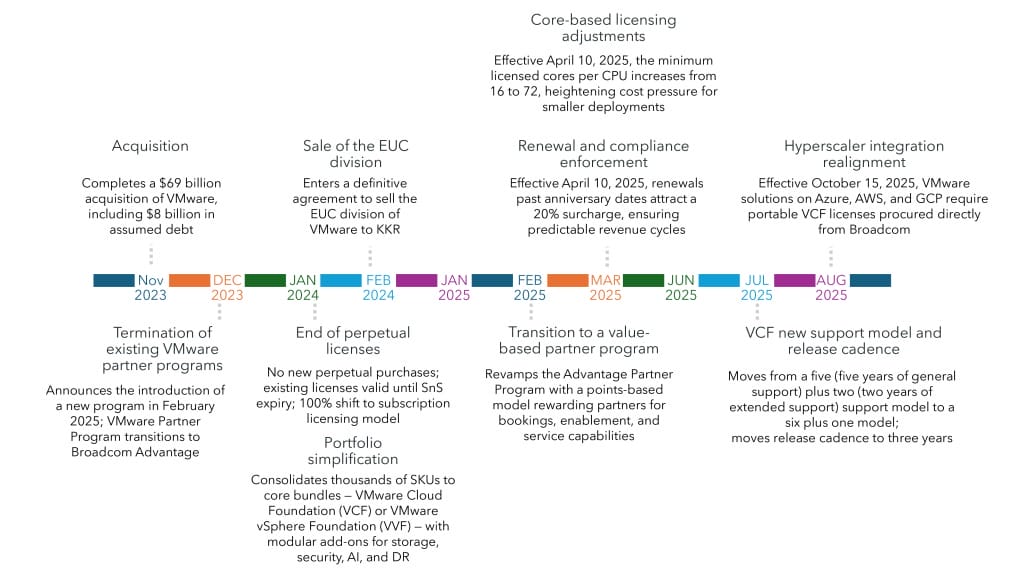
While VMware had been encouraging subscription adoption before the acquisition, perpetual licenses were still widely used—approximately 60% of customers continued to purchase them. Broadcom’s mandate for subscription-only licensing, coupled with restructuring of partner programs, now directly impacts enterprise cost, flexibility, and vendor relationships.
Broadcom’s licensing changes have triggered renewal anxiety, budget shocks, and operational complexity.
In sum, what began as a licensing change has evolved into a systemic disruption, creating financial uncertainty, operational rigidity, and long-term strategic risk. Organizations that once viewed VMware as a stable infrastructure foundation are now urgently reassessing their options, seeking agility and leverage in an increasingly vendor-driven market.
As customers absorb these shifts, a key consideration arises: How can enterprises mitigate financial impact, maintain operational continuity, and explore modernization without compromising strategic objectives?
Progressive enterprises are taking a proactive approach to mitigating costs, modernizing infrastructure, and diversifying their IT footprint.
While Broadcom offers transitional incentives (such as credit for unused perpetual licenses and bundled migration pricing), many organizations are pursuing multipronged strategies.
Based on our interaction with enterprise customers, not every organization is abandoning VMware immediately, given the dependency of legacy and mission-critical workloads; however, there is clear momentum toward diversification, cost optimization, and future-ready platforms.
Enterprises are pursuing multiple pathways:
Many enterprises are also taking a phased approach, running VMware on cloud-native platforms such as Azure VMware Solution (AVS) or Google Cloud VMware Engine (GCVE) as an interim step while planning longer-term exits. However, even in these models, Microsoft and Google transparently pass VMware license costs to customers, resulting in limited potential for cost optimization. The primary advantage of AVS and GCVE lies in their pay-as-you-go flexibility and operational agility, rather than in reducing overall VMware-related spend.
The overall momentum indicates a clear trend toward hypervisor-agnostic, hybrid cloud architectures that emphasize flexibility and cost control, thereby avoiding vendor lock-in.
As enterprises reassess their virtualization strategies following Broadcom’s licensing realignment, procurement teams face new layers of complexity. The shift from perpetual to subscription-based models has exposed structural gaps in how organizations evaluate, negotiate, and govern IT contracts.
Drawing from Avasant’s experience as a trusted consulting partner supporting enterprise sourcing transformations, several key procurement hurdles have emerged, along with actionable strategies to address them.
| Procurement challenge | Avasant’s approach | Business impact |
| Limited market intelligence | Through its proprietary databases, benchmark models, and global sourcing intelligence, Avasant delivers actionable insights into Broadcom and VMware pricing trends, contract structures, and migration strategies, enabling clients to optimize value and mitigate risk in their virtualization and cloud portfolios. | It ensures a stronger negotiation leverage, realistic pricing expectations, and improved sourcing confidence. |
| IT and procurement misalignment | Avasant facilitates structured alignment sessions among IT, business, and procurement teams to establish shared priorities, particularly for subscription renewals, migration plans, and cloud alternatives in Broadcom–VMware environments. Its governance frameworks ensure that sourcing strategies balance transformation goals with cost control. | It enables improved collaboration, faster sourcing cycles, and balanced outcomes between agility and cost control. |
| Contractual and licensing complexity | Avasant’s multidisciplinary team of commercial, legal, and technical experts helps clients navigate Broadcom’s evolving licensing and renewal strategies, assess compliance and operational risks, and negotiate terms for multiyear subscriptions. | It helps attain reduced risk exposure, clearer accountability, and accelerated contract closure timelines. |
| Evolving technology and commercial models | Avasant’s category specialists provide real-time insights into VMware’s shift to subscription-only models and its hybrid cloud portfolio through RadarView reports and custom research. This helps redesign sourcing and pricing models to align with subscription- or consumption-based cost structures. | It offers adaptive sourcing strategies that stay relevant amid rapid technology change. |
| Inadequate spend visibility | Avasant enables centralized visibility across VMware Cloud Foundation (VCF) or VMware vSphere Foundation (VVF) subscriptions through governance dashboards and spend analytics. It identifies shelfware, consolidation opportunities, and cost-saving levers across virtual infrastructure estates. | It ensures enhanced transparency, optimized license utilization, and measurable cost efficiency. |
| Vendor lock-in and limited competition | Avasant helps enterprises assess exit scenarios, cloud migration paths, and open virtualization alternatives to reduce overdependence on Broadcom–VMware. It also supports competitive RFPs across hyperscalers, Tier I providers, and emerging virtualization vendors to maintain negotiating leverage. | It enables increased vendor diversification, reduced dependency, and stronger negotiation power. |
| Post-contract governance | Avasant establishes vendor management offices (VMOs) and post-contract governance structures to monitor performance and renewal terms under Broadcom’s new frameworks. It tracks SLA compliance, cost escalations, and feature utilization to ensure sustained value realization. | It ensures sustained cost efficiency, proactive risk management, and improved vendor performance. |
By institutionalizing these procurement practices with Avasant’s guidance, enterprises can transform reactive cost management into proactive value realization. In the evolving Broadcom–VMware environment, this maturity will differentiate organizations that merely adapt from those that strategically reinvent their IT and sourcing models.
Case Study: Strategic Negotiation and Migration Optimization for Mainframe Services RenewalClient situationThe client, a leading US-based transportation and freight company, was approaching the renewal of its on-premises mainframe services contract, a mission-critical engagement with significant financial and operational implications. The renewal was planned for a three-year term, covering both infrastructure services and associated software licenses. Notably, Broadcom mainframe licenses accounted for nearly 25% of the overall contract value, making license negotiations a key driver of total cost. ChallengeBroadcom maintained a firm commercial stance, offering licenses only under a five-year term, which would have locked the client into extended financial commitments and reduced flexibility to align with its mainframe modernization road map. In parallel, the client sought to optimize its mainframe cost base while progressively migrating workloads off the mainframe platform. Our approachAvasant was engaged to lead commercial and contractual negotiations, drive cost optimization, and align the renewal with the client’s transformation strategy. Avasant adopted the following multipronged approach:
Outcomes and impact
Value deliveredThrough an integrated strategy combining commercial acumen, negotiation expertise, and transformation alignment, Avasant enabled the client to realize substantial financial savings, improve contractual flexibility, and advance its mainframe modernization objectives. |
While procurement maturity defines what to negotiate and how to govern it, execution excellence determines how quickly those strategies deliver value. This is where MSPs step in, translating sourcing intelligence and contractual rigor into operational outcomes.
Avasant has access to specialized MSPs who can operationalize these strategies. This helps build the right approach based on client requirements, assess service provider competency, and select the optimal partner for migration, cost optimization, or transformation initiatives. With this capability, organizations can translate sourcing intelligence and contractual rigor into tangible operational outcomes, ensuring alignment between business objectives and IT execution.
The Broadcom–VMware era represents both disruption and renewal in enterprise IT. By shifting to subscription-only models, Broadcom has accelerated VMware’s alignment with cloud-era economics, while also challenging customers to rethink their cost structures, platform dependencies, and modernization strategies.
Broadcom’s VMware transformation is forcing enterprises to reassess cost structures, licensing strategies, and platform dependencies—the question, now, is not whether to act, but how quickly.
Avasant’s proven sourcing intelligence, benchmark models, and transformation frameworks are helping leading enterprises with the following:
Connect with Avasant today to assess your VMware exposure and build a road map that turns disruption into opportunity.
By Andre Sole, Partner, Krishnendu Moulick, Partner, and Gaurav Dewan, Research Director