
As enterprises scale data-driven initiatives, data lakehouse platforms are gaining prominence for their ability to unify diverse data workloads and support advanced analytics and AI requirements. The vendor landscape continues to expand, with platforms enhancing capabilities to meet rising demands for real-time analytics, AI-ready data pipelines, and enterprise-wide data democratization. To cater to this demand, vendors are strengthening their offerings with unified data governance layers, support for open data formats, and seamless handling of multimodal data workflows. These advancements enable organizations to modernize legacy architectures, unlock new AI and analytics use cases, and drive more agile, governed, and cost-efficient data ecosystems.
The supply-side trends are covered in Avasant’s Data Lakehouse Platforms 2025 RadarView™. The report presents a comprehensive study of data lakehouse platform vendors and closely examines the market leaders, innovators, disruptors, and challengers in this space. It also provides a view of key market trends and developments impacting the data lakehouse space.
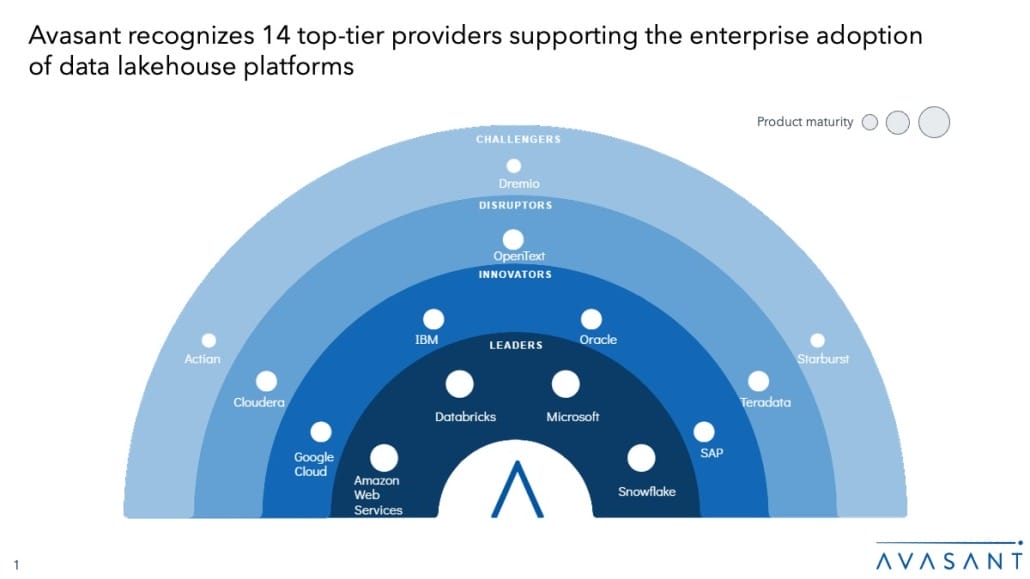
Avasant evaluated 21 platform vendors across three dimensions: product maturity, enterprise adaptability, and investment and innovation. Of these 21 vendors, we recognized 14 that brought the most value to the market over the past 18 months.
The report recognizes platform vendors in four categories:
Figure 1 below from the full report illustrates these categories:
“Enterprises now expect data platforms to enable the development of custom AI models tailored to their specific business needs,” said Madhu Kaushik, Avasant partner. “Vendors are responding by embedding model life cycle management and feature engineering capabilities directly into their platforms.”
The reports provide a number of findings, including the following:
“Data lakehouse platforms have now evolved into intelligent foundations for enterprise AI, with built-in support for vector search, model tracking, and retrieval augmented generation,” said Saurav Jayant, senior research analyst at Avasant. “The next phase will unify governance across data, models, and AI agents for greater trust and control.”
The Data Lakehouse Platforms 2025 RadarView™ features detailed profiles of 14 platform vendors, along with an overview of their solutions, offerings, and experience in assisting enterprises in their data-to-insights journey.
This Research Byte is a brief overview of the Data Lakehouse Platforms 2025 RadarView™. (Click for pricing.)