
With rapid digitalization, enterprises are creating a high demand for digital skills. Advances in generative AI and the adoption of LLMs are disrupting the talent landscape, with current roles being reshaped and new job roles such as prompt engineers, LLM architects, and data curators and trainers seeing high demand. The gig work model is seeing long-term adoption, with the demand for gig workers increasing by 41% during 2016–2022, driven by access to specialized skills and cost benefits. The demand is further enhanced by GCCs ramping up hiring to access skilled talent in locations like India. As a result, finding and retaining the right digital talent has become increasingly difficult for organizations. To address the challenges of the competitive talent landscape, enterprises pivot toward skills-based models of talent recruitment and development.
These trends, among others, are covered in our Digital Talent Capability 2023–2024 Market Insights™ and Digital Talent Capability 2023–2024 RadarView™ . The reports offer a comprehensive study of the digital talent capabilities of service providers and closely examine the market leaders, innovators, disruptors, and challengers.
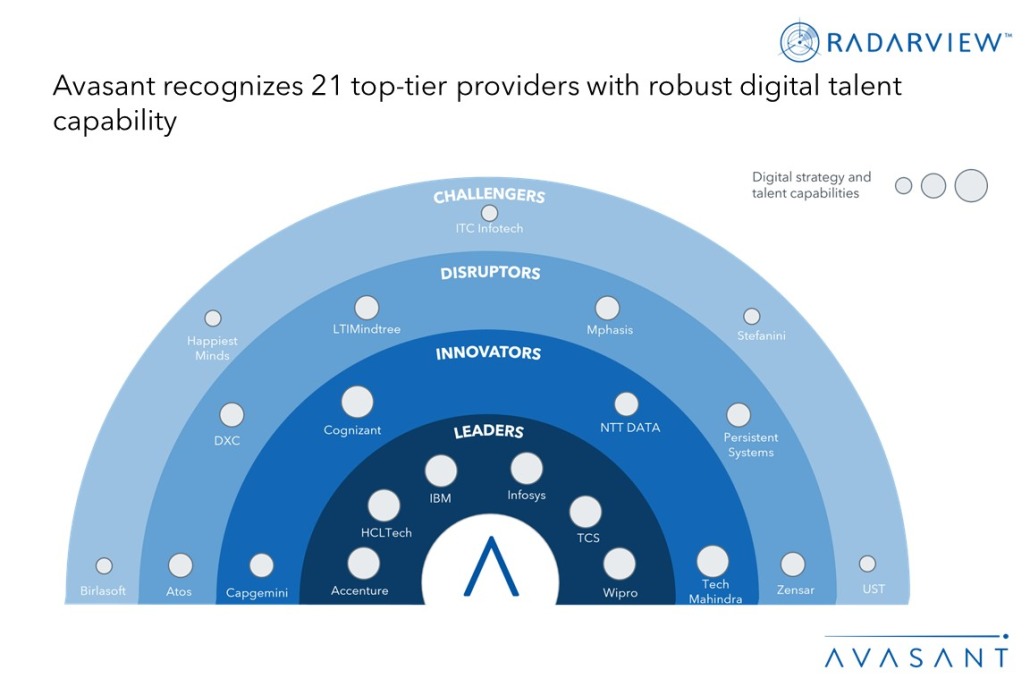
We evaluated over 36 service providers across three dimensions: digital strategy and talent capabilities, talent transformation, and talent investments and innovation. Of these, we recognized 21 that brought the most value to the market during the past 12 months.
The reports recognize service providers in four categories:
Figure 1 from the full report illustrates these categories:
“Attracting and retaining digital talent is now a persistent challenge that requires recalibration of existing talent strategies,” said Akshay Khanna, managing partner at Avasant. “Pivoting toward skills-based talent models and embracing gig work will help companies become more agile in mobilizing talent to meet critical business needs.”
The reports provide several findings, including the following:
“The widening digital skills gap requires organizations to prioritize internal skilling and training over external recruitment,” said Shwetank Saini, associate research director at Avasant. “Establishing a digital skills baseline and shifting from a job role to a skills-based approach of talent development will help build a sustainable digital talent pipeline.”
The RadarView also features detailed profiles of the 21 service providers, along with their digital talent strategy, talent investments, and experience in assisting enterprises to solve digital talent challenges.
This Research Byte is a brief overview of the Digital Talent Capability 2023–2024 Market Insights™ and Digital Talent Capability 2023–2024 RadarView™ (click for pricing).