
If there were any doubts about the need for disaster recovery planning, these were dispelled over the past few years. A worldwide pandemic, power outages, wars, and cyberattacks exposed organizations that were not fully prepared. But what if the IT organization does not have the resources or the capability to develop and implement such a plan in the event of a disaster? To meet this need, many organizations find value in disaster recovery outsourcing, where a service provider is responsible for off-site data storage, recovery data centers, or redundant systems.
As shown in Figure 2 from our full report, Disaster Recovery Outsourcing Trends and Customer Experience, the percentage of organizations outsourcing this function spiked to 46% in 2022, after being stagnant in the thirty-percent range for many years. In 2023, it continues to increase to 49%. The COVID-19 pandemic taught us that not all disaster recovery scenarios involve major natural events or malicious attacks. It is likely that the pandemic has shifted the perspective of businesses, as many have opted to continue reducing internal workloads to an external service provider with significant experience, specialized skills, and appropriate facilities to minimize disruption risks.
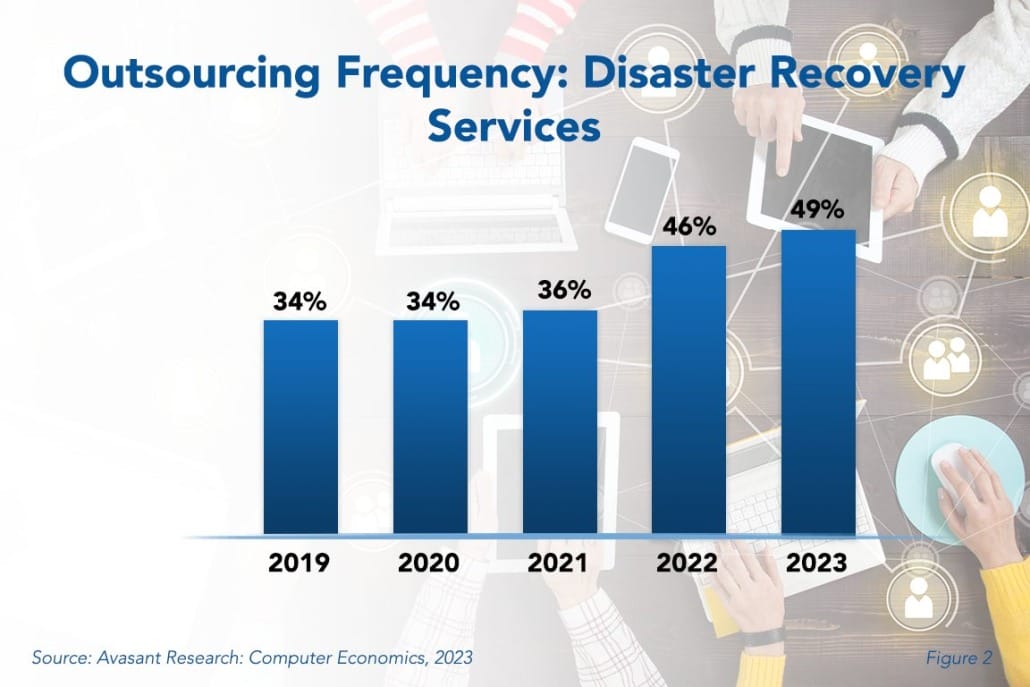
Although outsourcing of this function has considerably increased, it is surprising that more organizations have yet to adopt this strategy. Some CIOs may have decided that disaster recovery is too important to outsource despite the high service and cost success. Others have invested in the cloud in hopes that many of their disaster recovery responsibilities would shift to the provider.
Emerging from a global pandemic with the new economic factors that are occurring, disaster recovery continues to be important, whether responsibility remains in-house or delegated to a service provider. The number of online business transactions continues to expand, even for traditional brick-and-mortar organizations, making the cost of downtime more expensive. Factories and distribution centers are increasingly automated, and operations can grind to a halt if disaster strikes. A network outage can also be adverse for healthcare providers that rely on digital images and electronic medical records for patient care. Moreover, in some industries, such as banking, disaster recovery capabilities are mandated by law.
“One major disaster can put a company out of business, or at least set it back for months or years,” said Waynelle John, a research analyst for Computer Economics, a service of Avasant Research based in Los Angeles. “For companies that lack the resources, outsourcing disaster recovery can be a smart way to ensure business continuity.”
It is important to remember that disaster recovery scenarios do not only include major global crises. Disruptions are more likely to involve public-grid power outages, network outages, transit failures, simple human errors, or system failures. In these cases, organizations simply want employees to communicate effectively during temporary work disruptions. IT managers ought not lose sight of the more mundane incidents that can disrupt business operations.
To help IT executives understand their options, the full report analyzes the percentage of organizations outsourcing disaster recovery capabilities (frequency), the scope of work outsourced (level), and the change in the amount of work being outsourced (trend). We also present success rates for the cost and service experiences and show how these trends differ by organization size and sector. We also discuss the elements that every disaster recovery plan should contain.
This Research Byte is based on our report on this subject, Disaster Recovery Outsourcing Trends and Customer Experience. The full report is available at no charge for subscribers, or it may be purchased by non-clients directly from our website (click for pricing).