
Regardless of how long the pandemic lasts, one thing that appears to be here to stay for IT personnel is working from home, although the percentage will drop. Our annual IT salary study finds that about a quarter of IT workers will ply their trade from home, full-time, after the pandemic subsides.
The work from home (WFH) percentages can be seen in Figure 4 from our full study, IT Salary Report 2021 (click to download the introduction). Before the pandemic, at the median, no IT personnel worked full-time from home. Then overnight, the majority of IT staff members switched to remote work in March and April, 2020. As shown in the figure, at the median, 75% of IT personnel were working full-time from home at the time of our survey, during the pandemic.
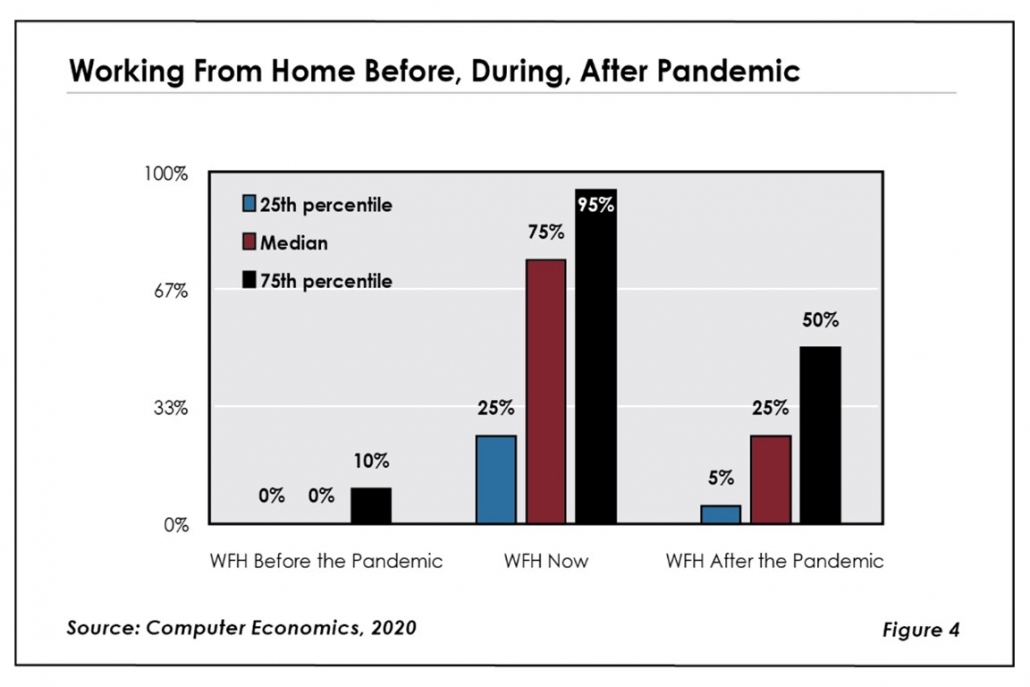
Before the pandemic not many IT staff members were able to work fully from home. Some may have had the option to work from home, say, one day a week. But generally, most IT staff members had to spend the majority of their time in the office.
“Managers were split on whether workers were more productive at home or in the office,” said Tom Dunlap, director of research for Computer Economics, a service of Avasant Research, based in Los Angeles. “But many workers are ready to trade their commute for more time at home. And in time, organizations may be willing to let them do so, to save money, retain top talent, and improve worker engagement.”
Many survey respondents gave us an earful on the issue. As with many challenges in 2020, people have passionate views. One survey respondent wrote: “Pre-pandemic, our team would rotate WFH once to twice a week. This was well-balanced and did not impact productivity. Full-time WFH has been very disruptive and had a negative effect on the team.” Another summed up the WFH reality: “Our introverts are now happy and productive. Our extroverts … not so much.”
The full salary report estimates 2021 salaries for 80 IT job functions in more than 400 U.S. metropolitan areas and 20 sectors. The report is based on our annual salary survey of IT organizations in the U.S., along with other sources of compensation data as well as regional and industry data from the U.S. Bureau of Labor Statistics. For trend information, we also use our annual IT Spending and Staffing Benchmarks study and data from our year-end Worldwide IT Spending and Staffing Outlook for 2021 study. A complete description of the methodology is provided at the end of this report.
This Research Byte is a brief overview of our report, IT Salary Report 2021. The full report is available at no charge for Avasant Research subscribers or may be purchased directly from our website? (click for pricing). The complete 38-page executive summary and sample salary tables can be downloaded at no charge.