
Outsourcing levels are growing as more organizations take advantage of the cost flexibility that service providers offer. In light of increasing global threats—the pandemic, supply chain issues, the Ukraine-Russia war, inflation, climate change—outsourcing has become a strategic focus, rather than only a cost-cutting measure. Outsourcing provides the needed support for IT departments as they move to become more resilient, flexible, and responsive, while reducing down-time. IT leaders expect to increase their outsourcing budgets this year, according to our new IT Outsourcing Statistics 2022 study, and they expect to reap outsourcing benefits of streamlined processes and reduced operational costs.
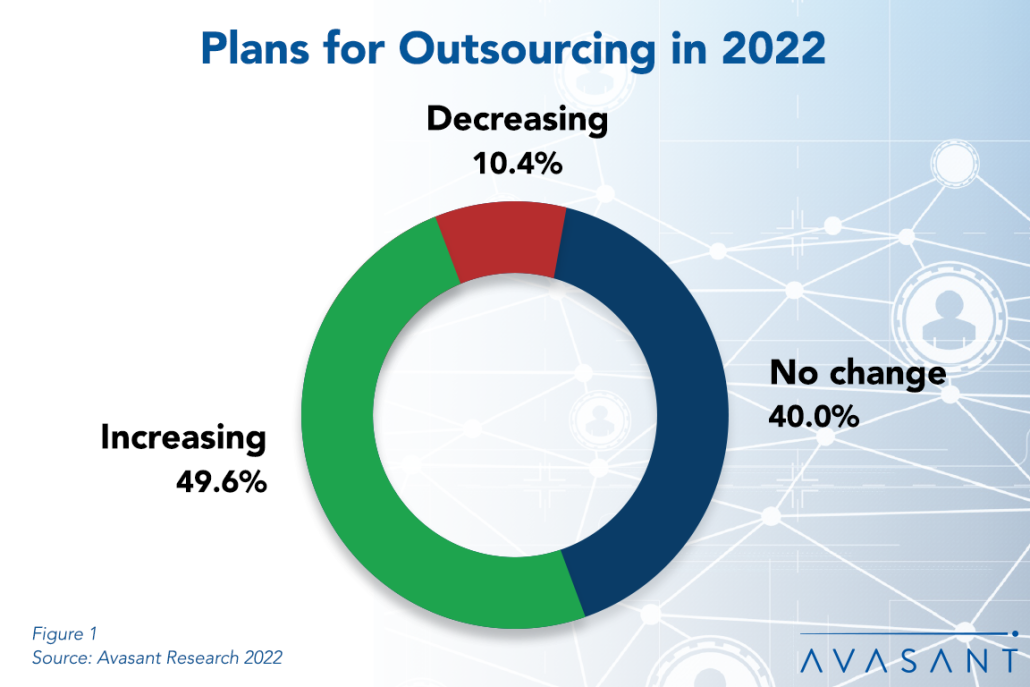
As shown in Figure 1 from our full study, 49.6% of IT organizations plan to increase the amount of outsourcing they do, compared with 10.4% that plan to reduce outsourcing. Another 40.0% plan to keep outsourcing at current levels, consistent with the steady increases in outsourcing that we have seen recently.
One reason organizations continue to increase their outsourcing budgets is digital transformation. The pandemic showed the importance of digital business models, as nearly every part of the economy required remote or virtual access. Customer behavior and expectations are likely changed forever. This requires an omnichannel, hyper-personalized experience driven by digital technologies. Finding strategic partners to aid in digital transformation is certainly a priority for many. And simply “getting out of the data center business” so that IT can concentrate on these higher-value efforts is another factor.
“Outsourcing is becoming more strategic and less about cost savings,” said Tracell Frederick, research analyst for Computer Economics, a service of Avasant Research, based in Los Angeles. “If businesses plan to thrive, they need to focus on transforming their core business and leave routine IT operations to someone that can do it more efficiently and effectively.”
Here are other key findings from our study this year:
In the full study , we profile outsourcing activity for 11 IT functions: application development, application management, cloud infrastructure management, data center operations, desktop support, disaster recovery services, help desk services, IT security, network operations, system implementation/integration, and web operations.
For each IT function, we measure the frequency and level of outsourcing. We also look at the current plans of IT organizations to increase or decrease the amount of work they outsource. Finally, we examine the customer experience to assess whether organizations are successfully lowering costs or improving service through outsourcing.
This Research Byte is a brief overview of our report on this subject, IT Outsourcing Statistics 2022. The full report is available at no charge for our subscribers, or it may be purchased by non-clients directly from our website (click for pricing).