Mergers and acquisitions (M&A) are powerful growth strategies, but they come with significant operational complexity. Among the most critical and often underestimated challenges is contract harmonization: the process of aligning disparate legal agreements across merging entities to ensure consistency, compliance, and operational continuity.
This case study explores how a strategic application of Artificial Intelligence (AI) enabled a seamless contract harmonization process during the merger of two industry leaders, one in safety, specialty, and industrial services, and the other in fire safety and security solutions. By leveraging AI, the Avasant Procurement Services Team not only overcame major obstacles but also set a new benchmark for efficiency, accuracy, and strategic alignment in M&A execution.
The merger aimed to create a dominant force in the safety and security sector by leveraging the complementary strengths of both organizations to expand market reach, enhance service offerings, and drive operational efficiency. However, integration efforts were quickly challenged by the complexity of harmonizing over 100 IT supplier contracts, each with distinct terms, jurisdictions, and compliance requirements. Avasant conducted a comprehensive review of each contract to evaluate its full life cycle and facilitated the transfer and consolidation of necessary contracts under the acquiring company’s ownership. Then, established a centralized contract repository, ensuring accurate filing and maintenance of all contracts and related documents from subject matter experts (SMEs).
Avasant hit a major roadblock when we discovered that essential contract documents were missing, halting our progress. In response, Avasant shifted its focus to building a centralized document repository. This required a deep dive into both organizations to locate and compile existing contracts. The experience revealed a significant gap in document management and highlighted the urgent need for better systems to ensure accessibility and continuity moving forward.
Contract harmonization during M&A involves identifying, analyzing, and reconciling discrepancies in contracts to create a unified framework. For the merger, the key challenges included:
Traditional contract review and harmonization methods couldn’t keep up with the scale and complexity of the merger, since a traditional contract analysis took approximately one to two days to complete. Faced with these constraints, Avasant recognized that a conventional approach would not suffice. A transformative solution was needed, and AI was the answer.
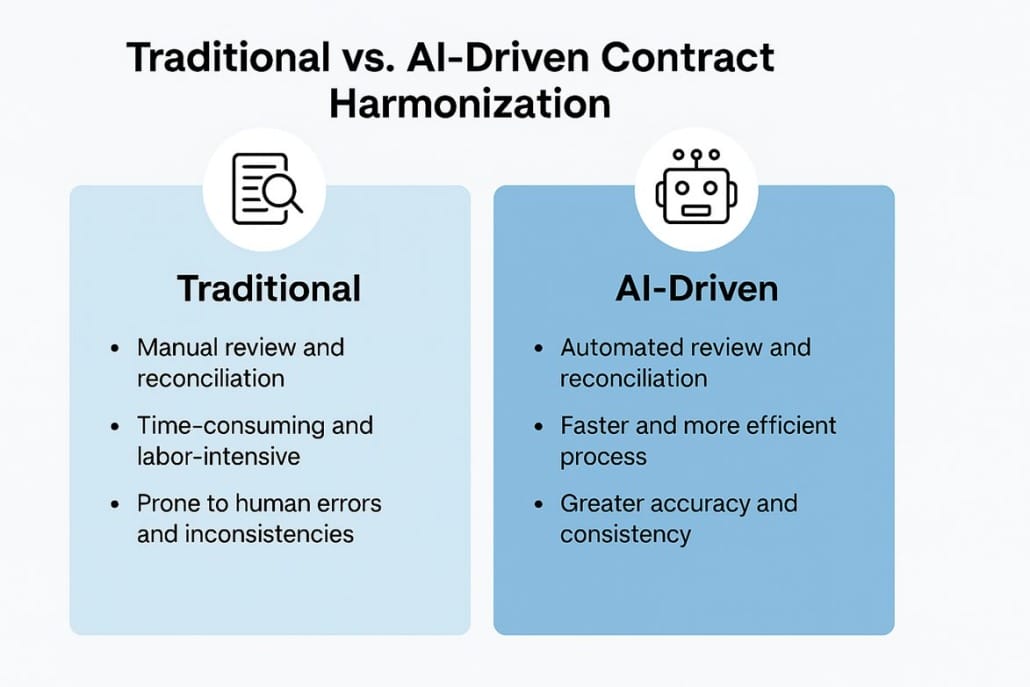
Figure 1 illustrates the transformative benefits of AI in procurement. AI-driven methods significantly outperform traditional approaches in terms of speed and scalability, enabling faster harmonization across large contract portfolios. AI also enhances accuracy and reduces compliance risks through intelligent analysis and pattern recognition. While traditional methods are resource-intensive and heavily reliant on manual effort, AI reduces operational load, freeing up valuable time and resources. Most importantly, AI unlocks strategic value by generating actionable insights that support smarter, data-driven procurement decisions.
To address these challenges, Avasant turned to AI-powered solutions. The AI tools quickly and accurately processed large volumes of contracts, identifying discrepancies and extracting key information. AI also performed in-depth contract analyses and recommended effective harmonization strategies. The following AI-driven approaches were implemented:
Figure 2 depicts the results achieved by the implementation of AI for contract harmonization during the merger:
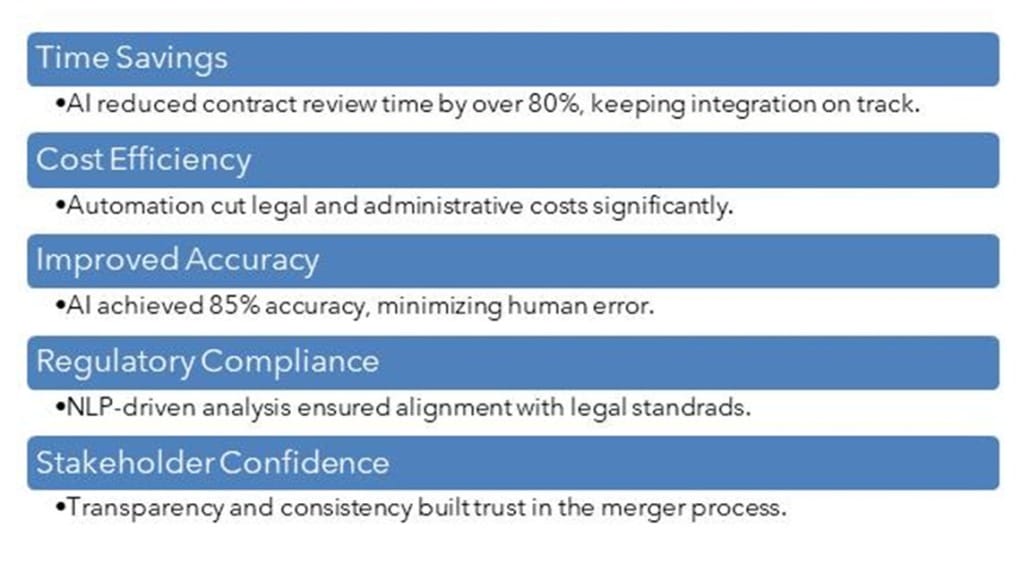
The implementation of AI in contract harmonization significantly accelerated the review process, cutting time by over 80% while reducing legal costs and improving accuracy by 85%. This intelligent, transparent approach also ensured regulatory compliance and strengthened stakeholder confidence in the merger’s success.
The success of the merger highlights the transformative potential of AI in M&A processes. Key takeaways include:
The merger’s success highlights AI’s transformative role in modern M&A. Its scalability enables efficient handling of large contract volumes, while seamless integration with existing systems enhances collaboration across legal, compliance, and operations. AI’s adaptability and continuous learning help organizations stay agile amid regulatory and market changes. This case demonstrates how AI turns contract integration from a complex challenge into a strategic advantage, accelerating integration, reducing risk, and setting new benchmarks for operational excellence.
By: Denzil Rajack-Prayag, Sr. Procurement Specialist