Microsoft Ignite 2025: Accelerating AI Integration to Transform Operations
November, 2025
Over the past year, the number of enterprise AI projects has increased significantly. According to Avasant’s Applied AI Services 2024–2025 Market Insights report, 68% of generative AI (Gen AI) projects in production now focus on streamlining core processes and knowledge management.
Similarly, Avasant and Nasscom’s Digital Enterprise 2025: Advancing to an AI-first Enterprise study shows that 90% of current AI agent use cases concentrate on backend and diagnostic workflows, with IT, operations, sales, and marketing leading in-house agentic adoption.
At Microsoft Ignite 2025, leaders from Mercedes-Benz, Epic, UBS, Adobe, and other organizations showcased how they are integrating AI into their businesses:
Mercedes-Benz demonstrated enterprise-wide AI adoption, with over 15,000 employees using Copilot and 52 internal functions building operational agents via Copilot Studio. For instance, the finance team automated the invoicing workflow. GitHub Copilot has boosted developer engagement by 70%. It is bringing AI to the factory floor by leveraging MO360, a Mercedes-Benz Cars Operations 360 digital production ecosystem that contains all the important software applications and data of the global production network, to unify data across 30 passenger plants and use digital factory chat to investigate the cost by analyzing production data and generating a consolidated report. This aims to reduce production diagnostics from days to minutes.
Epic showcased how AI embedded directly into clinical workflows unlocks massive efficiency gains. Its Azure-powered AI-generated end-of-shift notes and AI-assisted summarization now generate millions of clinical summaries per month, cut prior-authorization time by 30%–40%, and surface missed clinical insights 28% of the time. It cited how it helped Christ Hospital achieve a 69% early-stage cancer detection rate, compared to the national average of 46%.
UBS highlighted a decade-long cloud-first transformation, with over 50% of workloads on Azure and more than 100 Azure services deployed globally. Its cloud-native, governance-driven approach has become the foundation for secure AI adoption in a highly regulated environment, powering new advisor tools that enhance productivity and client experience.
Adobe demonstrated deep integration of Microsoft AI across Photoshop, Acrobat, and its marketing suite. Photoshop now supports multiple AI models, and document workflows are increasingly agentic, while Adobe’s Content Authenticity Initiative reinforces trust and data governance across enterprise-generated content.
Taken together, these examples show that AI has evolved from a point solution into the strategic backbone of the enterprise.
Emerging Enterprise Challenges in Scaling AI
Despite rapid progress, organizations are now confronting issues that were less visible during the experimentation phase. Microsoft’s Chief Commercial Officer, Judson Althoff, identified four recurring causes of AI project failure:
Misalignment between business and IT
Poor data quality and fragmentation
Governance and regulatory requirements
Overemphasis on experimentation rather than scalable business impact
These themes reinforce Avasant’s own findings. As organizations transition from pilots to enterprise-scale AI programs, data foundations, governance maturity, and alignment with business outcomes become the differentiators between leaders and laggards.
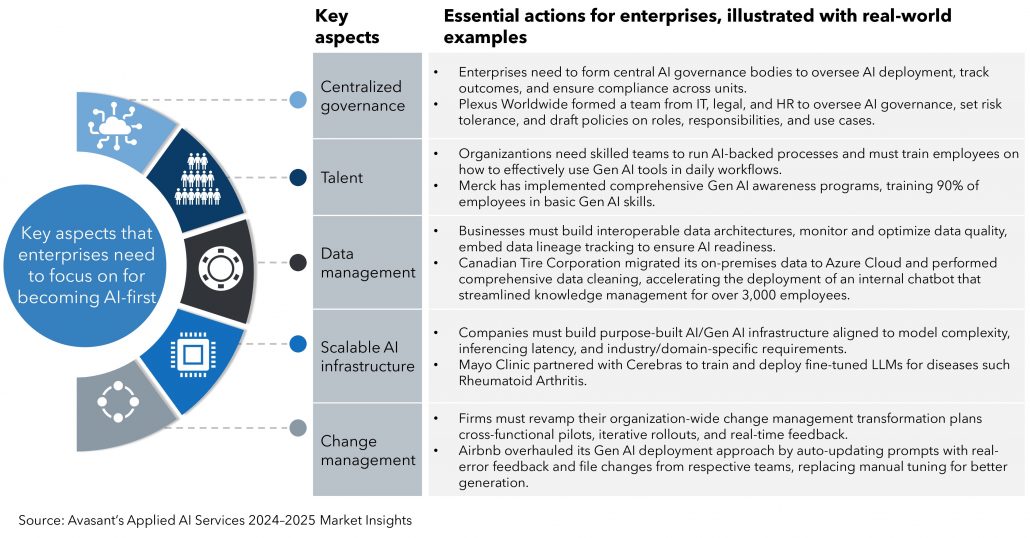
Figure 1: Enterprises can drive AI-first transformation by focusing on governance, data management, scalable infrastructure, talent development, and change management
Avasant’s research reinforces that enterprises need to rethink how AI is introduced, governed, and scaled to unlock value responsibly.
The Frontier Firm Imperative
Microsoft introduced the concept of the frontier firm—organizations that operationalize AI across every workflow, pairing employees with digital agents and shifting to outcome-based work structures. This raises the central question for enterprises:
How can organizations evolve into frontier firms that scale AI responsibly, align investments with business ambition, and achieve measurable outcomes?
Microsoft’s Intelligence Stack: The Blueprint for an AI-First Enterprise
At Ignite 2025, Microsoft answered this question with a cohesive set of innovations spanning
strategy, multi-model intelligence, data context, governance, security, and workflow integration:
Align AI adoption with business ambition: Microsoft introduced a Frontier Success
Framework that emphasizes:
Empowering employees through enriched AI-driven experiences
Advancing customer engagement through personalization
Reimagining business processes with AI-first design
Driving continuous innovation
This guidance helps enterprises anchor AI initiatives to clear business outcomes rather than
disconnected experimentation.
Scale AI responsibly with multi-model governance and control: Microsoft unveiled
several foundational capabilities, including:
Anthropic’s Claude models in Microsoft Foundry
Foundry’s expansion to include Anthropic models – alongside OpenAI, Mistral, and Llama –
strengthens its role as an open, modular app-server that provides unified governance, life cycle
management, and operations for production-grade agent applications.
Model Router
The Model Router, now generally available, automatically selects the most suitable model based
on accuracy, performance, or cost while enforcing US/EU data boundaries by default. Early
adopters report 50% lower latency and 15% higher quality, enabling responsible, optimized
multi-model usage across the enterprise.
Agent 365 for enterprise agent governance
Responding to the rise of agentic systems, Microsoft introduced Agent 365, a unified control
plane that provides full visibility, permissioning, and risk management for all agents –
Microsoft-built, custom, or partner-cloud. It ensures secure interactions with enterprise data
and applications, equipping IT, security, and development teams to safely scale agent ecosystems.
Unlock measurable business impact through context, intelligence, and workflow integration:
To close the intelligence gap between structured and unstructured data, Microsoft introduced a three-tier intelligence foundation:
Work IQ gives Copilot and agents real-time organizational understanding across emails, documents, apps, and workflows.
Fabric IQ provides shared business logic and entity models, enabling consistent semantics across apps, agents, and analytics.
Foundry IQ extends Retrieval-Augmented Generation (RAG) into full context engineering, allowing agents to reason, plan, and act using all enterprise knowledge.
Together, these layers enable:
End-to-end workflow automation
Natural language querying across enterprise data
Consistent, explainable, high-quality AI decisions
This directly supports measurable impact by improving decision quality, reducing manual work,
and scaling automation.
Microsoft also expanded Copilot in the flow of work by introducing:
Word, Excel, and PowerPoint agents inside Copilot Chat to streamline document creation and revision
Inbox-wide reasoning to prioritize email, extract action items, and prepare meeting insights
These capabilities strengthen employee productivity and accelerate outcome delivery.
Additionally, Security Copilot is now integrated into M365 E5
Analysts can now detect threats, investigate incidents, and visualize reasoning in real time,
providing measurable improvements in response times and protection.
Conclusion: Advancing Toward the Frontier
Microsoft Ignite 2025 made one theme clear: AI is evolving into the operational fabric of the modern enterprise. The announcements—from multi-model orchestration and unified intelligence to agent governance and embedded Copilot experiences—provide a complete blueprint for becoming an AI-first organization.
From Avasant’s perspective, this aligns with what we observe across progressive global enterprises: organizations are shifting from isolated pilots to structured, enterprise-wide AI programs built on strong data foundations, responsible governance, and measurable business value. While technology is critical, becoming a frontier firm ultimately requires a new organizational mindset—one where employees collaborate with digital agents, workflows are redesigned for AI-native execution, and innovation becomes a continuous process.
As enterprises move into 2026 and beyond, Avasant believes the leaders will be those who:
Build strong data and governance foundations
Adopt multi-model, agent-centric architectures
Focus on measurable value creation
Empower employees through human–agent collaboration
Embed security and trust into every layer of the AI stack
The path toward becoming a frontier firm is clearer than ever. What matters now is execution—combining strategy, governance, and the right technology to unlock sustained competitive advantage.
By Gaurav Dewan, Research Director
CONTACT US
DISCLAIMER:
Avasant’s research and other publications are based on information from the best available sources and Avasant’s independent assessment and analysis at the time of publication. Avasant takes no responsibility and assumes no liability for any error/omission or the accuracy of information contained in its research publications. Avasant does not endorse any provider, product or service described in its RadarView™ publications or any other research publications that it makes available to its users, and does not advise users to select only those providers recognized in these publications. Avasant disclaims all warranties, expressed or implied, including any warranties of merchantability or fitness for a particular purpose. None of the graphics, descriptions, research, excerpts, samples or any other content provided in the report(s) or any of its research publications may be reprinted, reproduced, redistributed or used for any external commercial purpose without prior permission from Avasant, LLC. All rights are reserved by Avasant, LLC.
Welcome to Avasant
LOGIN
Login to get free content each month and build your personal library at Avasant.com