As enterprises accelerate digital transformation, the cost structures of CRM platforms have become less predictable, challenging procurement leaders to rethink how Total Cost of Ownership (TCO) is modeled. In particular, the variable costs related to AI-enhancements are still in early stages as providers test market acceptance. These platforms not only enhance customer engagement but also enable scalable growth and operational agility. However, the shift toward dynamic, usage-based pricing, where costs fluctuate based on real-time consumption, has disrupted traditional procurement models and introduced new forecasting complexities for CIOs and CFOs.
For modeling TCO, Avasant provides a strategic framework in environments governed by dynamic pricing. Our approach offers actionable guidance to anticipate cost variability, mitigate financial risk, and strengthen negotiation outcomes. By adopting a lifecycle-based view of CRM investments and leveraging scenario planning, predictive analytics, and FinOps tools, enterprise leaders can build resilient cost models that align with business growth and operational priorities.
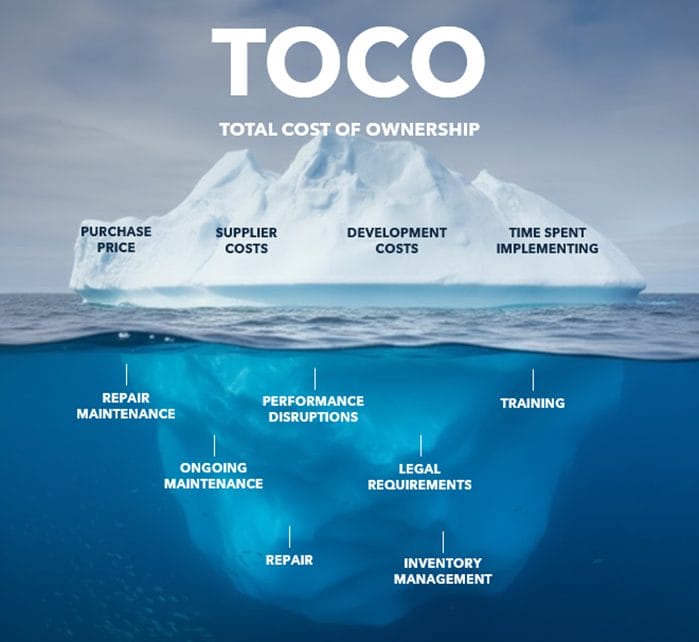
TCO is more than a budgeting metric—it’s a strategic lens through which to assess CRM investments over their full lifecycle. For virtualized platforms, TCO includes not just software subscription fees, but also implementation, operations, personnel, and hidden transition costs in both the short and long-term. When overlooked, these components can derail budgets and diminish ROI. Procurement executives must ensure their teams take a comprehensive, lifecycle-based view that aligns with enterprise strategy and supports forecasting, such as Avasant’s Digital Operating Model Framework.
Dynamic usage pricing introduces a “pay-as-you-go” model that adjusts costs based on actual CRM usage. On the surface, it seems like a win: you only pay for what you consume. For organizations with seasonal workloads or evolving business units, this flexibility is invaluable. But with flexibility comes risk. Without clear usage patterns or cost controls, expenses can balloon—especially during business spikes or unmonitored usage surges.
Procurement leaders must push their teams to go beyond upfront pricing and evaluate how consumption will scale across departments, projects, and fiscal years, working hand in hand with operational teams. Dynamic pricing requires visibility, discipline, and foresight.
In virtualized CRM environments where dynamic usage-based pricing disrupts traditional cost models, enterprise leaders need more than intuition—they need precision. The six strategies below offer a proven blueprint for modeling Total Cost of Ownership (TCO) with confidence:
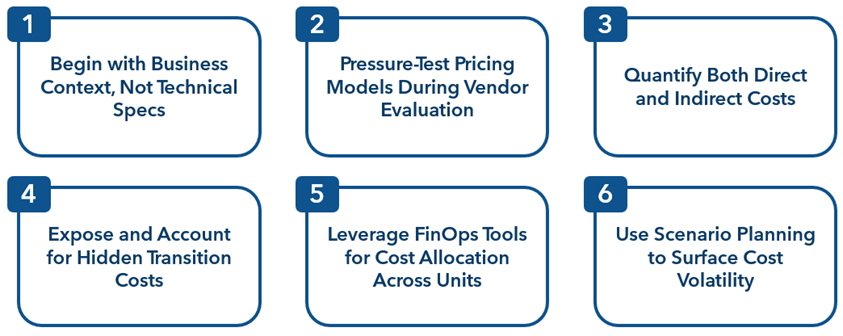
In the Avasant model, each strategy is paired with practical executive takeaways designed to sharpen forecasting, strengthen negotiation leverage, and expose hidden cost drivers before they impact the bottom line. A brief description of each follows:
Procurement should work with business and IT stakeholders to map realistic consumption baselines and future-state projections. For example, a retail chain anticipating holiday surges must model CRM API usage accordingly—not just on annual averages.
Contract language must embed pricing protections and adjustment clauses. This is not just a procurement task—it’s a strategic negotiation requiring executive visibility.
Executives must insist that indirect costs are captured early and included in ROI models. Consider these as core TCO components, not fringe line items.
Executives must demand transparency from both internal teams and vendors. If hidden costs are discovered mid-project, the business impact may be greater than the financial hit.
Executives should support the deployment of FinOps practices and tooling to increase visibility and accountability in cross-functional environments.
By running simulations, procurement can prepare CFOs and business leaders for best- and worst-case outcomes. This also sharpens renewal strategies and budget planning.
To illustrate how these strategies translate into financial outcomes, consider another real-world example. A regional financial services firm anticipates annual CRM usage of approximately 3.85 million API calls, with a vendor charging $0.0135 per call. That results in a Year 1 usage cost of $51,975. The firm also invests $82,400 in implementation, including data migration, integrations, and configuration, which incurs $18,750 in training and change management. Ongoing maintenance and support are budgeted at $9,600 annually, all of which produces a total Year 1 TCO comes to $162,725.
In Year 2, usage is expected to increase by 15%, pushing API volume to 4.43 million calls. At the same per-call rate, the usage cost rises to $59,805. Assuming maintenance remains stable and no new implementation costs occur, Year 2 TCO is projected at $69,405.
This scenario underscores the importance of accurately forecasting consumption growth and incorporating indirect costs upfront, as even minor changes in usage patterns can shift budget requirements by tens of thousands of dollars annually.
Executives overseeing CRM investments must push for TCO discipline, especially in the face of flexible pricing models. That means driving collaboration across finance, IT, and procurement functions to build realistic cost models and embed controls.
By adopting a structured and forward-looking TCO approach, organizations can avoid cost surprises, improve budgeting accuracy, and extract maximum value from their virtualized CRM platforms.
By David Acklin, Senior Director and Will Galske, Senior Manager