
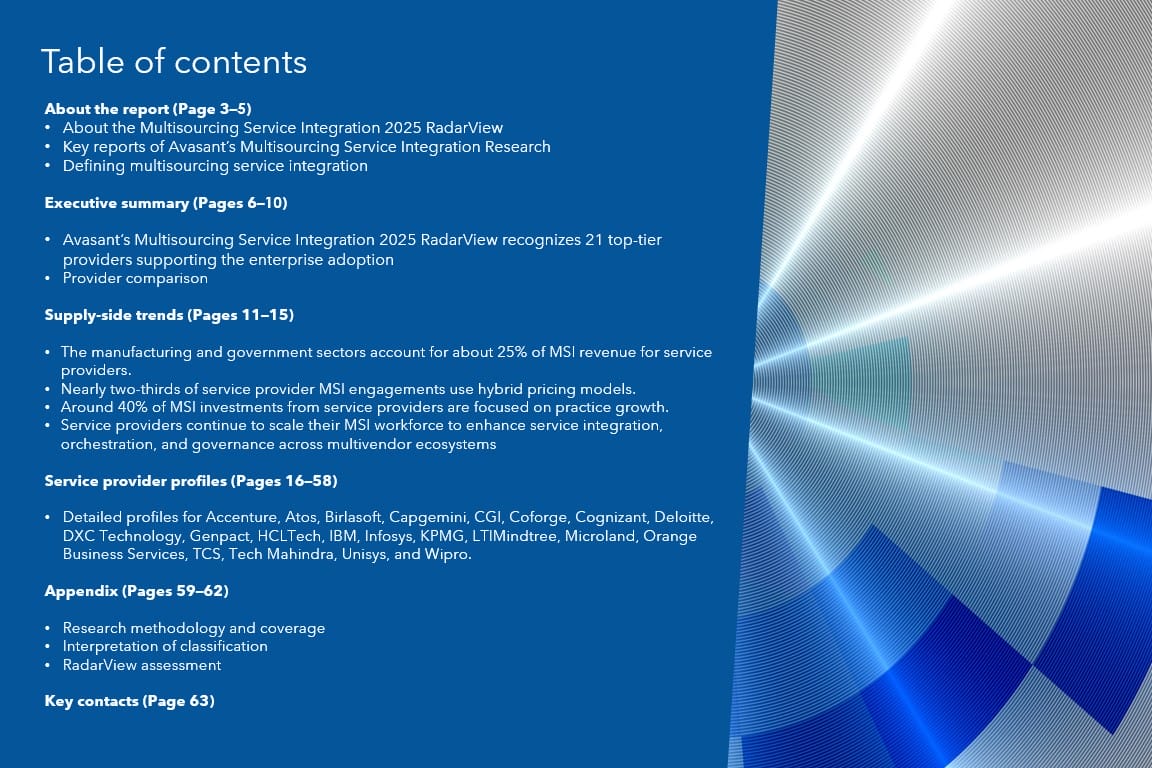

This RadarView™ helps enterprises in adopting multisourcing service integration (MSI) to manage IT services across a mulitvendor landscape. It begins with a summary of key trends shaping the supply side of the market. It continues with a detailed assessment of 21 providers offering MSI services. Each profile presents an overview of the service provider, its key IP assets, and a list of clients and partnerships, along with brief client case studies. Each profile concludes with analyst insights on the provider’s practice maturity, partner ecosystem, and investments and innovations.
Why read this RadarView?
MSI enables organizations to manage complex multivendor ecosystems amid rising demands for centralized governance, evolving regulatory requirements, and cost optimization. Enterprises are increasingly extending MSI practices beyond IT into functions such as HR, customer service, and finance to drive integrated service delivery. In response, service providers are investing in proprietary platforms, generative AI-powered capabilities, and targeted talent development to scale their MSI offerings and address the growing need for agile service orchestration, risk mitigation, and stakeholder alignment across industries and regions.
The Multisourcing Service Integration 2025 RadarView™ highlights key supply-side trends in the MSI space and Avasant’s viewpoint on them. It aids companies in identifying top service providers to assist them in adopting MSI services. It also analyzes each service provider’s technology and delivery support capabilities, enabling organizations to identify the right strategic partners for managing their multivendor IT landscape.
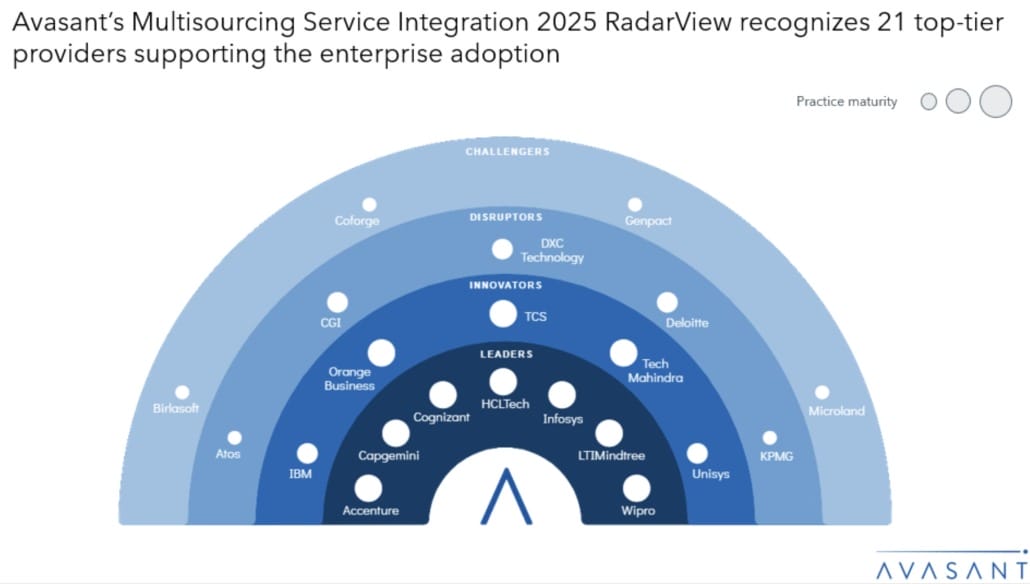
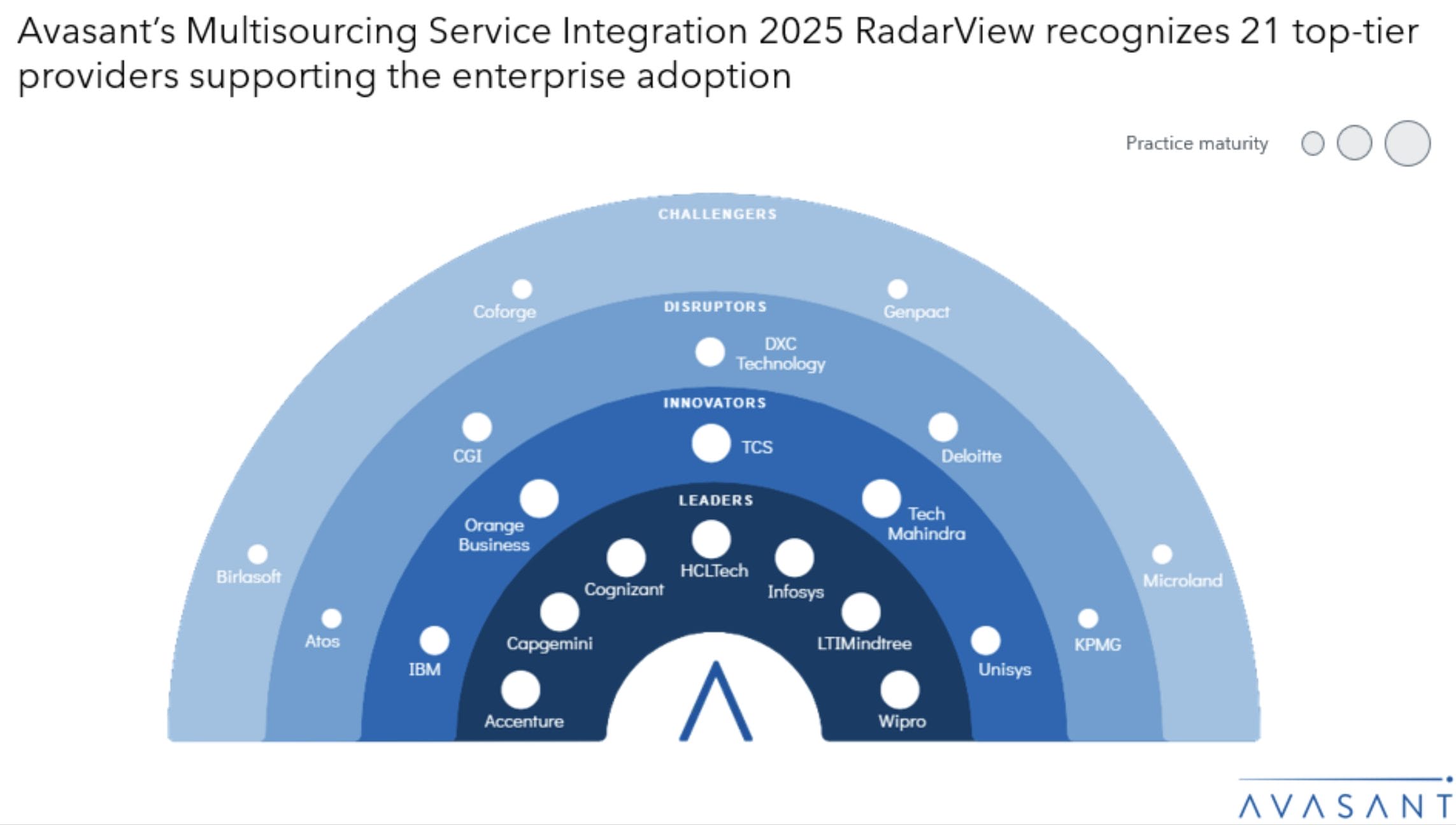
This RadarView includes a detailed analysis of the following MSI service providers: Accenture, Atos, Birlasoft, Capgemini, CGI, Coforge, Cognizant, Deloitte, DXC Technology, Genpact, HCLTech, IBM, Infosys, KPMG, LTIMindtree, Microland, Orange Business, TCS, Tech Mahindra, Unisys, and Wipro.
Our evaluation of service providers is based on primary input from the providers, focused briefings, public disclosures, validation from their clients, and Avasant’s ongoing market interactions. The assessment is across the three dimensions of practice maturity, partner ecosystem, and investments and innovation, leading to our recognition of those service providers that have brought the most value to the market over the past 12 months.
About the report (Page 3–5)
Executive summary (Pages 6–10)
Supply-side trends (Pages 11–15)
Read the Research Byte based on this report. Please refer to Avasant’s Multisourcing Service Integration 2025 Market Insights™ for demand-side trends.