
The last couple of years have been volatile in terms of IT staffing for network support. This is representative of a larger shift in IT services and staffing overall, driven by digital transformation and the pandemic.
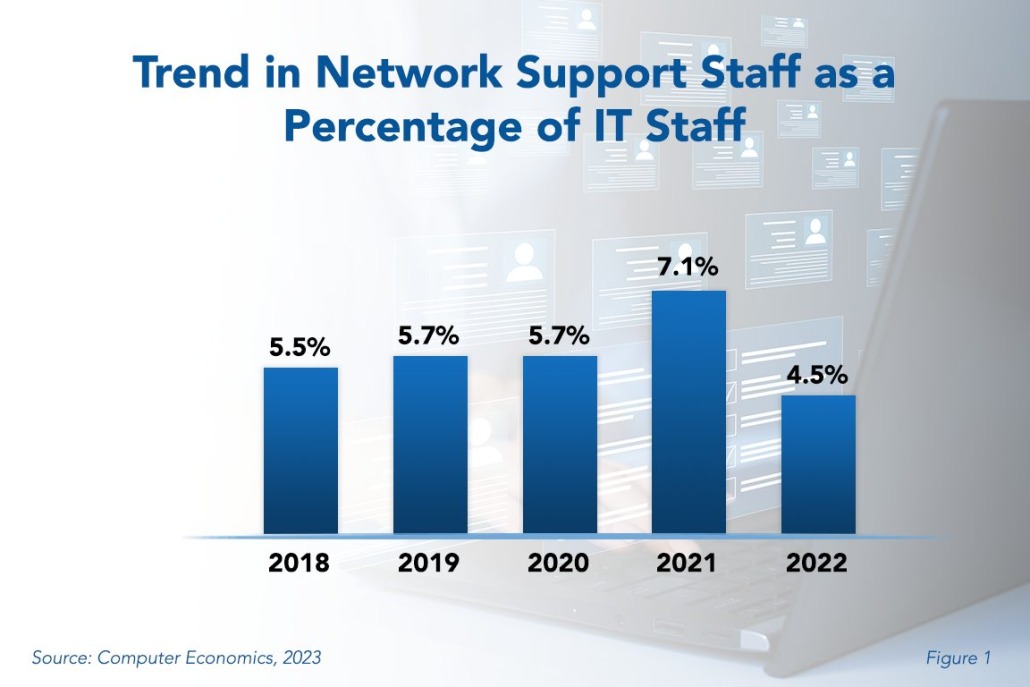
As shown in Figure 1 from our full report, Network Support Staffing Ratios, network support personnel in 2022 makes up 4.5% of the total IT staff. This is a significant decrease from 2021 when they made up 7.1% of IT staff. Prior to 2021, a slight upward trend can be seen; however, the 2022 percentage is well below pre-pandemic levels. As other IT staff functions increase, a reduction in network support staff as a percentage of the total IT staff is noted.
A decrease in network staffing is understandable, but why is it significantly lower than in recent years? In response to the COVID-19 pandemic, businesses began to transition to remote or hybrid styles of work. Employees could then access restricted company applications from anywhere. This increased the demand for network support personnel. However, in 2022, many businesses returned to “normal” operations, thereby reducing network traffic loads. There has also been an increase in the use of automation and adoption of software-defined networking.
Despite this, the network remains a fundamental IT service, crucial to the modern enterprise; its role is simply changing. An increase in alternative demand does not necessarily minimize the need for network support personnel. Networks are getting easier to manage with the expansion of software-defined networks, and traffic can be automatically rerouted in response to disruptions or changes in network traffic demand.
“More powerful networking tools bring additional complexity in technology and skills required by the design and support team,” said Mark Gaffney, director at Avasant, based in Los Angeles. “They are seeing increased demand for a wider variety of skills than ever before.”
Increasing the use of AIOps and other tools requires skills beyond traditional networking expertise. More complex network services and tools necessitate skills in full-stack engineering. Additionally, current trends need networking teams with a greater understanding of the broader business use cases.
In this study, network support staff includes personnel with titles of network engineer, architect, administrator, technician, specialist, or analyst for voice and data networks. The network support staff head count does not include managers but encompasses supervisors and senior-level personnel.
Our full report will help IT managers determine whether their organization is keeping pace with improvements in network management by comparing their network support staffing ratios against industry benchmarks. We provide four benchmarks: network support staff as a percentage of the IT staff, network support staff as a percentage of the Network and Communications Group, users per network support staff member, and network devices per network support staff member. We also provide benchmarks for the composite sample and by sector and organization size. We conclude with recommendations for optimizing the cost of network support staff.
This Research Byte is a brief overview of our report on this subject, Network Support Staffing Ratios. The full report is available at no charge for subscribers, or it may be purchased by non-clients directly from our website (click for pricing).