
As enterprises accelerate AI adoption amid rising cyber risks, ServiceNow has taken decisive steps to strengthen its security and governance stack. The acquisitions of Veza, an identity security platform, and Armis, a cybersecurity firm specializing in exposure management, align with ServiceNow’s broader strategy of consolidating identity governance, device security, and AI control into a cohesive platform.
Taken together, these acquisitions address two structural gaps that increasingly constrain enterprise AI deployments: governing dynamic identities (human, machine, and AI) and securing an expanding attack surface that now includes unmanaged and cyber-physical assets.
As enterprises operationalize AI agents, identity governance is no longer limited to users and applications. AI agents require context-aware, time-bound, and least-privilege access to enterprise systems, permissions that must adapt dynamically as workflows, data sources, and risk profiles change.
Veza brings a differentiated approach through its Access Graph, which maps relationships across human, machine, and AI identities. This offering enables continuous visibility into “who or what can access what,” allowing enterprises to enforce granular controls and conduct real-time risk assessment across increasingly fluid identity environments.
ServiceNow’s acquisition of Veza, valued at over $1 billion, marks a pivotal step in securing AI-driven workflows. By integrating Veza’s capabilities into its AI Control Tower (the AI governance layer within the Now Platform), ServiceNow enables enterprises to gain centralized visibility, control, and assurance over AI models and agents operating across workflows. This integration addresses a significant obstacle in enterprise AI adoption: the lack of visibility into who or what has access to sensitive systems.
For example, if an AI agent tasked with supply chain analytics requires different access rights than one handling HR or financial data, Veza’s Access Graph ensures these permissions are dynamically adjusted while maintaining compliance with global regulations such as the EU AI Act.
The rise of AI coincides with a rapid expansion of unmanaged assets, including OT, IoT, medical devices, and industrial systems, that sit outside traditional endpoint security models. Armis has built its products and services on agentless discovery and continuous monitoring of these environments, an area where visibility gaps remain a major enterprise risk.
Armis’ AI-driven approach shifts threat management from a reactive to a predictive model, leveraging machine learning to identify vulnerabilities months or years before they are publicly disclosed. For example, Armis has reported providing early warnings on vulnerabilities, such as CVE-2022-43939, a critical authorization bypass vulnerability in Hitachi Vantara Pentaho BA Server, up to 693 days ahead of broader disclosure. This capability is particularly valuable in an era where AI-led attacks are becoming more sophisticated and harder to detect.
The $7.75 billion acquisition of Armis significantly expands ServiceNow’s security posture, extending from digital workflows into exposure management and cyber-physical environments. Integrating Armis’ real-time asset discovery, threat intelligence, and risk prioritization capabilities with ServiceNow’s automated remediation and response workflows, the company aims to create a unified, end-to-end security platform. By connecting Armis’ unique dataset to the ServiceNow AI Control Tower, the company strengthens its broader security investments while addressing a critical enterprise need: end-to-end exposure management and identity governance as AI adoption scales.
ServiceNow’s Security and Risk business surpassed the $1 billion annual contract value (ACV) threshold in the third quarter of 2025. The integration of Armis is expected to triple ServiceNow’s addressable market for security and risk solutions, increasing it from $30 billion to $100 billion, and accelerating ServiceNow’s road map to autonomous proactive cybersecurity. Additionally, the combined platform will help customers reduce risk across their environments by eliminating fragmentation and automating remediation actions, especially for industries with cyber-physical assets, such as manufacturing and healthcare.
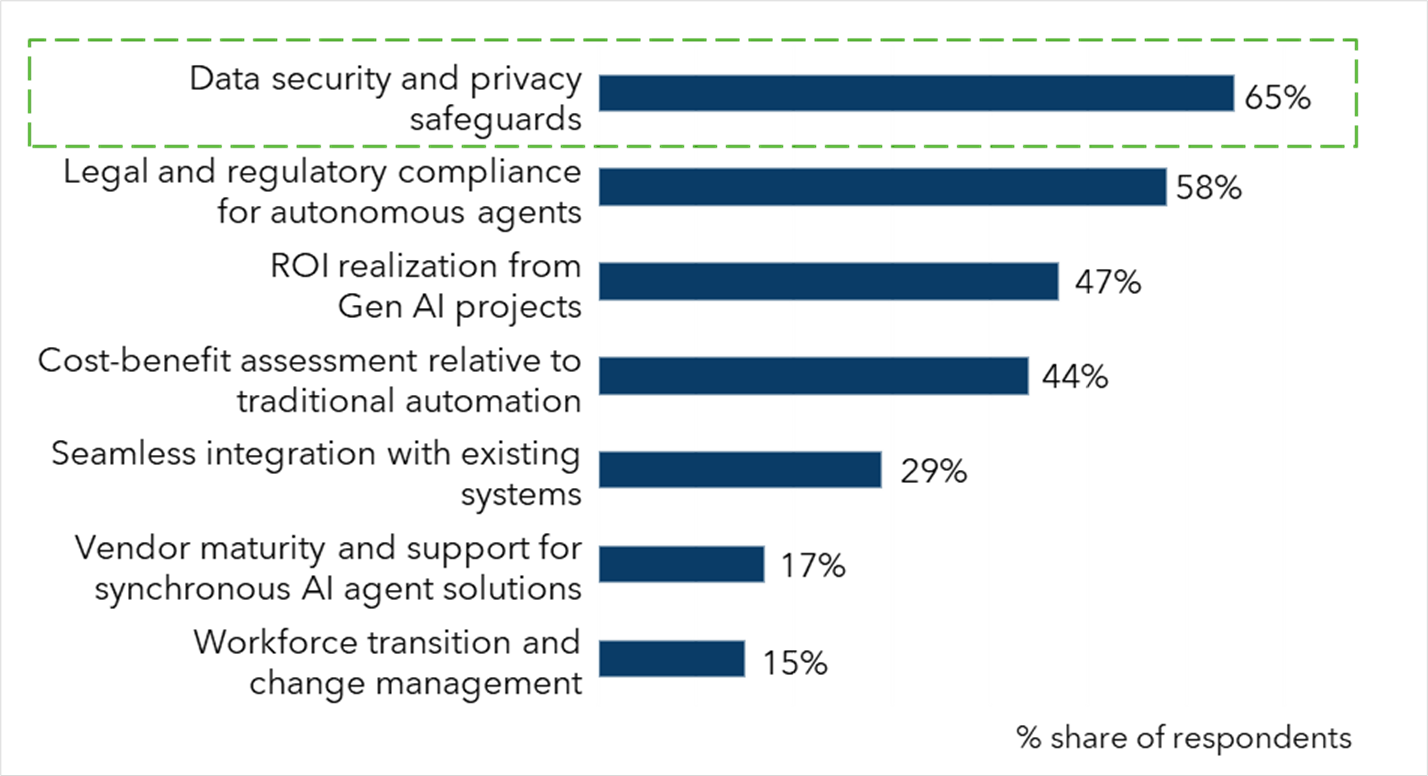
Security continues to be the number one priority for CEOs as organizations navigate increased adoption of AI. According to Avasant’s The Evolution of Synchronous AI Agents: Enterprise Adoption Trends and Strategies, enterprise AI budget allocation increased by 45% between 2024 and 2025, with data security and privacy emerging as the primary decision factors for generative (Gen) AI and agentic AI investments (Figure 1).
ServiceNow’s moves come amid intensifying consolidation in cybersecurity. The $7.75 billion Armis deal is one of the largest in the industry this year, following Google’s $32 billion acquisition of Wiz (cloud security provider) and Palo Alto Networks’ $25 billion purchase of CyberArk (identity security provider). While these transactions deepen security capabilities, ServiceNow’s differentiation lies in the convergence of security intelligence, workflow automation, and AI governance within a single operational fabric.
Moreover, these deals complement ServiceNow’s previous acquisition of Moveworks, an AI-powered enterprise search and conversational support company. This acquisition strengthens ServiceNow’s AI Platform by integrating advanced natural language understanding, multilingual conversational interfaces, and retrieval-based search to enable intelligent, automated workflows across the enterprise.
By integrating Veza and Armis into its platform, ServiceNow is attempting to position itself as a one-stop shop for enterprise AI management and cybersecurity. This strategy aligns with CEO Bill McDermott’s vision of creating an “AI control tower” that not only governs and secures AI agents, models, and workflows, but also orchestrates actions and drives business outcomes across increasingly complex enterprise environments as AI adoption scales.
ServiceNow plans to integrate Veza and Armis into its existing platform seamlessly. The company has already established several integrations between Armis’ data and ServiceNow’s workflows, which will be further deepened once the acquisition is completed. This integration is expected to be fast, leveraging the companies’ existing synergies and joint customer base.
From an Avasant perspective, these acquisitions represent a structural repositioning of ServiceNow rather than incremental capability expansion. By addressing identity governance and exposure management as foundational requirements for AI adoption, ServiceNow is aligning itself with the next phase of enterprise transformation, where AI scale is constrained less by innovation and more by trust, control, and risk management.
Execution will matter. However, if integration proceeds as planned, ServiceNow is well-positioned to emerge as a strategic governance and orchestration layer for AI-enabled enterprises, particularly in complex, regulated, and asset-intensive environments where secure AI at scale is rapidly becoming a board-level mandate.
By Gaurav Dewan, Research Director