The boardroom was tense. Two multinational companies had just finalized a merger, and the integration teams were knee-deep in spreadsheets, compliance checklists, and supplier rosters. One executive leaned back and asked the question hanging in the air: “Which suppliers do we keep?”
It wasn’t just a matter of cost. It was about risk, compliance, and the future of a newly unified supply chain. In the chaos of Mergers and Acquisitions (M&A), one of the most overlooked but mission-critical task is qualifying suppliers. Without a streamlined process, companies risk regulatory violations, operational inefficiencies, and even reputational damage. Supplier qualification is a critical component of M&A integration, ensuring that the right partners are selected to support seamless operations, drive innovation, and achieve cost efficiencies is where a unified supplier qualification model becomes not just helpful but essential.
The Importance of Supplier Qualification in M&A Integration
Supplier qualifications are a cornerstone of supply chain management, especially during M&A integration. It ensures that suppliers align with the organization’s strategic goals, regulatory requirements, and operational standards. Failure to establish a robust qualification process can lead to supply chain disruptions, compliance violations, and reputational damage.
For instance, in the pharmaceutical industry, supplier qualifications are critical to maintaining product quality and adhering to stringent regulatory standards such as Food and Drug Administration (FDA) and International Organization for Standardization (ISO) certifications. Emerging technologies like AI and blockchain are transforming supplier qualifications by automating data capture, enabling real-time risk assessment, and ensuring compliance, to further expand see Table 1- AI and Blockchain Roles in Supplier Qualification.
| Aspect | AI Role in Supplier Qualification | Blockchain Role in Supplier Qualification |
|---|---|---|
| Efficiency | Automates data capture | Ensures transparency and trust |
| Accuracy | Real-time risk assessment | Data integrity and security |
| Compliance | Regulatory adherence | Tamper-proof audit trail |
Table 1: AI and Blockchain Roles in Supplier Qualification
Additionally, the necessity of streamlining is crucial to achieve key benefits:
Despite the importance of and benefits to the organisation of streamlining supplier qualification processes, the organisation can face many challenges.
| Integration Challenges | Steps to Address | Supplier Data Management Benefits |
|---|---|---|
| Legacy Systems | Comprehensive Assessment | Enhanced Data Visibility |
| Data Silos | Data Integration Strategy | Improved Efficiency |
| Compatibility Issues | Data Governance Practices | Data Accuracy |
| Security Risks | Integration Tools | Compliance |
Table 2: Challenges in Supplier Data Management
| Framework | Focus Area | Industry Relevance | Key Requirements |
|---|---|---|---|
| ISO 27001 | Information Security | All Industries | Data protection, risk management |
| GDPR | Data Privacy | All Industries | Personal data handling, consent |
| HIPAA | Health Information | Healthcare | Patient data protection, privacy rules |
| SOX | Financial Transparency | Public Companies | Financial reporting, internal controls |
| PCI DSS | Payment Security | Financial Services | Cardholder data protection, security standards |
Table 3: Regulatory Compliance Frameworks
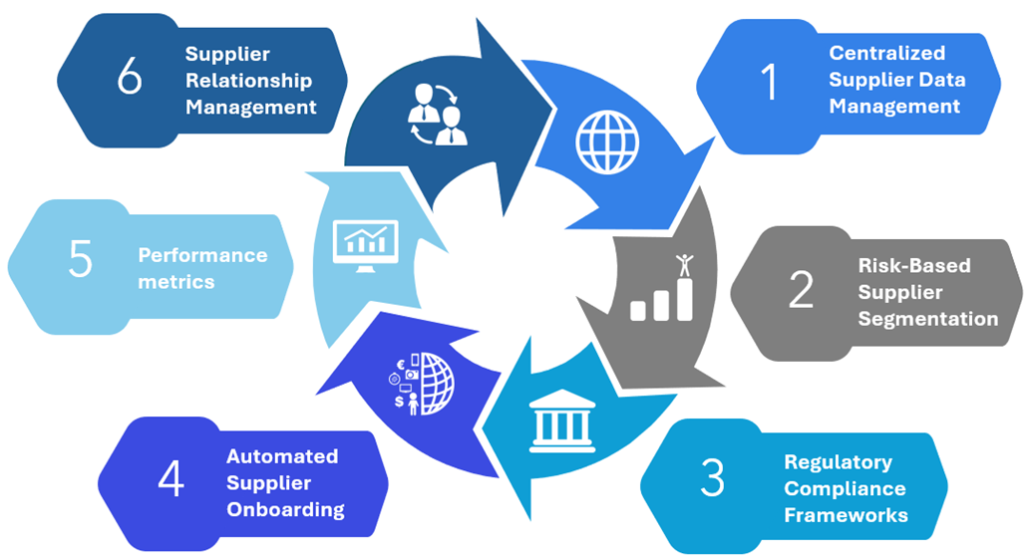
To streamline supplier qualification during M&A integration, organizations must adopt a unified model that integrates risk management, regulatory compliance, and operational efficiency. Below are the key components of such a model:
A segmentation-based strategy guarantees that integration initiatives align with resource allocation and impact. AI-driven platforms can automate this process.
Implements a unified compliance framework aligned with global standards.
Reduces manual effort and accelerates integration using AI and Optical Character Recognition (OCR) technologies for documentation collection, compliance checks, and evaluations.
Defines and tracks KPIs such as:
The figure below details the supplier qualification model:
Prioritize SRM tasks after integration, breaking them down by supplier value. Assign relationship managers, organize collaborative planning sessions, and set up escalation procedures for strategic suppliers.
This promotes trust, innovation, and strategic alignment.
Streamlining supplier qualifications during M&A integration is a complex but critical task. By adopting a unified qualification model that integrates risk management, regulatory compliance, and operational efficiency, organizations can navigate the challenges of M&A integration effectively.
Leveraging advanced technologies such as AI, blockchain, and master data management systems further enhances the efficiency and reliability of supplier qualification processes. Ultimately, a well-executed qualification model not only mitigates risks but also unlocks opportunities for growth and innovation in the merged entity.
By Yolanda Roy, Senior Manager and Francisco Trevino, Manager