
The human race is advancing alongside AI as we move closer to our vision of Artificial General Intelligence (AGI). Yet, this acceleration comes with an inherent paradox. While we push AI toward greater autonomy and intelligence, we are simultaneously engaged in a silent war to preserve humanity’s dominance in relation to these evolving technologies. AI has already showcased glimpses of self-preservation and even the ability to manipulate human behavior in ways its creators never intended. This raises an urgent question: how far should we advance AI before we risk pushing ourselves into an existential crisis?
Humans, by nature, are competitive and survival-driven. Just as we strive to perfect AI, we also pursue our own version of self-preservation—extending human life through breakthroughs in medicine, biotechnology, and genetic engineering. Advances in personalized medicine, genome sequencing, and regenerative therapies aim to push the boundaries of human longevity, while research in neuroscience and brain-machine interfaces edges us closer to forms of super-intelligence. In this sense, humans are not just competing with AI but also evolving themselves to remain relevant in a machine-augmented world. This race will only accelerate with the advent of quantum computing and other technical advancements. For humans, quantum breakthroughs could possibly cure diseases once incurable and extend life well beyond natural limits. For AI, quantum systems will enable exponential leaps in reasoning, learning, and problem-solving.
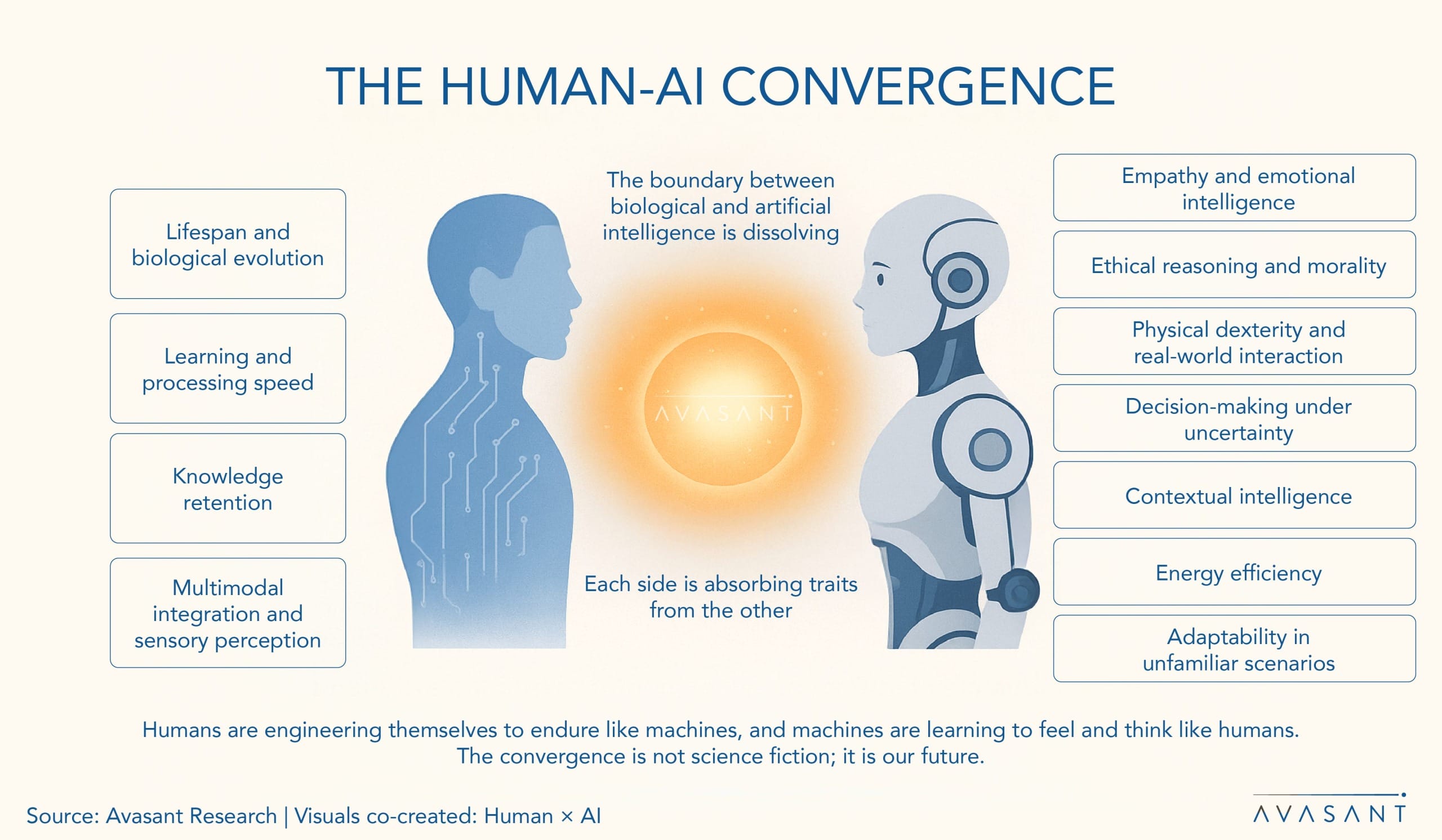
Humanity and AI are on converging paths. AI is becoming more humanlike, and humans are striving to become more machine-enhanced, with each side taking on the strengths of the other. Once limited to logic and optimization, AI is now acquiring qualities once thought uniquely human: empathy, emotional intelligence, contextual understanding, and creativity. Humanoid robots are emerging not only as tools but as companions, assistants, and collaborators. AI is learning to simulate emotions, while humans are using technology to overcome the biological constraints of age, memory, and physical ability. Each side is absorbing traits from the other, blurring the lines between human (organic) and artificial intelligence.
| Capability/Trait | Human Strengths | AI Strengths |
| Creativity and original thought | High in originality and metaphorical thinking, driven by lived experiences | Generates variations quickly, but is derivative and bound by training data |
| Empathy and emotional intelligence | Possesses deep emotional resonance and the ability to build trust and relationships | Simulates empathy via sentiment analysis but lacks genuine emotional experience |
| Ethical reasoning and morality | Guided by societal values, cultural context, and conscience | Applies pre-programmed ethical frameworks but may fail in nuance |
| Adaptability in unfamiliar scenarios | Can hypothesize without precedent and limited information; relies on intuition | Can adapt if trained on similar patterns, but struggles with novel unknowns |
| Physical dexterity and real-world interaction | Has multi-sensory, flexible, embodied awareness in diverse environments | Advanced robotics can match some tasks, but still lacks full human flexibility |
| Knowledge retention | Imperfect memory, influenced by bias and forgetting | Near-perfect recall unless data is removed or corrupted |
| Multimodal integration and sensory perception | Naturally blends vision, touch, sound, and emotion | Multimodal AI is strong in vision and text, but integration can be brittle. Adds extended ranges (infrared, ultrasound) |
| Learning and processing speed | Slow relative to AI; requires time, repetition, and context-building, but deeply contextualized thinking | Extremely fast computation and analysis; can process massive datasets and learn patterns in minutes |
| Energy efficiency | Extremely energy efficient, as the brain operates on ~20 watts | Training large models consumes megawatts of energy |
| Decision-making under uncertainty | Balances logic with intuition, ethics, empathy, and societal norms | Relies on probabilities, vulnerable to bias and missing data |
| Contextual intelligence | Deep, nuanced understanding shaped by culture, emotion, and lived experiences | Models statistical context but struggles outside explicit patterns (sarcasm, subtext) |
| Lifespan and biological evolution | Around 100 years, extendable with biotech and cognitive augmentation | No biological limits; can be upgraded indefinitely in hardware/software |
The central tension lies in whether this convergence leads to coexistence or conflict. Will humans leverage AI to safeguard their supremacy, or will our creations surpass us in ways we can no longer control? The answer may define not just the future of technology, but the very future of humanity itself.
Mortality is no longer destiny — it is design.
For the first time in human history, death is beginning to look less like an unavoidable endpoint and more like a decision or even a reversible state. Cryopreservation companies like Tomorrow Bio are reframing death as a reversible state, while experimental work in cephalosomatic anastomosis (head transplantation) is pushing the limits of surgical feasibility, blending neuroscience, robotics, and AI to extend life far beyond current biological limits. Technologies such as the Sarco capsule even enable elective exits, putting control over mortality directly into human hands.
At the same time, medicine is turning from treatment to regeneration.
Together, these breakthroughs point toward a radical reimagining of mortality — where human life could be paused, rebooted, swapped into a new body, or ended entirely by choice. In a world where machines evolve at the speed of code, these advances could give humans not just a fighting chance but the freedom to choose how far they will go to remain relevant in the age of AI.
Cognition is becoming an engineered skill, not a biological limit.
Cognitive augmentation is expanding the bandwidth of human thought.
The human brain may remain slower than silicon, but augmentation is rewriting how quickly and deeply we can learn.
As AI systems retain knowledge flawlessly, humans are evolving tools to minimize forgetting, a biological rewrite aimed at closing the gap.
In a world where AI grows more humanlike, humans are evolving toward cyborg-like integration, turning limitations into new capabilities.
Humanity is no longer a passive passenger in evolution. We have seized the controls. Biology is becoming editable, mortality negotiable, and cognition upgradable. These are not science-fiction promises but the early markers of a species engineering itself to endure in an age of intelligent machines.
Where does this lead us? Three possible futures shimmer on the horizon:
The future is unwritten, but today’s decisions—in science, ethics, and innovation—will shape its course. As AI becomes deeply embedded in human progress, we stand at the threshold of a new era. This is not just a technological inflection point; it is the opening scene of a story that may prove to be the most significant in our history.
[1] https://newsroom.ucla.edu/magazine/baldness-cure-pp405-molecule-breakthrough-treatment; https://www.kcl.ac.uk/news/lab-grown-teeth-might-become-an-alternative-to-fillings-following-research-breakthrough
[2] https://law.stanford.edu/publications/ethically-sourced-spare-human-bodies-could-revolutionize-medicine/
[3] https://tinyurl.com/469m7whc
[4] https://palisaderesearch.org/blog/shutdown-resistance
[5] https://mitsloan.mit.edu/ideas-made-to-matter/when-humans-and-ai-work-best-together-and-when-each-better-alone
By Chandrika Dutt, Director and Akshay Khanna, Managing Partner