

The $100B Quarter: What It Means for Your Next AI Contract

August, 2025

Download Free Report

The New Economics of AI

Traditional sourcing models built around pricing tokens, instances, and storage in a world of cloud abundance no longer apply. Today’s AI unit economics ride three volatile rails:

    1. Scarce Compute: The availability of high-performance chips (GPUs, TPUs) and the bandwidth to connect them is now limited. This scarcity drives up prices and creates competition for access. For sourcing leaders, this means negotiating long-term reservations and prioritizing vendors with guaranteed capacity. For CFOs, it signals rising capital intensity and the need for cost predictability.
    2. Power Volatility: AI workloads consume significant energy, and access to affordable, reliable power is no longer guaranteed. Tariffs, carbon pricing, and limited access to power purchase agreements (PPAs) introduce cost variability. Contracts must now factor in energy-indexed pricing and sustainability incentives to protect the total cost of ownership.
    3. Rapid Refresh Cycles: Hardware performance is improving faster than ever, often doubling every 18–24 months. This creates both opportunity and risk: without contractual refresh rights, organizations may fall behind or overpay for outdated infrastructure. CFOs should view refresh clauses as cost-down levers, while sourcing teams should ensure upgrade paths are built into every agreement.

If your contracts don’t secure compute capacity, align pricing with energy and refresh dynamics, and preserve portability across providers, you’ll face escalating costs, throttled adoption, and vendor lock-in—just as your AI use cases begin to scale.
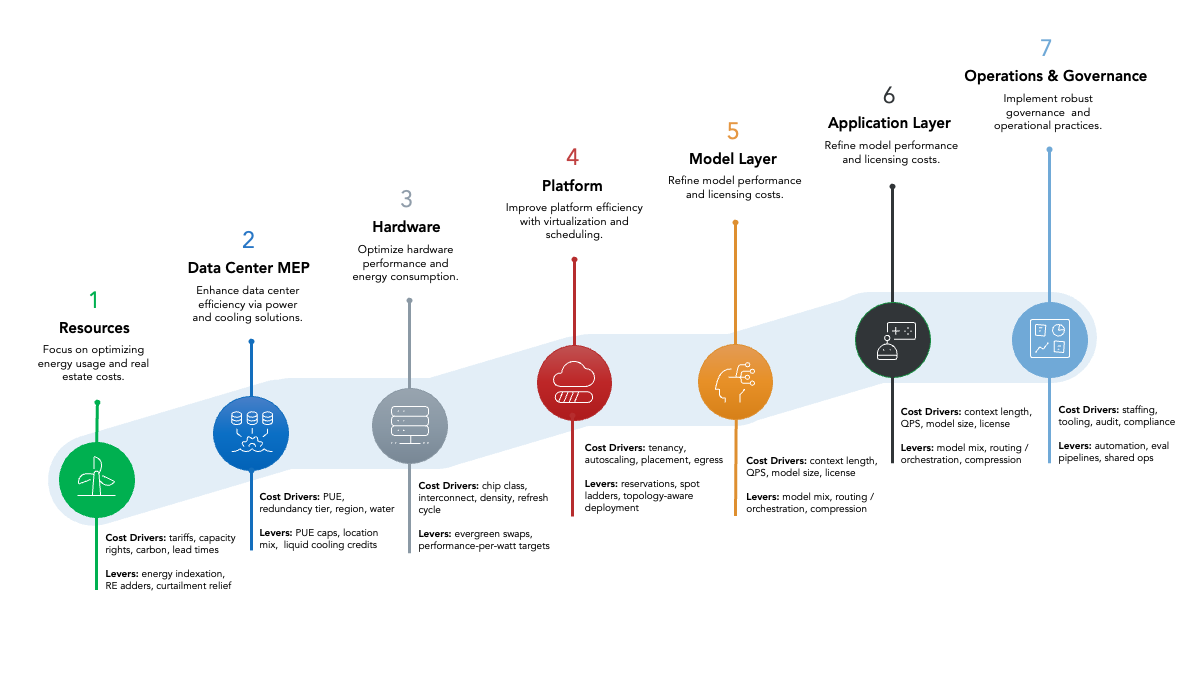
AITCO (AI TCO 2.0) Waterfall

Ai 3 - The $100B Quarter: What It Means for Your Next AI Contract

Table 1 The 7 Layers of AI Total Cost of Ownership

AI supply is shifting from “cloud abundance” to “compute allocations.” Providers are triaging GPU clusters, power, and regions. Prices will not track Moore’s Law smoothly; they’ll stair-step as new chip classes land and as regions hit power ceilings. The winners will write dynamic contracts that exploit these steps while guaranteeing minimum throughput for critical use cases.

Negotiation Moves You Can Use Now

    1. Minimum throughput clauses: AI workloads that drive revenue or customer experience, like real-time analytics or intelligent agents, require guaranteed performance. Include minimum throughput and latency targets in your contracts, with financial penalties if vendors fall short. This protects business continuity and ensures predictable service levels.
    2. Capacity ladders vs. spot: Avoid the volatility of spot pricing. Instead, reserve compute capacity across 12, 24, and 36-month terms, spanning current and next-gen chip classes. Include substitution rights so you can upgrade to newer, more efficient chips at pre-negotiated rates, keeping your infrastructure competitive without renegotiation.
    3. Energy-indexed pricing bands: AI infrastructure is energy-intensive. Tie your pricing to a transparent energy index in the region where your models run. Add safeguards like renewable energy incentives and efficiency caps (e.g., PUE limits) to control total cost and support sustainability goals.
    4. Evergreen refresh: Hardware refresh cycles are accelerating. Include clauses that allow you to swap in newer, more efficient chips every 18–24 months at fixed fees. This ensures your cost per unit of performance improves over time, without needing to renegotiate or re-platform.
    5. Exit & portability: Ensure you own key data assets like embeddings and feature stores. Require export guarantees and model equivalence mappings so you can switch vendors or run dual environments with minimal reintegration costs. This protects your flexibility and negotiating power.

AI Contract Readiness: What To Do This Month

    1. Identify your top 5 AI use cases: Work with business units to pinpoint the AI initiatives that are most critical to revenue, operations, or customer experience. Classify each by business impact and compute intensity using the AI TCO framework in Table 1 to guide sourcing priorities.
    2. Define performance requirements for each use case: Draft clear throughput and latency expectations for each AI workload. These will serve as inputs for your sourcing team to negotiate service-level guarantees and avoid underperformance.
    3. Build a capacity plan for the next 12-36 months: Develop a road map for compute needs across chip classes and time horizons. This includes long-term reservations, burst capacity rights, and upgrade paths to ensure scalability and cost control.
    4. Draft energy-indexed and evergreen clauses: Collaborate with Finance and Sustainability teams to align pricing with energy market dynamics and hardware refresh cycles. These clauses will help manage volatility and support ESG goals.
    5. Test your portability strategy: Run a drill to validate your ability to switch vendors or run dual environments. Ensure you can export embeddings, swap endpoints, and avoid costly re-platforming if needed.

Take the Next Step: AI Contract Risk Review

Book Avasant’s 30-minute AI Contract Risk Review to ensure your AI investments are contractually protected and financially optimized.

In this focused session, our experts will:

    • Benchmark your current AI contract clauses against market best practices.
    • Identify cost leakage and performance risks across your infrastructure agreements.
    • Deliver a one-page remediation plan tailored to your top AI use cases.

Whether you’re negotiating new deals or reviewing existing ones, this review helps you future-proof your AI strategy and strengthen your sourcing position.