Cloud computing has become the foundation of enterprise IT strategy. More than 80%–90% of Global 2000 enterprises already operate in a hybrid IT environment, and over 60% manage multiple clouds, with the average enterprise leveraging around 3.5 different cloud platforms. However, as organizations scale their cloud operations, they face increasing challenges in managing fragmented infrastructure, optimizing cloud costs, and ensuring security across distributed environments. At the same time, AI-driven applications are placing unprecedented demands on cloud infrastructure, making seamless data integration and workload orchestration essential.
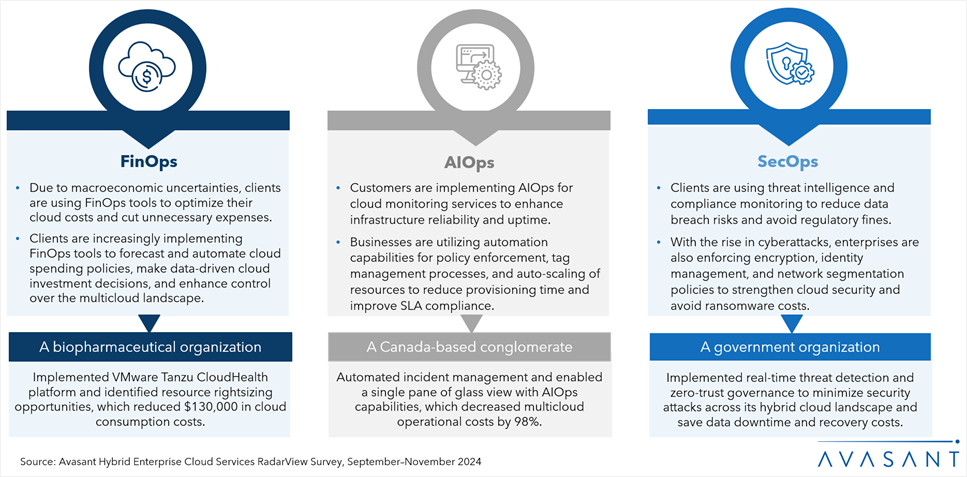
To address these challenges, enterprises are shifting toward FinOps, AIOps, and SecOps frameworks to enhance cloud efficiency, optimize costs, and mitigate security risks. According to Avasant’s Hybrid Enterprise Cloud Services 2024–2025 Market Insights™, organizations across industries are leveraging these approaches to streamline their cloud strategies.
Today, organizations require a purpose-built cloud platform that not only unifies disparate environments but also integrates AI workloads, security, and cost optimization into a single framework.
Enterprises today operate across a mix of public, private, and on-premises cloud environments, leading to a fragmented IT landscape. Workloads are distributed across hyperscalers, edge computing sites, and in-house data centers, creating operational silos that make management, cost control, and security enforcement more complex.
For example, a large BFSI enterprise might have customer-facing applications on a public cloud, internal office applications on a private cloud, and on-premises workloads. Without a unified control plane, they struggle to monitor performance, allocate resources efficiently, and ensure compliance across environments.
Cloud cost inefficiencies are a growing concern, with enterprises frequently overpaying for underutilized infrastructure. Many CIOs report that while their business revenue grows at 10%–12% annually, their cloud spending increases by 25%–30%. This imbalance underscores the need for automated workload optimization and real-time cost governance to right-size cloud investments.
AI adoption is accelerating, but enterprises struggle to transition from AI experimentation to scalable deployments. AI workloads require high-performance computing (HPC), GPU clusters, and optimized data pipelines, yet many organizations lack the infrastructure to support large-scale AI model training and inferencing.
For instance, an automotive company managing connected vehicle data found that 67% of its telemetry data was discarded due to high storage costs and inefficient data pipelines. Without an optimized cloud architecture, enterprises cannot fully capitalize on their AI initiatives.
As enterprises expand their cloud footprint, they become increasingly vulnerable to cyber threats. Multicloud security gaps, compliance risks, and ransomware attacks pose significant challenges. Enterprises need an integrated security framework that enforces encryption, identity management, and automated policy compliance across cloud environments.
For example, a government organization handling sensitive citizen data required real-time threat detection across its hybrid cloud infrastructure. Without a zero-trust security model, it was exposed to potential data breaches and compliance violations.
To address the challenges stated above, enterprises require a platform that provides seamless orchestration across multicloud and hybrid environments, allowing them to optimize performance, automate resource allocation, and maintain security compliance without vendor lock-in.
In line with this vision, Tata Communications launched the Vayu Cloud last week, introducing a structured approach to managing multicloud complexity, optimizing cloud investments, and securing workloads at scale.
During our interaction with Vice President and Global Head of Cloud and Edge Business Neelakantan Venkataraman and Bhaskar Gorti, executive vice president of Cloud and Cybersecurity Services at Tata Communications, they emphasized the need for a purpose-built cloud platform that integrates AI scalability, cost optimization, and security within a unified framework.
Tata Communications’ Vayu Cloud enables enterprises to unify, optimize, and secure their cloud environments with the following capabilities:
By integrating these features, Vayu Cloud enables enterprises to scale AI workloads, optimize cloud investments, and enforce security at every layer—offering a structured, purpose-built alternative to traditional cloud models.
As enterprises navigate the complexities of hybrid and multicloud environments, they face mounting challenges in managing distributed workloads, controlling rising cloud costs, and scaling AI-driven applications. Organizations must move beyond traditional cloud models to remain competitive and adopt purpose-built cloud solutions that offer a unified solution, AI-ready infrastructure, cost efficiency, and integrated security. This approach not only drives innovation but also strengthens long-term resilience and operational control.
By Gaurav Dewan, Research Director, Premal Shah, Principal Analyst, and Dhanusha Ramakrishnan, Lead Analyst, Avasant