
The importance of computer networks cannot be overstated in this digital age. However, the level of network support staffing has plateaued in recent years and shows no signs of rebounding.
In other words, the increasing need for more bandwidth, better security, analytics, and reliability has not driven up the ratio of network support staff to total IT staff in the typical organization. Rather, as with other infrastructure support functions, the data suggests that easier-to-support technology and automation are enabling IT organizations to do more with the same number of network support personnel.
As shown in Figure 1 from our full report, Network Support Staffing Ratios, network support personnel in 2015 made up 5.7% of the total IT staff. That number stands at exactly the same percentage this year, and it has not varied much from that level in the years between.
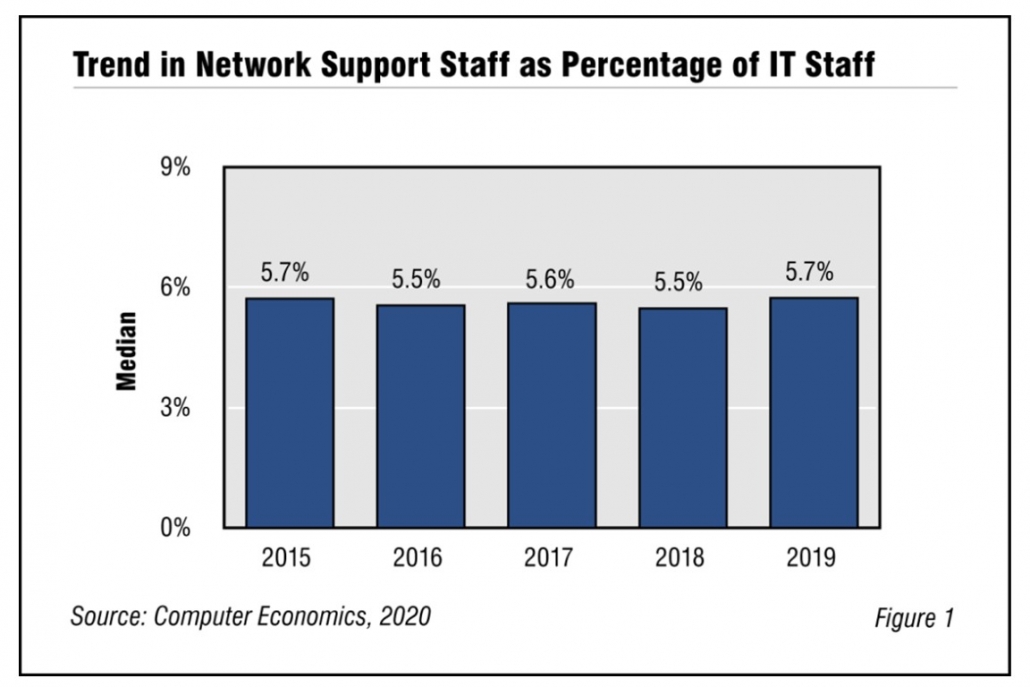
This plateau might seem surprising, considering that the network demands on IT organizations have been steadily increasing, with more software as a service (SaaS), public cloud infrastructure, videoconferencing, the Internet of Things, real-time big data analytics, and other network-heavy technology.
“When it comes to networks, IT organizations have simply been able to support larger, faster, and more complex networks without major increases in staff,” said Tom Dunlap, research director at Computer Economics, an IT research and consulting firm based in El Segundo, Calif. “Automation, virtualization, software-defined networks, and improved best practices are making network support professionals more productive.”
In this study, network support staff includes personnel with titles of network engineer, architect, administrator, technician, specialist, or analyst for voice and data networks. The network support staff head count does not include managers but encompasses supervisors and senior-level personnel.
Our full report will help IT managers determine whether their organization is keeping pace with improvements in network management by comparing their network support staffing ratios against industry benchmarks. We provide four benchmarks: network support staff as a percentage of the IT staff, network support staff as a percentage of the Network and Communications Group, users per network support staff member, and network devices per network support staff member. We provide benchmarks for the composite sample and by sector and organization size. We conclude with recommendations for reducing or at least maintaining the cost of network support staff.
This Research Byte is a brief overview of our report on this subject, Network Support Staffing Ratios. The full report is available at no charge for Avasant Research subscribers, or it may be purchased by non-subscribers directly from our website (click for pricing).