
By the end 2025, over 60% of procurement decisions will be influenced by AI, yet most organizations still struggle to implement it effectively. Procurement leaders face a paradox: Artificial Intelligence promises transformation, but only when implemented with surgical precision. The hype is over—AI is now a board-level mandate actively reshaping how procurement functions, but turning promise into performance demands more than interest; it requires executive clarity. In our last article, we explored how AI creates value. This time, we’re focused on how to unlock it. From fragmented data and compliance constraints to change resistance and misaligned processes, the road to AI success is lined with pitfalls. What separates the leaders is a practical, people-first approach—one that aligns technology with business goals, ensures stakeholder trust, and delivers measurable impact.
Organizations often face an uphill battle with the initial investment required for AI implementation. Infrastructure upgrades, software acquisition, and employee training demand not only financial commitment but also internal coordination across departments. This transition can be disruptive. Employees often resist new tools or workflows due to concerns about job relevance or steep learning curves. The companies that succeed are those that view AI not as a replacement for human talent, but as a strategic partner amplifying critical thinking and eliminating repetitive tasks that hinder productivity. Procurement professionals, when empowered with the right AI tools, can shift their focus from clerical duties to high-level functions such as supplier development, risk management, and innovation.
The dependency on data also reveals AI’s greatest vulnerability. Poor data quality, lack of standardization, or hidden biases can compromise the reliability of AI outputs. Human oversight becomes not just advisable but essential. AI processes data but cannot interpret anomalies or navigate supplier relationship nuances. Particularly in global procurement settings where political, cultural, and logistical factors intertwine, AI must be complemented by human intelligence to navigate complexity with discretion. Over-reliance on algorithms without critical review risks making procurement decisions that are technically sound but operationally impractical.
Compounding this risk is the challenge of data privacy and regulatory compliance. As AI systems require vast volumes of sensitive data to operate effectively, companies must contend with legal frameworks like the General Data Protection Regulation (GDPR) and California Consumer Privacy Act (CCPA), which impose strict rules around data collection, storage, and usage. The stakes are high. According to the IBM Cost of a Data Breach Report 2024, the global average cost of a breach has risen to $4.88 million, the highest figure ever recorded. However, the report also highlights that organizations leveraging AI-powered security and automation tools saw a 45% reduction in breach costs, validating the role of AI not only as a vulnerability but also as a defense mechanism when implemented responsibly. It underscores the need for a comprehensive data governance strategy encompassing vendor vetting, privacy impact assessments, robust access controls, and user consent protocols.
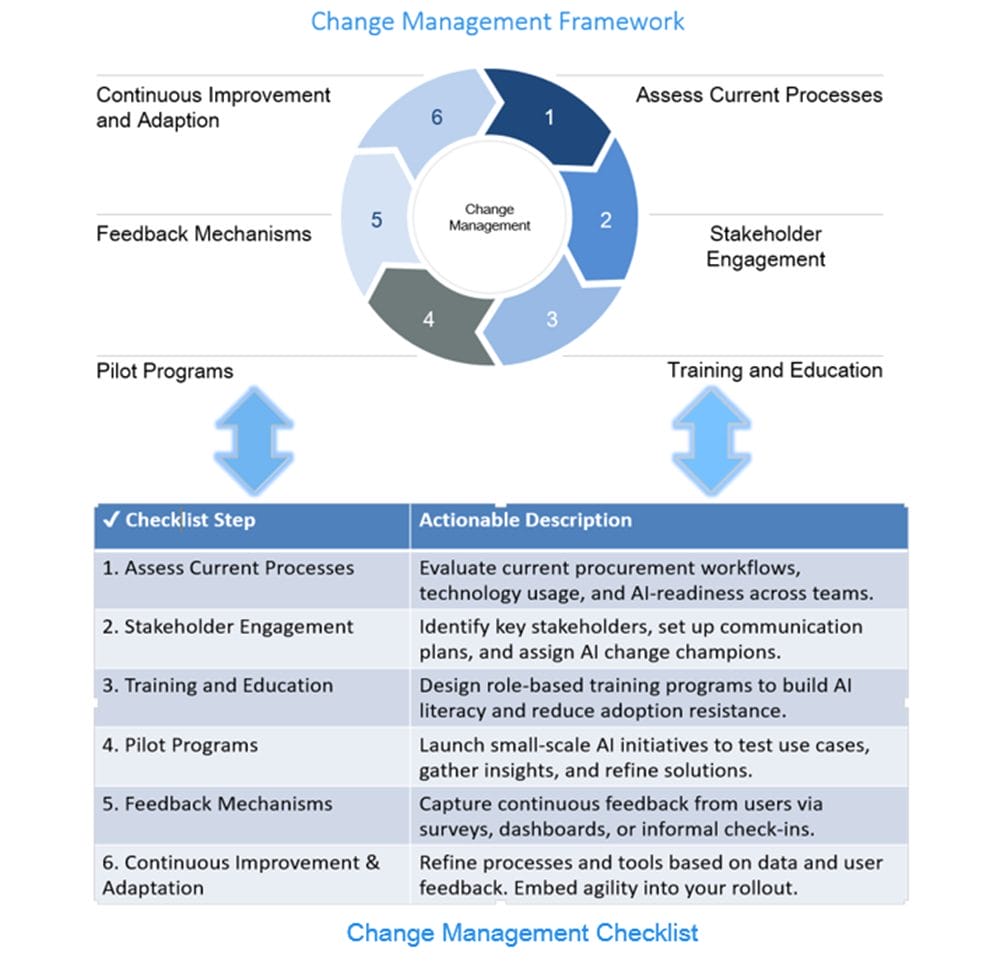
Amidst these technical and regulatory complexities, organizations must also orchestrate cultural and procedural transformation. Effective change management is essential to successful AI adoption. Success starts with evaluating current procurement processes, identifying inefficiencies, and mapping opportunities for AI integration, particularly in tasks that are repetitive, time-consuming, or error-prone. Gaining executive sponsorship and early stakeholder engagement is critical to building internal momentum and reducing resistance. When employees understand the ‘why’ behind the technology, they are more likely to embrace the ‘how.’ Training that demystifies AI and shows its practical use builds employee confidence to adopt it in daily workflows.
Pilot programs offer a low-risk testing ground to observe AI performance in controlled environments. Starting small allows teams to gather user feedback, adjust configurations, and uncover unforeseen challenges before a full-scale rollout. These pilots should be complemented with continuous feedback mechanisms, surveys, performance dashboards, and user interviews that keep implementation agile and responsive.
However, technology alone is not enough. Successful AI adoption hinges on cultural readiness, which must be deliberately cultivated. As illustrated in Figure 1, a change management framework provides a structured approach to this transformation, emphasizing six key pillars: assessing current processes, stakeholder engagement, training and education, pilot programs, feedback mechanisms, and continuous improvement. When paired with the change management checklist, organizations can systematically assess readiness, identify resistance points, and ensure that change initiatives are both inclusive and sustainable.
Training is pivotal. Programs that simplify AI and show practical use build employee confidence to adopt these tools. When employees understand the ‘why’ behind the technology, they are more likely to embrace the ‘how.’ AI is not a ‘set and forget’ solution — it requires ongoing review and adaptation to remain aligned with evolving business needs. Continuous improvement is what separates AI deployments that merely function from those that flourish.
Walmart faced significant challenges in optimizing its procurement processes. The primary issues included the complexity of supplier negotiations, the need for standardization in non-resale goods contracts, and the risk of business disruption during the implementation of new technologies. Additionally, there was a need to ensure alignment among stakeholders from procurement, finance, and supplier relationship management to facilitate smooth integration and minimize resistance.
To address these challenges, Walmart introduced Pactum AI, a chatbot platform designed to autonomously negotiate supplier contracts. The initiative began with a three-month pilot program focused on non-resale goods with standardized terms. This approach minimized business risk while allowing thorough observation of the tool’s effectiveness. Early engagement of stakeholders from procurement, finance, and supplier relationship management was crucial to ensure alignment and smooth integration. Human oversight was maintained throughout the process to allow for intervention where nuance or flexibility was required.
The pilot program demonstrated that AI’s true value lies not only in processing negotiations faster but also in freeing procurement teams to focus on strategic relationship building and innovation. As Walmart transitioned from pilot to production, the company ensured that human oversight remained intact, preserving trust and transparency. The result was not just automation, but acceleration, enabling Walmart to achieve significant efficiencies without sacrificing the quality of supplier relationships.
Walmart’s AI journey illustrates how targeted pilots and stakeholder alignment can unlock measurable procurement value, but what broader lessons can procurement leaders take from this success? To better understand the evolution of AI in procurement, Table 1’s framework—adapted from Avasant’s Procurement Business Process Transformation RadarView 2023—outlines four key maturity stages:
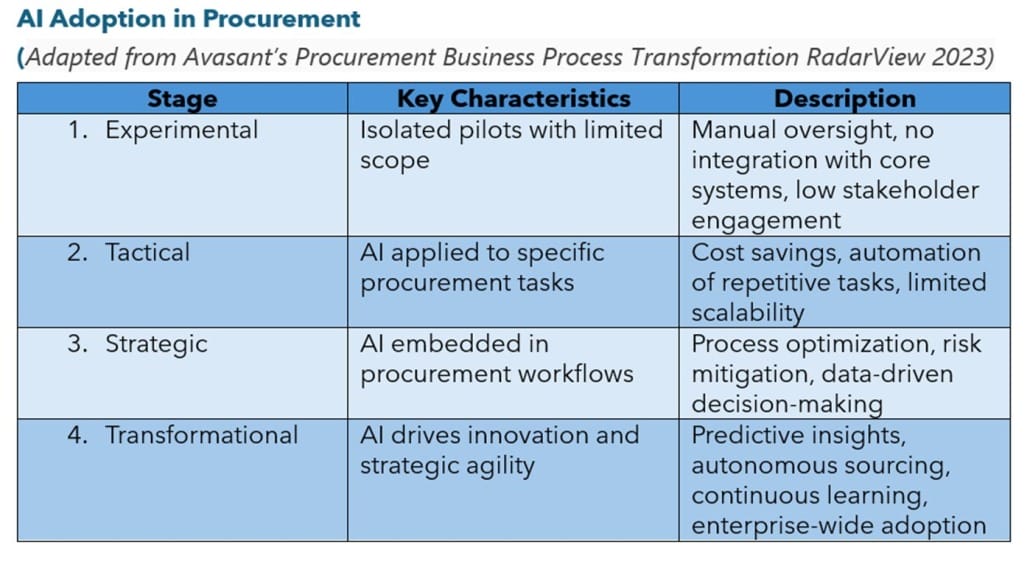
The case study validates a broader lesson for organizations: the most successful AI implementations are those grounded in pragmatism and guided by purpose. It’s not about chasing cutting-edge tech for the sake of innovation but about aligning tools with tangible procurement goals, cost reduction, compliance, supplier performance, and strategic agility. Businesses must remain flexible, iterative, and resilient as they embrace AI, understanding that transformation is a process, not an event.
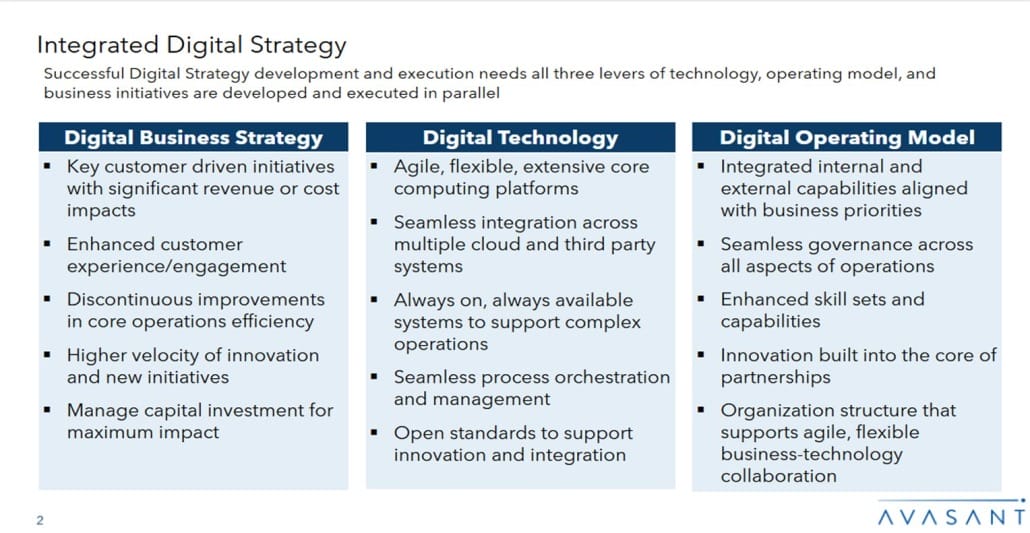
To move from experimentation to enterprise-wide impact, procurement leaders must align AI initiatives with broader operating models. Avasant’s Integrated Digital Strategy (as shown in Table 2 below) provides a blueprint for this alignment—integrating AI across three levers to ensure that technology investments deliver measurable business outcomes, from cost savings to supplier innovation.
Looking ahead, the role of AI in procurement is poised to deepen further. As AI becomes more embedded in procurement strategy, enterprises must evolve their transformation approach to keep pace with rising complexity and expectations. Avasant’s Digital Transformation Roadmap (as shown in Figure 2 below) offers a phased guide for this evolution, starting with foundational readiness, progressing through operational integration, and culminating in enterprise-wide innovation.
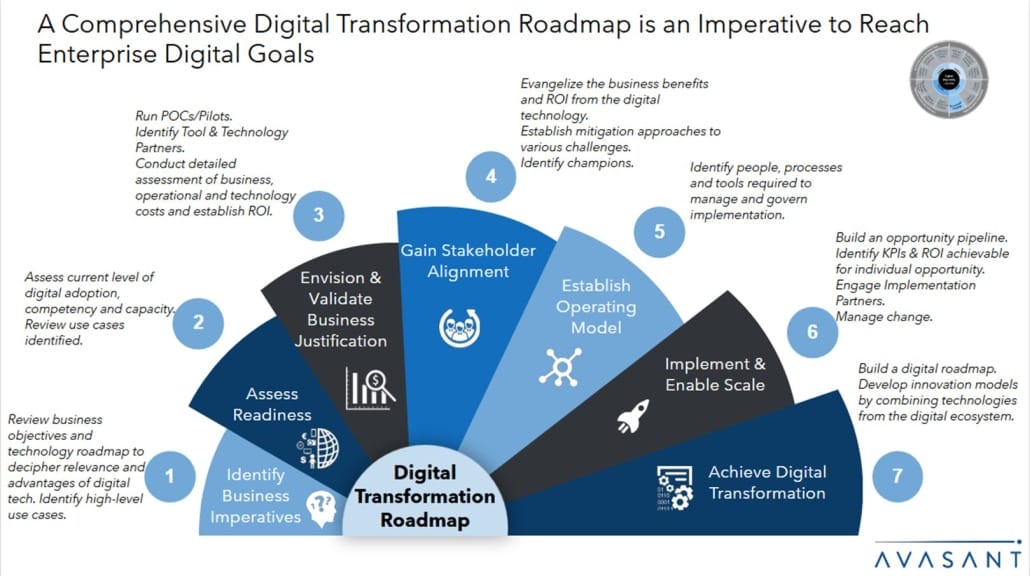
This roadmap emphasizes the importance of aligning AI initiatives across people, processes, and platforms, ensuring that technology investments are not only effective but also governed responsibly. This alignment is essential as procurement leaders face growing demands for ethical AI, transparency, and accountability. Organizations that stay proactive in these areas will be best positioned to lead not only in efficiency, but in trust and resilience.
By Johann Rodriguez, Senior Procurement Specialist