
As enterprises look to transform their contact centers into customer experience centers, technologies, including generative AI (Gen AI), automation, and analytics, take center stage. Evolving customer journeys and the need for seamless experiences across channels push enterprises to offer omnichannel support and digital self-service options. Service providers have allocated 27% of their investments toward emerging technology integration and 35% dedicated to new tools and platforms, as noted in our Contact Center Business Process Transformation 2023–2024 RadarView.
The introduction of Gen AI has significantly changed contact center outsourcing. This technology’s impact on employee productivity in contact centers cannot be overstated. It has revolutionized contact center operations by enhancing efficiency and improving customer service.
However, the rise of AI in contact centers presents both job displacement risks and productivity gains. AI’s integration into contact centers could automate routine tasks, potentially reducing entry-level positions and streamlining workflows, necessitating fewer manual roles. While some jobs may vanish, new AI management and development roles could arise. On the productivity front, AI enhances agent performance with real-time assistance, optimizes workforce management, and elevates customer satisfaction through faster, personalized service. The overall effect on employment remains uncertain, influenced by the rate of AI adoption, the complexity of tasks, and the commitment to workforce reskilling.
Contact center agents grapple with high volumes of repetitive tasks, risking burnout and diminished productivity. Gen AI offers a solution by automating routine tasks and providing real-time support, enabling agents to deliver personalized and efficient customer service. It facilitates seamless communication across languages, interprets customer sentiment for empathetic interactions, and accelerates agent training with interactive simulations. Gen AI empowers agents to focus on complex tasks, enriching their work experience and boosting productivity.
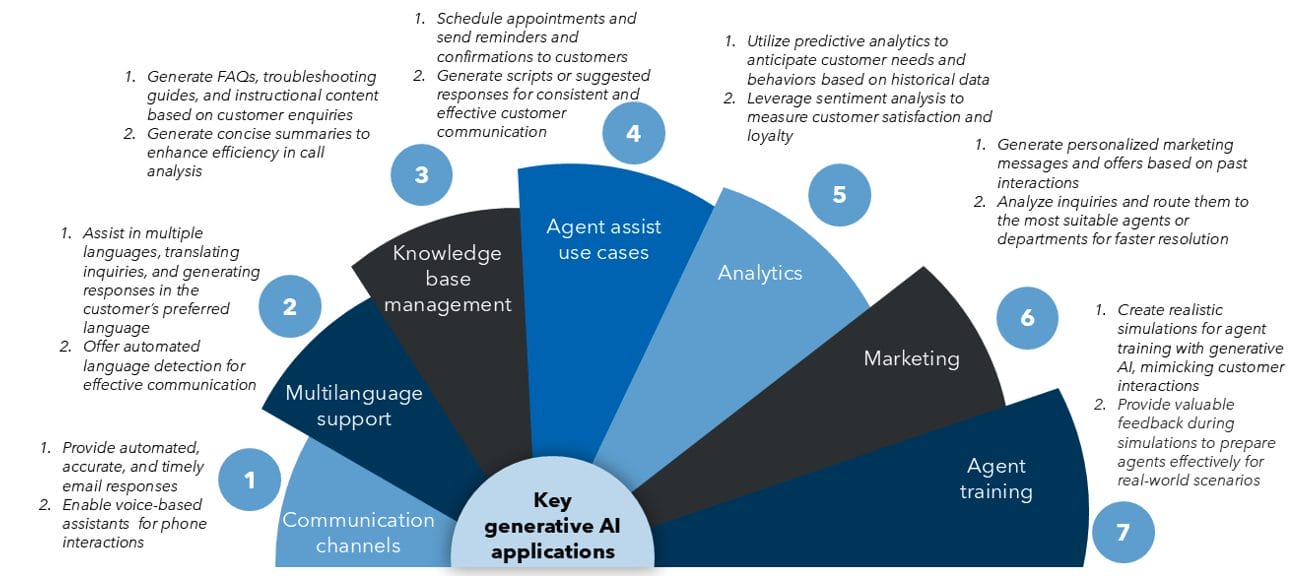
Implementing Gen AI in contact centers presents several challenges, including technical limitations like accuracy and bias, human-AI interaction issues such as over-reliance and job displacement fears, ethical concerns including data privacy and algorithm transparency, and practical considerations such as integration costs and infrastructure needs. Addressing these challenges is crucial for realizing the productivity benefits of generative AI.
The harmonious integration of humans and AI in contact centers is contingent upon a strategic, responsible, and ethical approach. Transparency, data privacy, and human oversight are paramount to fostering trust and counteracting AI’s inherent biases. Cultivating a culture of continuous learning and development is crucial, as it equips agents with the necessary skills to effectively collaborate with AI, while ongoing refinement of AI algorithms ensures they evolve in tandem with real-world applications.
Gen AI will play a key role in streamlined contact center operations, automated mundane tasks, and enhanced customer interactions, leading to a marked increase in productivity. Agents can now manage more interactions without sacrificing quality, signaling a transformative shift in outsourced customer service with Gen AI at the helm.
As this technology progresses, it promises to further revolutionize the industry, underscoring its clear benefits to contact center agents. The future of customer service lies in a human-AI partnership that amplifies efficiency and empathy, personalization, and authenticity. This synergy is the cornerstone of a new era in customer service excellence, where technology augments human capabilities, fostering deeper connections, greater satisfaction, and a future where customers feel genuinely valued and understood.
By Surya Teja, Senior Research Analyst, Avasant, and Aditya Jain, Research Leader, Avasant