
This RadarView addresses the need for enterprises to adopt data lakehouse platforms to enable AI and business intelligence workloads on a unified, scalable, and governed data platform. It begins with a summary of key trends shaping the supply side of the market. It continues with a detailed assessment of 14 vendors delivering data lakehouse platforms. Each profile gives an overview of the platform vendor, its key IPs and assets, and a list of major clients and partnerships, along with brief client case studies. Each profile concludes with analyst insights on the vendor’s product maturity, enterprise adaptability, and investments and innovation.
Why read this RadarView?
As enterprises scale data-driven initiatives, data lakehouse platforms are gaining prominence for their ability to unify diverse data workloads and support advanced analytics and AI requirements. The vendor landscape continues to expand, with platforms enhancing capabilities to meet rising demands for real-time analytics, AI-ready data pipelines, and enterprise-wide data democratization. To cater to this demand, vendors are strengthening their offerings with unified data governance layers, support for open data formats, and seamless handling of multimodal data workflows. These advancements enable organizations to modernize legacy architectures, unlock new AI and analytics use cases, and drive more agile, governed, and cost-efficient data ecosystems.
The Data Lakehouse Platforms 2025 RadarView™ highlights key supply-side trends in this space and Avasant’s viewpoint on them. It aids companies in identifying top platform vendors who can assist them in implementing data lakehouse solutions. Additionally, it provides an evaluation of each platform vendor’s technology and support services, helping organizations select the appropriate strategic partners for data lakehouse implementation.

Featured providers
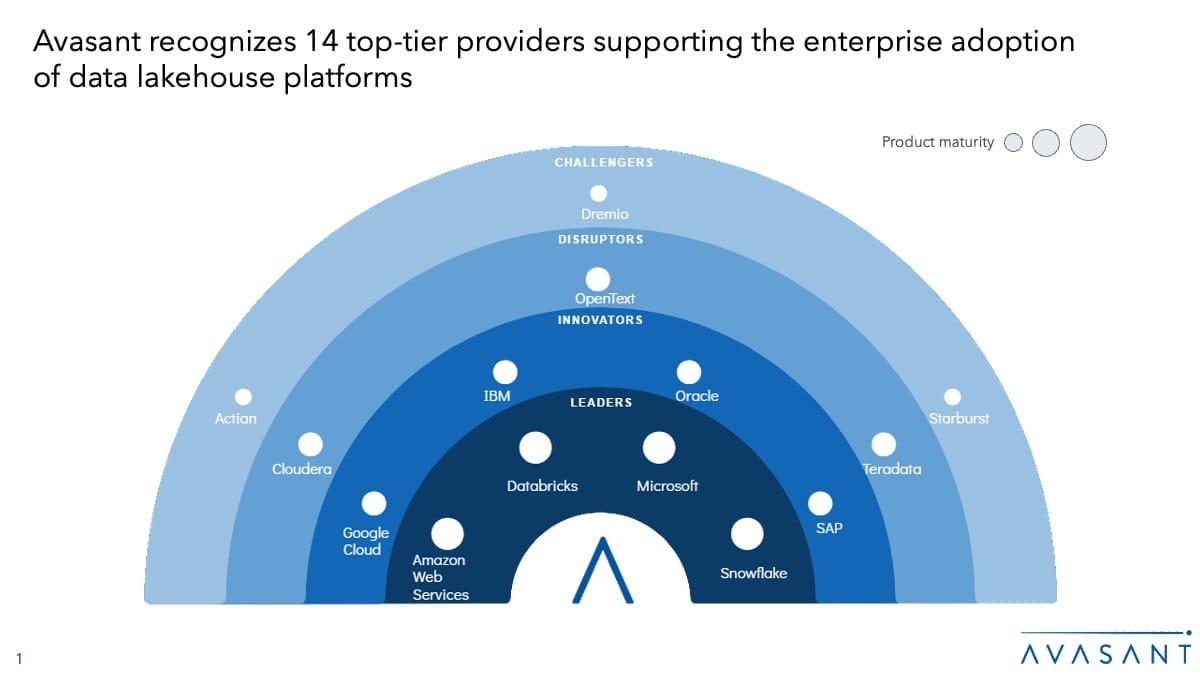
This RadarView includes a detailed analysis of the following data lakehouse platform vendors: Actian, Amazon Web Services, Cloudera, Databricks, Dremio, Google Cloud, IBM, Microsoft, OpenText, Oracle, SAP, Snowflake, Starburst, and Teradata.
Methodology
Our evaluation of platform vendors is based on primary input from the vendors, focused briefings, public disclosures, validation from their clients, and Avasant’s ongoing market interactions. The assessment is across the three dimensions of product maturity, enterprise adaptability, and investments and innovation, leading to our recognition of those platform vendors that have brought the most value to the market over the past 18 months.
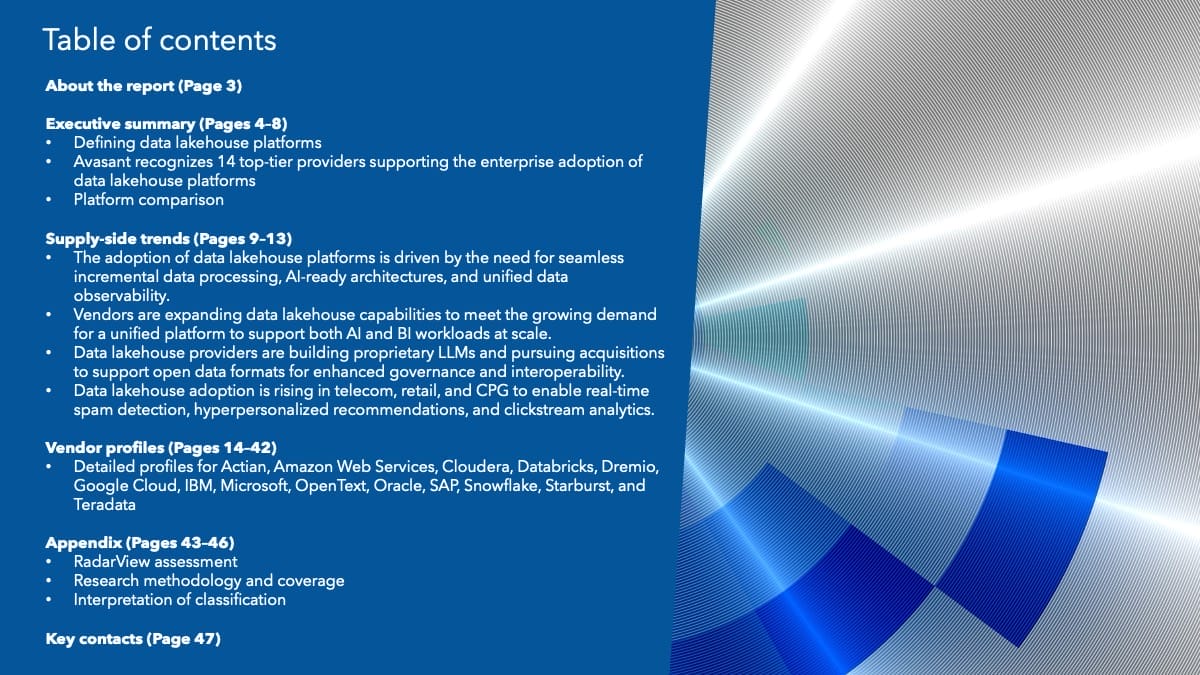
Table of contents
About the report (Pages 3)
Executive summary (Pages 4–8)
-
- Defining data lakehouse platforms
- Avasant recognizes 14 top-tier providers supporting the enterprise adoption of data lakehouse platforms
- Platform comparison
Supply-side trends (Pages 9–13)
-
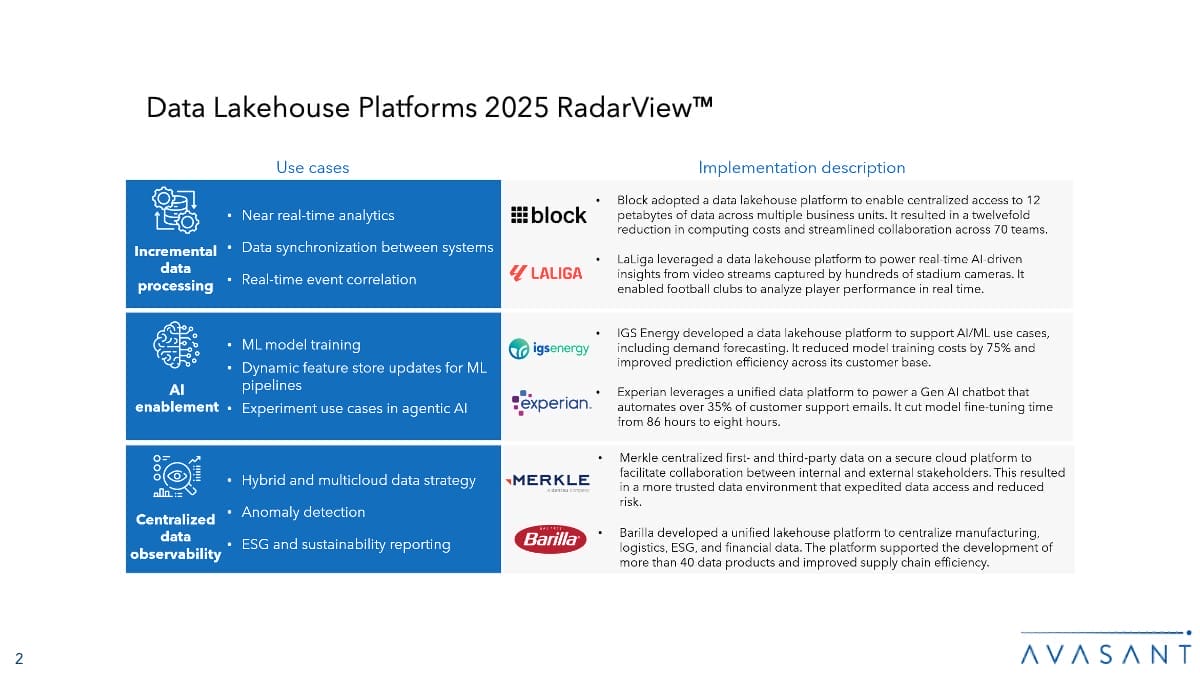
- The adoption of data lakehouse platforms is driven by the need for seamless incremental data processing, AI-ready architectures, and unified data observability.
- Vendors are expanding data lakehouse capabilities to meet the growing demand for a unified platform to support both AI and BI workloads at scale.
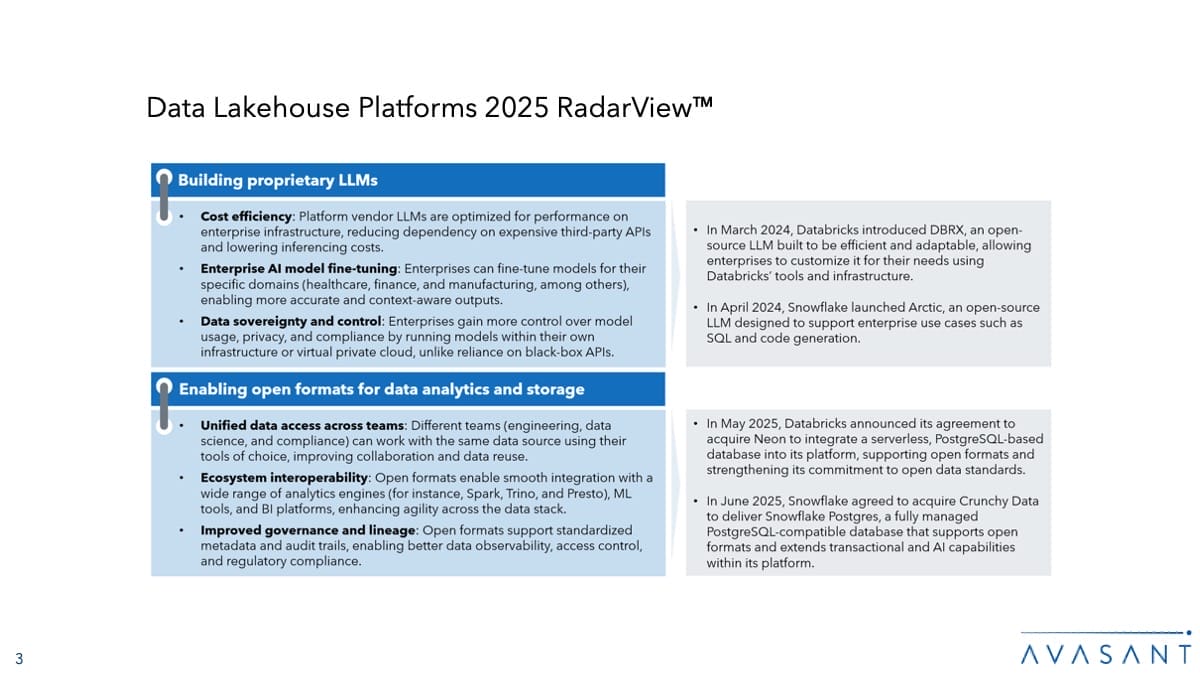
- Data lakehouse providers are building proprietary LLMs and pursuing acquisitions to support open data formats for enhanced governance and interoperability.
- Data lakehouse adoption is rising in telecom, retail, and CPG to enable real-time spam detection, hyperpersonalized recommendations, and clickstream analytics.
Vendor profiles (Pages 14–42)
Detailed profiles for Actian, Amazon Web Services, Cloudera, Databricks, Dremio, Google Cloud, IBM, Microsoft, OpenText, Oracle, SAP, Snowflake, Starburst, and Teradata
Appendix (Pages 43–46)
-
- RadarView assessment
- Research methodology and coverage
- Interpretation of classification
Key contacts (Page 47)
Read the Research Byte based on this report.