Reports
Showing 1105–1120 of 4763 results
-

Pioneering Innovation In Global Capability Centers: Insights and Success Stories
The report Pioneering Innovation In Global Capability Centers: Insights and Success Stories, explores the significant role of Global Capability Centers (GCCs) in driving business growth and innovation. It highlights the evolution of GCCs from operational support units to strategic hubs, particularly in India, which hosts over 1,700 GCCs employing more than 2 million professionals. GCCs in India have been growing at an average of over 60 new centers established each year until 2024. The report showcases various success stories and case studies, emphasizing the importance of collaboration with tech innovators, startups, and government authorities in fostering innovation and achieving key breakthroughs.
December, 2024
-

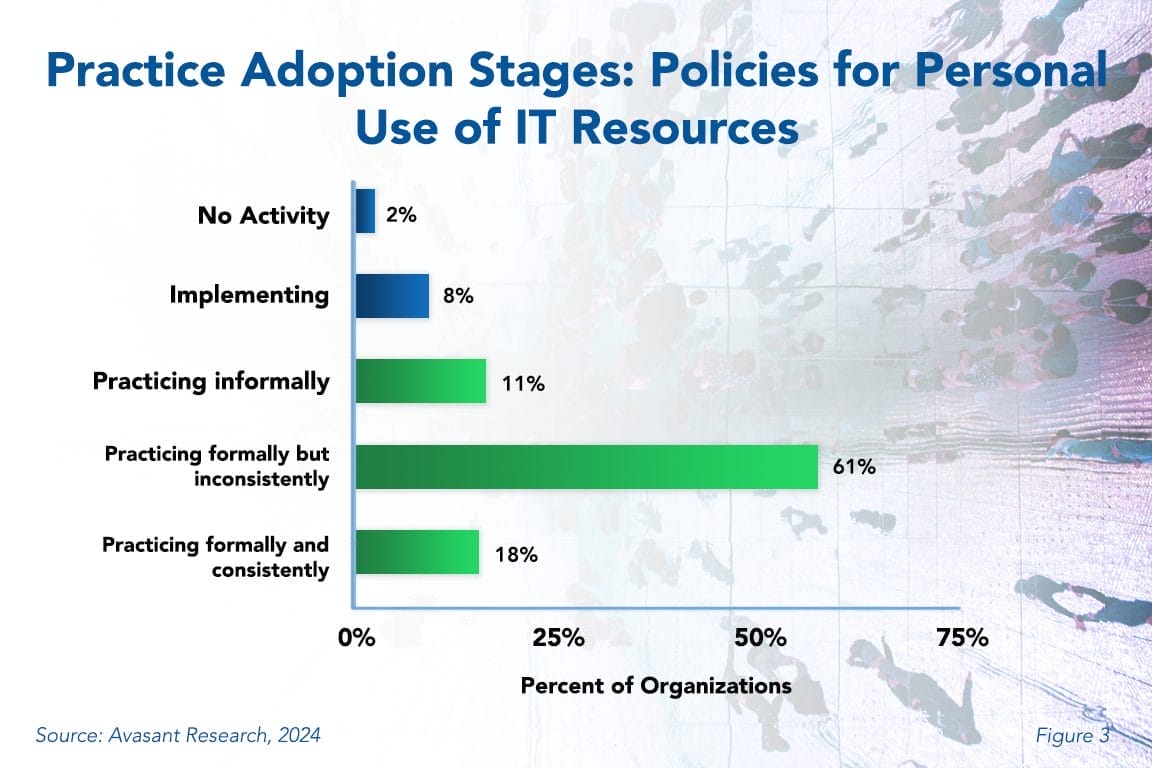
Policies for Personal Use of IT Resources Best Practices 2024
Policies for personal use of IT resources are policies that explicitly restrict or permit use of the organization’s IT resources for personal reasons. The good news is that 90% of survey respondents have adopted personal-use policies, at various levels of commitment. However, despite high adoption, not all companies consistently and formally practice them. This Research Byte summarizes our full report on policies for personal use as a best practice.
January, 2024
-

Policy Harmonization for IT Procurement: Alignment Across Entities
Despite the European Union’s push for smarter procurement, over 55% of public tenders still prioritize price alone—leaving innovation and sustainability on the sidelines. This signals a pressing need for harmonized IT procurement policies that unlock broader strategic value. When aligned across entities, IT procurement policies can deliver powerful outcomes: cost savings, lower compliance risks, streamlined operations, and accelerated innovation. For organizations operating across diverse structures—whether multinational corporations, government agencies, or academic institutions—policy harmonization isn’t just beneficial, it’s essential.
October, 2025
-

Post-Merger IT Contract Governance: A Strategic Blueprint for Value Realization
Digital engineering is undergoing a paradigm shift, fueled by the infusion of AI, cloud, IoT, and edge computing across industries. From transforming vehicles into rolling computers to enabling immersive media experiences and reshaping healthcare delivery, AI is no longer an auxiliary tool; it has become the foundation of innovation. This wave is not just about incremental gains; it is redefining industries, business models, and consumer experiences at scale.
September, 2025
-

Power is the New Procurement: Buying Compute + Kilowatts Together
As AI workloads scale, the true cost of compute is no longer measured in tokens or instances; it is measured in kilowatts, carbon intensity, and latency thresholds. This shift demands a new commercial playbook where energy becomes a first-class contract term. Enterprises must now co-price compute with power, embed energy-indexed clauses, and negotiate for sustainability-linked incentives. Avasant’s AI Contract Intelligence framework helps organizations future-proof their sourcing strategies by integrating energy terms across the compute stack, from hardware to application. The result: predictable costs, assured capacity, and measurable ESG impact.
September, 2025
-

Powering Resilience: Strengthening Supply Chains in the Age of Grid Strain and AI Expansion
In today’s hyperconnected economy, supply chains are only as strong as the infrastructure that powers them. Yet, the U.S. electricity grid—much of it built in the mid-20th century—is buckling under the dual pressures of aging infrastructure and surging demand from AI-driven data centers. The Energy Information Administration (EIA) projects global electricity demand could increase by about one-third to three-quarters by 2050, depending on the case . As AI becomes a cornerstone of modern business operations, its energy appetite is reshaping the grid and exposing vulnerabilities that could ripple across global supply chains. For C-level executives, the question is no longer if disruptions will occur, but how to prepare. Can AI, paradoxically, be both the disruptor and the solution? How can C – Level executives leverage AI to future-proof their supply chains against energy volatility and infrastructure fragility?
October, 2025
-

Powering the Next Generation of Freight and Logistics with Innovative Technology
Freight and logistics companies are leveraging digital platforms, automation, and demand forecasting to enhance operational efficiency, real-time visibility, and last-mile delivery optimization. They are broadening service offerings, collaborating with partners, and acquiring companies to strengthen their capabilities, including managing digital freight marketplaces and adopting eco-friendly technologies. Additionally, they are using blockchain for secure tracking, automation for improved productivity, and big data for resilient supply chains while strategically planning to reduce environmental impact and operational costs. Freight and logistics enterprises collaborate with service providers for digital transformation, which requires strong technological expertise and delivery capabilities.
August, 2024
-

Pre-Merger Contract Assessment
In mergers and acquisitions (M&A), pre-merger contract assessment is a critical step in due diligence. Before any deal is finalised, organisations must thoroughly review existing contracts to identify risks, obligations, and opportunities that could impact the transaction’s success. This process ensures that both legal and financial exposures are understood, regulatory requirements are met, and integration planning is informed by accurate information. By focusing on contract assessment early, companies can avoid costly surprises and lay the groundwork for a successful merger or acquisition.
October, 2025
-

Prismforce: Meeting the Needs of the Talent Supply Chain Ecosystem
IT and tech services companies with hundreds of development projects have always had difficulty matching developer skills with open jobs. One of the companies tackling this talent supply chain morass is Prismforce. Prismforce is a US-India startup that provides a SaaS platform designed to address the talent supply chain challenges faced by IT and tech services. Prismforce has already garnered the trust of over 20 top-tier IT services and tech companies, boasting about 500,000 users on its platform. It is a Tech Innovator to watch.
June, 2024
-

Proactive Compliance Management in Life Sciences: Leveraging AI for Early Risk Detection
Life sciences organizations operate in some of the most stringent regulatory environments globally, governed by frameworks such as the FDA, EMA, cGMP, and GxP, as well as data integrity standards. Maintaining compliance is essential not only for regulatory approval but also for ensuring product quality, patient safety, and corporate reputation. Traditional compliance processes are often reactive, heavily manual, and data-fragmented—making it difficult to anticipate risks before they result in violations. Predictive identification of compliance risks, enabled by artificial intelligence (AI), offers a significant shift in approach. By leveraging historical audit and operational data, AI models can identify patterns and signals of potential noncompliance, enabling proactive intervention and continuous quality improvement.
December, 2025
-

Proactive Risk Management in Complex Vendor Networks
Working with multiple vendors offers key advantages, such as cost savings and quality improvements. More importantly, engaging multiple vendors helps reduce reliance on a single supplier, which protects the organization from potential supply chain disruptions, financial instability, or operational failures on behalf of one vendor. However, this benefit comes with the challenge of managing a more complex network of vendor relationships. To mitigate risks effectively in a multi-vendor environment, businesses need clear contract management, strategic vendor selection, greater transparency, and rigorous performance monitoring. Balancing risk reduction with operational efficiency is key to ensuring successful mitigation without disrupting the organization.
July, 2025
-

Process Transformation for Compliant, Cost-Efficient, and Employee-Centered Payroll
Payroll is a backend, internal business function with the sole objective of paying people in an accurate and timely manner. Hence, process transformation has never been the topmost priority for payroll professionals. Lately, businesses are transforming their people, processes, and technology to improve compliance and costs and manage ancillary priorities such as unifying global payroll operations, generating payroll insights, improving employee experience, and facilitating seamless employee mobility. Companies are increasingly partnering with payroll service providers to consolidate their vendor base, improve digital adoption, and offer on-demand payroll. As a result, the number of active clients of payroll business process transformation service providers has increased by 21% between June 2022–June 2023. Both demand- and supply-side trends are covered in Avasant’s Payroll Business Process Transformation 2023–2024 Market Insights™ and Payroll Business Process Transformation 2023–2024 RadarView™, respectively.
November, 2023
-

Process Transformation for Value-Based, Cost-Efficient, and Coordinated Clinical and Care Management Services
The healthcare industry is shifting towards a more coordinated and patient-centered approach. The global population is aging, raising the nurse demand and creating a nursing shortage. Due to rising healthcare costs, healthcare payers and providers are seeking ways to manage costs. These factors have led to a surge in demand for clinical and care management services, as evidenced by a 13% revenue increase and a 23% active client growth for clinical and care management service providers from December 2022 to December 2023.
June, 2024
-

Procurement Alchemy: Turning Compliance into Human Rights Gold
Human rights due diligence in procurement is not just a moral imperative but a legal necessity. Companies are increasingly held accountable for ensuring their supply chains are free from human rights abuses. This growing awareness is driven by international standards and local laws that mandate businesses to take proactive steps in identifying, preventing, and mitigating human rights risks within their supply chains. The importance of human rights due diligence cannot be overstated, as it safeguards the dignity and rights of individuals while protecting companies from reputational and legal risks.
May, 2025
-

Procurement Budgets, Staffing, and Process Metrics 2024/2025: Chapter 1: Executive Summary
This chapter provides an overview of the key findings from the full study and describes the contents of the subsequent chapters. It also includes information on the study participants and the survey methodology.
September, 2024
-

Procurement Budgets, Staffing, and Process Metrics 2024/2025: Chapter 10: Process Manufacturing
Chapter 10 provides benchmarks for process manufacturers. Process manufacturers are defined as those where the production process adds value by mixing, separating, forming, or chemical reaction. The sector includes manufacturers of chemicals, petrochemicals, semiconductors, pharmaceuticals, dietary supplements, food and beverage products, cosmetics, building materials, packaging materials, steel, glass, paper products, and other process-manufactured goods. The 18 organizations in this sample range from $600 million to over $31 billion in annual revenue.
September, 2024