Areas of Interest
Content Type
Industries
- Aerospace and defense
- Banking, Financial Services, and Insurance
- Energy and Resources
- Federal Government
- Healthcare and life sciences
- High-tech and telecommunications
- Higher Education
- Media and entertainment
- Private equity
- Public Sector
- Retail and manufacturing
- Social Impact Institutions
- Travel and transportation
Technologies
- Artificial Intelligence
- Automation
- Blockchain
- Business and data analytics
- Cloud
- Customer relationship management (CRM)
- Cybersecurity
- Digital Services
- Enterprise resource planning (ERP)
- Human capital management (HCM)
- Internet Of Things
- Machine Learning
- Networking
- Supply chain management (SCM)
- Virtual reality/Augmented reality
Areas of Interest


Latest Reports
IT Spending and Staffing Benchmarks 2022/2023: Chapter 20: Media and Information Services Sector Benchmarks
Chapter 20 provides benchmarks for the media and information services sector. The sector includes publishing, broadcasting, entertainment, and digital media organizations, as well as other media and information services companies. The 13 respondents in the sample have annual revenues ranging in size from about $50 million to around $50 billion.
IT Spending and Staffing Benchmarks 2022/2023: Chapter 21: High-Tech Subsector Benchmarks
Chapter 21 provides benchmarks for high-tech companies. The category includes computer products manufacturers, telecommunications equipment manufacturers, semiconductor manufacturers, aerospace and defense manufacturers, pharmaceutical makers, biotechnology product makers, software developers, software-as-a-service providers, and other high-tech companies. The 24 respondents in this sample range in size from a minimum of about $50 million to $50 billion in revenue.
IT Spending and Staffing Benchmarks 2022/2023: Chapter 22: Food and Beverage Subsector Benchmarks
Chapter 22 provides benchmarks for food and beverage manufacturers. The 23 respondents in the sample range in size from about $65 million to $60 billion in annual revenue. Food and beverage companies produce beverages, snack foods, meat products, seafood products, dairy products, dietary supplements, and other consumable food products. Some are suppliers to other food manufacturers or to the food service industry, while many also distribute consumer products to retailers or direct to consumers.
IT Spending and Staffing Benchmarks 2022/2023: Chapter 23: Industrial and Automotive Subsector Benchmarks
Chapter 23 provides benchmarks for industrial and automotive manufacturers. The 31 respondents in this subsector make auto parts, aviation products, material handling equipment, engines, machinery, vehicles, and similar capital goods. The manufacturers in the sample range in size from about $50 million to over $100 billion in annual revenue.
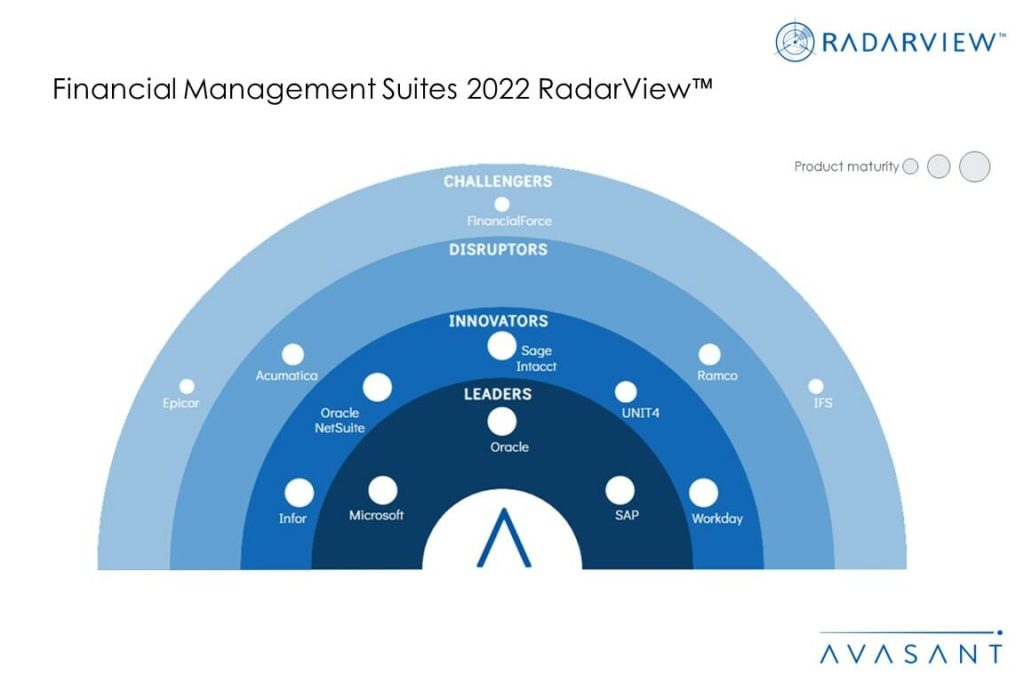
Factors Driving Adoption of Next-Generation Financial Management Systems
Financial management system vendors continue to see strong adoption of their next-generation suites. Customers are looking for new solutions to handle core financial processes, improve financial reporting, comply with changing regulatory requirements, and improve the accuracy of forecasting and budgeting. Vendors are also incorporating new functionality based on artificial intelligence, machine learning, robotic process automation, and optical character recognition to help enterprises detect anomalies, solve industry-specific challenges, and automate financial processes. These trends, and others, are covered in our Financial Management Suites 2022 RadarView™.
Financial Management Suites 2022 RadarView™
The Financial Management Suites 2022 RadarView™ addresses the need for enterprises to optimize their financial processes with a unified financial platform and identify the right financial management system vendors. The 51-page report also provides our point of view on how financial management suite vendors are serving the changing needs of organizations through a wide portfolio of products and services, thus delivering a general ranking based on key dimensions of product maturity, enterprise adaptability, and innovation road map.
IT Spending and Staffing Benchmarks 2022/2023: Chapter 30: Government Agency Subsector Benchmarks
Chapter 30 provides benchmarks for federal, state, and regional government agencies. The category includes public health agencies, courts and law enforcement agencies, organizations that provide IT services to government agencies, social service agencies, state parks, and other federal, state, and regional government units. The 23 respondents in the sample have operating budgets that range in size from about $62 million to about $40 billion.
IT Spending and Staffing Benchmarks 2022/2023: Chapter 32: Higher Education Subsector Benchmarks
Chapter 32 provides benchmarks for higher-education institutions. The sector includes public and private colleges and universities, research universities, business and medical schools, and for-profit institutions. The 21 respondents in the sample have annual revenues ranging in size from about $50 million to about $1.7 billion.

Embracing the Hybrid Workplace with a Cloud-first Strategy
During the pandemic, organizations quickly transitioned to remote work. But now, as we emerge from the pandemic, organizations need to transition to a more flexible, hybrid work model driven by cloud-enabled digital transformation. The employee experience must be at the center of defining a digital workplace. This Research Byte outlines the things that organizations should do to embrace the digital workplace models of tomorrow and how service providers are helping to facilitate this transformation. We highlight the efforts of one such service provider, Unisys, based on its recent analyst and advisor event.

Kyndryl’s New Strategy for Security and Cloud Services
Kyndryl has been reorganizing its practice areas after its spin-off from IBM’s managed infrastructure services business unit, formerly known as IBM’s Global Technology Services group. This research byte focuses specifically on Kyndryl’s Cloud and Security and Resiliency practices. Through Kyndryl’s webinar about its cloud and security services, we heard from Kris Lovejoy and Harish Grama, the global practice leaders for Security and Resiliency and Cloud, respectively. One common theme that emerged was a shift from an IBM-focused approach to an ecosystem approach involving partners in addition to IBM.