Areas of Interest
Content Type
Industries
- Aerospace and defense
- Banking, Financial Services, and Insurance
- Energy and Resources
- Federal Government
- Healthcare and life sciences
- High-tech and telecommunications
- Higher Education
- Media and entertainment
- Private equity
- Public Sector
- Retail and manufacturing
- Social Impact Institutions
- Travel and transportation
Technologies
- Artificial Intelligence
- Automation
- Blockchain
- Business and data analytics
- Cloud
- Customer relationship management (CRM)
- Cybersecurity
- Digital Services
- Enterprise resource planning (ERP)
- Human capital management (HCM)
- Internet Of Things
- Machine Learning
- Networking
- Supply chain management (SCM)
- Virtual reality/Augmented reality
Areas of Interest


Latest Reports

Digital CX Services 2025 Market Insights™
The Digital CX Services 2025 Market Insights™ assist organizations in identifying important demand-side trends that are expected to have a long-term impact on any digital CX transformation projects. The report also highlights key digital CX transformation challenges that enterprises face today.
Digital CX Services: Driving Scalable, Adaptive CX with Agentic AI Orchestration
Enterprises are increasingly prioritizing the modernization of customer service operations and the optimization of marketing workflows. Evolving global regulations on data privacy, cross-border data transfers, and AI governance are driving demand for compliant, secure, and interoperable digital CX solutions. However, challenges continue to persist in enterprise digital CX adoption due to organizational silos, legacy systems, data complexity, and weak governance. Service providers are addressing these challenges by investing in proprietary platforms, forming strategic partnerships, embedding AI into workflows, and delivering scalable, omnichannel, and personalized CX. They are also advancing from generative AI augmentation to autonomous agentic AI orchestration, deploying domain-specific agents to improve CX workflows.
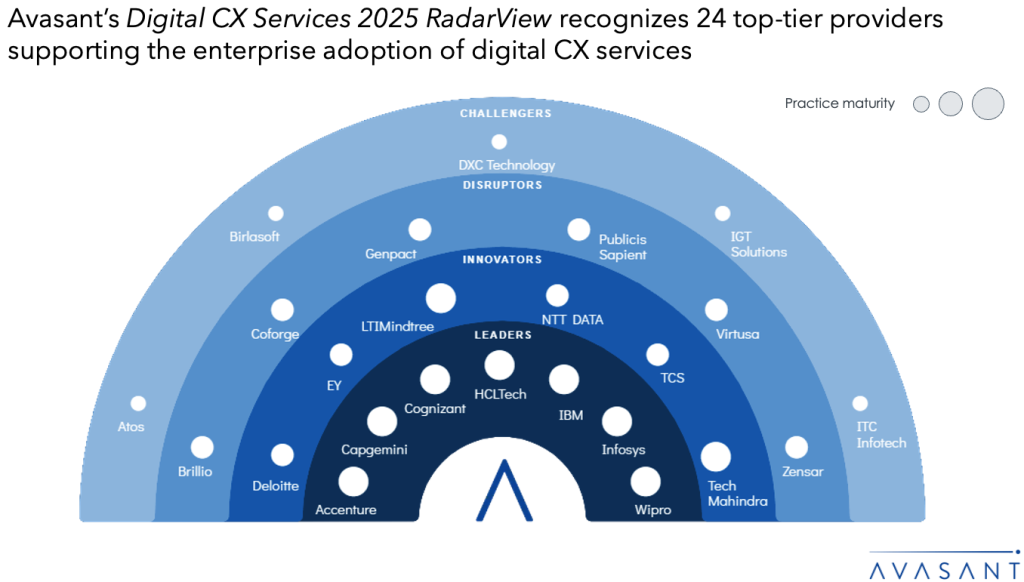
Digital CX Services 2025 RadarView™
The Digital CX Services 2025 RadarView™ assists organizations in identifying strategic partners for digital CX services by offering detailed capability and experience analyses for service providers. It provides a 360-degree view of key digital CX service providers across practice maturity, partner ecosystem, and investments and innovation, thereby supporting enterprises in identifying the right digital CX services partner. The 71-page report highlights top supply-side trends in the digital CX services space and Avasant’s viewpoint on them.
Vendor Discount Report October 2025
The largest and best discounts are often only offered to the vendors’ best customers, and buyers may find it difficult to determine whether the discount offered is typical or whether a better deal can be negotiated. The Vendor Discounts Report is designed to give procurement personnel, lessors, lessees, and departmental manager’s insight and guidance regarding current discount structures on a variety of categories of equipment in the marketplace.
Residual Value Forecast October 2025
Our quarterly Residual Value Forecast (RVF) report provides forecasts for the following categories of IT equipment: desktop computers, laptops, network equipment, printers, servers, storage devices, and other IT equipment. It also includes residual values for other non-IT equipment in the following categories: copiers, material handling equipment (forklifts), mail equipment, medical equipment, test equipment, and miscellaneous equipment such as manufacturing machinery and NC machines. Residual Value Forecasts are provided for five years for end-user, wholesale, and orderly liquidation values (OLV) prices.

Powering Resilience: Strengthening Supply Chains in the Age of Grid Strain and AI Expansion
In today’s hyperconnected economy, supply chains are only as strong as the infrastructure that powers them. Yet, the U.S. electricity grid—much of it built in the mid-20th century—is buckling under the dual pressures of aging infrastructure and surging demand from AI-driven data centers. The Energy Information Administration (EIA) projects global electricity demand could increase by about one-third to three-quarters by 2050, depending on the case . As AI becomes a cornerstone of modern business operations, its energy appetite is reshaping the grid and exposing vulnerabilities that could ripple across global supply chains. For C-level executives, the question is no longer if disruptions will occur, but how to prepare. Can AI, paradoxically, be both the disruptor and the solution? How can C – Level executives leverage AI to future-proof their supply chains against energy volatility and infrastructure fragility?

A Global AI Governance Decalogue for Procurement
With over 70 jurisdictions racing to regulate Artificial Intelligence (AI) systems, procurement leaders face a compliance minefield that could derail innovation and vendor agility. The European Union’s AI Act spans over 140 pages. The U.S. Executive Order on “Safe, Secure, and Trustworthy AI” adds over 30 pages. Brazil, China, Canada, Singapore, and numerous others are releasing their own legislation — creating a rapidly diversifying global mandate.

Workday HCM Services 2025 Market Insights™
The Workday HCM Services 2025 Market Insights™ assists organizations in identifying important demand-side trends that are expected to have a long-term impact on any Workday HCM project. The report also highlights key challenges that enterprises face today.
Enterprise-Scale AI Adoption Through Workday HCM: From Pilots to Transformation
Enterprises are accelerating the adoption of Workday HCM to standardize HR operations, strengthen compliance, and enable AI-driven workforce insights at scale. Workday’s native AI agents are gaining traction, with early pilots focused on recruiting, payroll accuracy, and employee self-service, where agentic automation delivers clear and measurable efficiency gains. Service providers are embedding AI across the Workday services life cycle, from data readiness and configuration to testing, release management, and continuous optimization. They are also driving enterprise-wide AI adoption, shifting pilots into scaled deployments that deliver sustained workforce transformation.
Workday HCM Services 2025 RadarView™
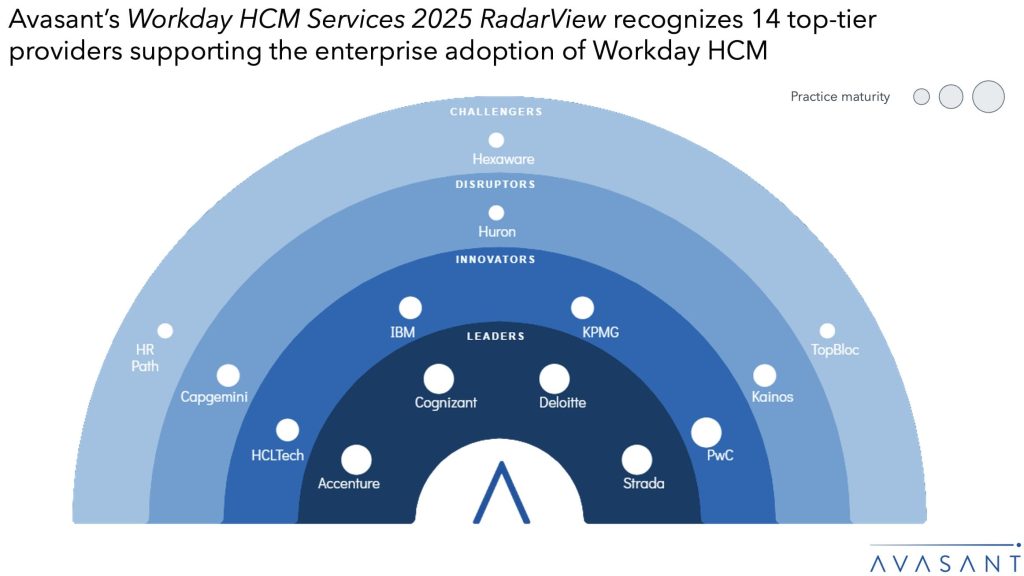
The Workday HCM Services 2025 RadarView™ assists organizations in identifying strategic partners for Workday HCM adoption by offering detailed capability and experience analyses for service providers. It provides a 360-degree view of key Workday HCM service providers across practice maturity, partner ecosystem, and investments and innovation, thereby supporting enterprises in identifying the right Workday HCM services partner. The 49-page report highlights top supply-side trends in the Workday HCM space and Avasant’s viewpoint.