Areas of Interest
Content Type
Industries
- Aerospace and defense
- Banking, Financial Services, and Insurance
- Energy and Resources
- Federal Government
- Healthcare and life sciences
- High-tech and telecommunications
- Higher Education
- Media and entertainment
- Private equity
- Public Sector
- Retail and manufacturing
- Social Impact Institutions
- Travel and transportation
Technologies
- Artificial Intelligence
- Automation
- Blockchain
- Business and data analytics
- Cloud
- Customer relationship management (CRM)
- Cybersecurity
- Digital Services
- Enterprise resource planning (ERP)
- Human capital management (HCM)
- Internet Of Things
- Machine Learning
- Networking
- Supply chain management (SCM)
- Virtual reality/Augmented reality
Areas of Interest


Latest Reports
IT Spending and Staffing Benchmarks 2024/2025: Chapter 15: IT Services and Solutions
Chapter 15 provides IT spending and staffing statistics for the IT services and solutions sector. This category includes software companies, SaaS providers, systems integrators, IT solution providers, business process outsourcing firms, and other providers of IT services and solutions. There are 49 organizations in the sample, ranging in size from around $50 million to over $100 billion in annual revenue.
IT Spending and Staffing Benchmarks 2024/2025: Chapter 13: Transportation and Logistics
Chapter 13 provides benchmarks for the transportation and logistics sector. The 31 respondents in this sample range in size from a minimum of $55 million to over $100 billion. The category includes organizations that operate buses, trucks, railways, airlines, barges, and ships. The sector also includes logistics companies that transport goods, transportation companies, and regional transportation authorities that move people.
Data Center Managed Services: Evaluating Cloud Strategies Amid the Surge in On-Premises Repatriation
Enterprises are reconsidering their cloud strategies due to rising costs, security concerns, and regulatory requirements. To address these challenges, they are implementing cloud repatriation to regain control and enhance performance by moving their workloads to on-premises data centers. On the other hand, service providers are using generative AI to optimize costs with automated infrastructure provisioning, enhance security by predicting threats, and improve compliance through real-time observability and control. Both demand-side and supply-side trends are covered in our Data Center Managed Services 2024 Market Insights™ and Data Center Managed Services 2024 RadarView™, respectively.
Data Center Managed Services 2024 RadarView™
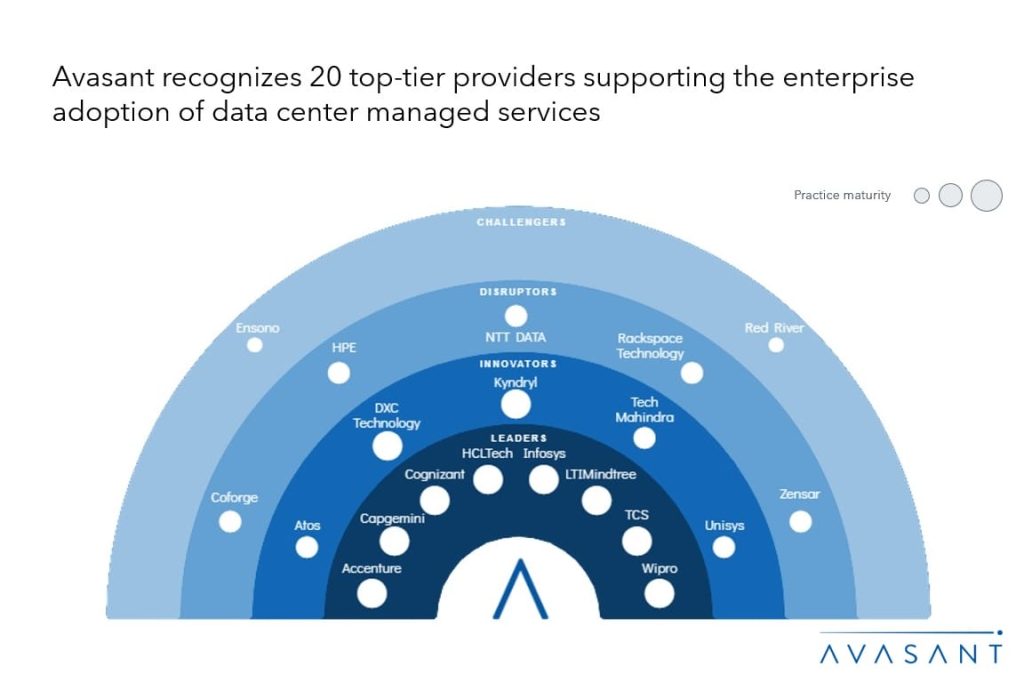
The Data Center Managed Services 2024 RadarView™ assists organizations in identifying strategic partners for data center managed services by offering detailed capability and experience analyses for service providers. It provides a 360-degree view of key data center managed services providers across practice maturity, partner ecosystem, and investments and innovation, thereby supporting enterprises in identifying the right data center managed services partner. The 61-page report highlights top supply-side trends in the data center space and Avasant’s viewpoint on them.
IT Spending and Staffing Benchmarks 2024/2025: Chapter 12: Professional and Technical Services
Chapter 12 provides benchmarks for professional and technical services organizations. The 58 respondents in the sample range in size from a minimum of about $50 million to about $40 billion in annual revenue. The sector includes firms that provide professional and technical services, including engineering, legal, accounting, financial advice, consulting, marketing, research, and other services.
IT Spending and Staffing Benchmarks 2024/2025: Chapter 11: Healthcare Services
Chapter 11 provides benchmarks for healthcare services companies. The 55 respondents in this sector include community hospital groups, multiregional hospital systems, healthcare systems, dental service organizations, university hospitals, long-term care facilities, and other healthcare organizations. These organizations range in size from a minimum of about $50 million to over $20 billion in annual revenue.

IT Spending and Staffing Benchmarks 2024/2025: Chapter 14: Construction and Trade Services
Chapter 10 provides benchmarks for public utilities, oil and gas producers, service companies, and midstream distributors across all organization sizes. The 60 respondents in this sector include public utilities (water, gas, and electric), integrated energy companies, upstream exploration and production companies, natural gas companies, pipeline operators, and other energy and utilities companies. The companies in our sample range in size from a minimum of about $50 million to more than $100 billion in annual revenue.
IT Spending and Staffing Benchmarks 2024/2025: Chapter 10: Energy and Utilities
Chapter 9 provides benchmarks for wholesale distributors. This category includes wholesale distributors of building products, home furnishings, home improvement products, auto parts, industrial components, fuel supply, electronics, food and beverage, and other products. The 49 respondents in the sample range in size from a minimum of about $50 million to $25 billion in revenue.
IT Spending and Staffing Benchmarks 2024/2025: Chapter 8: Retail
Chapter 8 provides benchmarks for retailers. This sector includes retailers of clothing, jewelry, hardware, furniture, sports equipment, groceries, pharmaceuticals, and general merchandise. They include department stores, fashion stores, furniture stores, pharmacies, convenience stores, sporting goods stores, and specialty retailers. We also include hospitality and consumer services in this sector. The 62 respondents in the sample range in size from $50 million to over $200 billion in annual revenue.
IT Spending and Staffing Benchmarks 2024/2025: Chapter 6: Banking and Finance
Chapter 6 provides benchmarks for banking and financial services companies. The firms in this sector include commercial banks, investment banks, credit unions, mortgage lenders, consumer finance lenders, and other types of lenders and financial services providers. The 48 respondents in this sector range in size from a minimum of about $50 million to over $75 billion in annual sales.