Areas of Interest
Content Type
Industries
- Aerospace and defense
- Banking, Financial Services, and Insurance
- Energy and Resources
- Federal Government
- Healthcare and life sciences
- High-tech and telecommunications
- Higher Education
- Media and entertainment
- Private equity
- Public Sector
- Retail and manufacturing
- Social Impact Institutions
- Travel and transportation
Technologies
- Artificial Intelligence
- Automation
- Blockchain
- Business and data analytics
- Cloud
- Customer relationship management (CRM)
- Cybersecurity
- Digital Services
- Enterprise resource planning (ERP)
- Human capital management (HCM)
- Internet Of Things
- Machine Learning
- Networking
- Supply chain management (SCM)
- Virtual reality/Augmented reality
Areas of Interest


Latest Reports

Governance, Risk, and Compliance Services 2026 Market Insights™
The Governance, Risk, and Compliance Services 2026 Market Insights™ assists organizations in identifying important demand-side trends that are expected to have a long-term impact on any GRC project. The report also highlights key implementation challenges that enterprises face today.
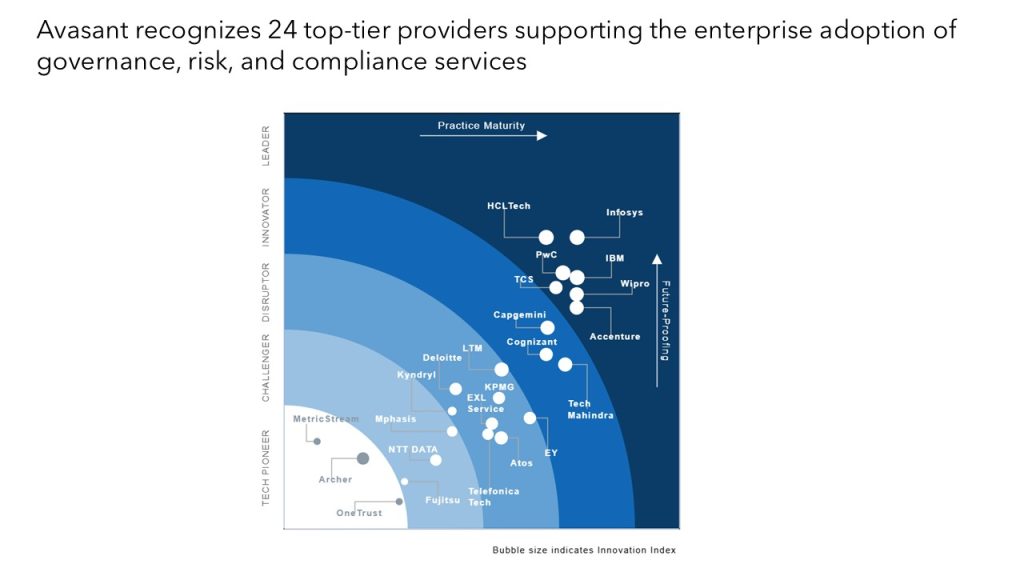
Redefining GRC Services Through AI-Driven Autonomous Operations
Enterprises are moving beyond rule-based automation toward autonomous governance, risk, and compliance (GRC) operations by leveraging generative AI (Gen AI) and agentic AI to automate control testing, streamline third-party risk management, and enable real-time regulatory mapping. At the same time, organizations face intensifying challenges due to increasing regulatory complexity, with mandates such as the EU AI Act, DORA, and ISO 42001 expanding compliance requirements, while fragmented data, legacy tools, and talent gaps continue to hinder GRC execution.
In response, service providers are developing proprietary platforms and partnering with vendors such as ServiceNow, Archer, and MetricStream to embed Gen AI and agentic AI across the GRC life cycle. Additionally, there is a clear focus on consolidating fragmented tools into unified platforms. With nearly 60% of investments directed toward human capital, providers are scaling GRC capabilities through talent development and dedicated GRC and AI governance CoEs.
Both demand-side and supply-side trends are covered in our Governance, Risk, and Compliance Services 2026 Market Insights™ and Governance, Risk, and Compliance Services 2026 RadarView™, respectively.
Governance, Risk, and Compliance Services 2026 RadarView™
The Governance, Risk, and Compliance Services 2026 RadarView™ assists organizations in identifying strategic partners by offering detailed capability and experience analyses of service providers. It provides a 360-degree view of key service providers across practice maturity and future-proofing, including the partner ecosystem and investments and innovations, thereby supporting enterprises in identifying the right partner. The 72-page report highlights top supply-side trends in the GRC services space and Avasant’s viewpoint on them.

Engineering and Construction Digital Services 2026 Market Insights™
The Engineering and Construction Digital Services 2026 Market Insights™ assists organizations in identifying important demand-side trends that are expected to have a long-term impact on any digital project in the engineering and construction industry. The report also highlights key challenges that enterprises face today.
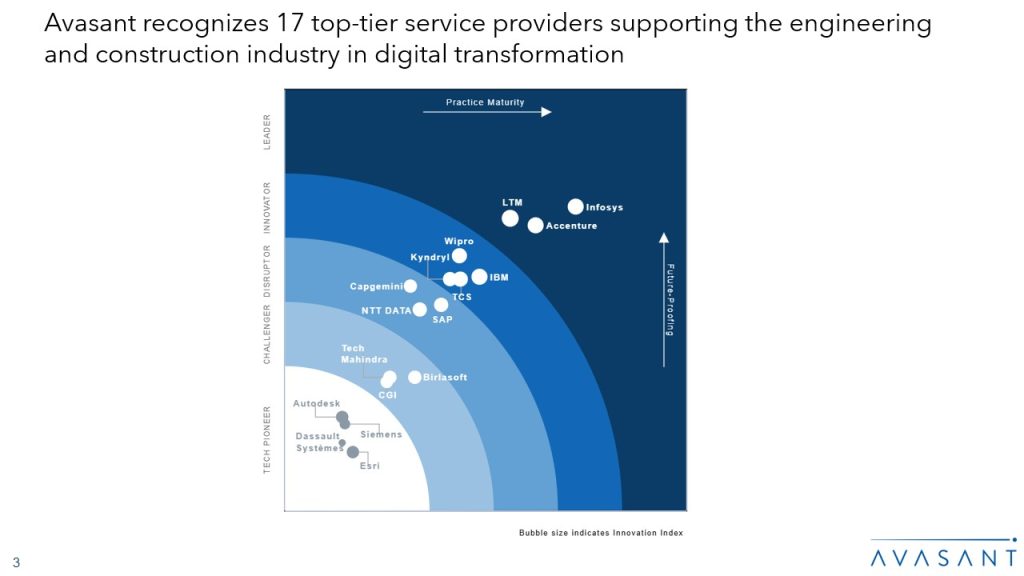
Engineering and Construction Enters a New Phase of AI-Embedded Execution and Industrialized Delivery
Persistent supply chain volatility, skilled labor shortages, accelerating demand for data centers and energy infrastructure, and tightening sustainability mandates are pushing engineering and construction enterprises to deepen their digital transformation. Firms are embedding AI-native platforms into project execution, industrializing delivery through modular and DfMA-led workflows, and scaling digital twins across design, construction, and asset operations. Fragmented systems are giving way to integrated platforms that strengthen cost control, schedule predictability, and procurement resilience. As sustainability shifts from a voluntary differentiator to a compliance-driven baseline, enterprises are adopting carbon tracking, life cycle assessments, and green building standards across project portfolios. To accelerate these initiatives, industry leaders are partnering with digital service providers to embed intelligence across the construction value chain.
Engineering and Construction Digital Services 2026 RadarView™
The Engineering and Construction Digital Services 2026 RadarView™ can help engineering and construction enterprises craft a robust strategy based on industry outlook, best practices, and digital transformation. The report can also help them identify the right partners and service providers to accelerate their digital transformation in this space. The 65-page report also highlights top market trends in the engineering and construction industry and Avasant’s viewpoint.
Generative AI Platforms 2026 Product Assessment™
Avasant’s Generative AI Platforms 2026 Product Assessment™ assists organizations in identifying strategic partners for developing and deploying generative AI solutions by offering detailed capability and experience analyses for 11 platform vendors.

Predictive Risk Stratification for Cost Control in Healthcare
Predictive risk stratification is shifting cost control in healthcare away from retrospective utilization review toward prospective allocation of clinical and operational resources. Instead of analyzing costs after they occur, this approach assigns each patient a probability of future cost or adverse events, enabling healthcare systems to design tiered intervention strategies.

Institutional Stablecoins: Market Infrastructure and Settlement Transformation
Financial market infrastructure is entering a period of structural transformation as institutions seek faster, programmable, and capital-efficient models for global settlement and liquidity movement. Institutional stablecoins combine fiat-backed stability with blockchain-based programmability, enabling near-instant settlement, real-time liquidity mobility, and atomic transfer of value across financial networks. Financial institutions are increasingly exploring stablecoins across treasury management, cross-border settlement, collateral mobility, and tokenized asset markets, supported by growing regulatory clarity and expanding institutional participation.
Residual Value Forecast May 2026
Our quarterly Residual Value Forecast (RVF) report provides forecasts for the following categories of IT equipment: desktop computers, laptops, network equipment, printers, servers, storage devices, and other IT equipment. It also includes residual values for other non-IT equipment in the following categories: copiers, material handling equipment (forklifts), mail equipment, medical equipment, test equipment, and miscellaneous equipment such as manufacturing machinery and NC machines. Residual Value Forecasts are provided for five years for end-user, wholesale, and orderly liquidation values (OLV) prices.