Areas of Interest
Content Type
Industries
- Aerospace and defense
- Banking, Financial Services, and Insurance
- Energy and Resources
- Federal Government
- Healthcare and life sciences
- High-tech and telecommunications
- Higher Education
- Media and entertainment
- Private equity
- Public Sector
- Retail and manufacturing
- Social Impact Institutions
- Travel and transportation
Technologies
- Artificial Intelligence
- Automation
- Blockchain
- Business and data analytics
- Cloud
- Customer relationship management (CRM)
- Cybersecurity
- Digital Services
- Enterprise resource planning (ERP)
- Human capital management (HCM)
- Internet Of Things
- Machine Learning
- Networking
- Supply chain management (SCM)
- Virtual reality/Augmented reality
Areas of Interest


Latest Reports
United Kingdom (UK) Digital Services: Powering National Resilience and Innovation through Next-Gen Digital Solutions
IT and Apps Managed Services Provider Trends: Quarterly Report for CQ1 2025
In this quarterly report (calendar quarter 1, 2025), Avasant provides key information on IT and apps managed services provider trends. The report covers key information on the IT services industry and the provider ecosystem. It covers the service provider facts and figures (including revenue and resource trends) and executive sentiment from the service provider community. The report covers trends across a gamut of IT services, including but not limited to IT infrastructure, application, and end-user services. The geographic coverage for the report is global. It builds on insights gathered through ongoing market research, data collection, and proprietary databases. It includes market data from providers accessed through multiple sources such as public disclosures, market interactions, and deals data.
United Kingdom (UK) Digital Services 2025 RadarView™
The United Kingdom (UK) Digital Services 2025 RadarView™ supports enterprises in shaping a strong digital services strategy by leveraging industry outlook, proven practices, and transformation trends. It also helps identify the right service providers and partners to accelerate digital initiatives. This 96-page report further outlines key supply-side trends in the UK’s digital services landscape, along with Avasant’s perspective.

Leveraging AI for Contract Harmonization – Mergers and Acquisitions
Mergers and acquisitions (M&A) are powerful growth strategies, but they come with significant operational complexity. Among the most critical and often underestimated challenges is contract harmonization: the process of aligning disparate legal agreements across merging entities to ensure consistency, compliance, and operational continuity.

Procurement in Engineering: A Blueprint for Success
Procurement is a fundamental aspect of engineering projects, encompassing the acquisition of essential materials, equipment, and services required to bring a project to fruition. The success of engineering endeavours heavily relies on the efficiency and effectiveness of the procurement process and planning. However, this process and planning is often riddled with challenges like complexity of projects, cost overruns and delay in supply chain that can significantly impact project timelines, budgets, and overall outcomes.
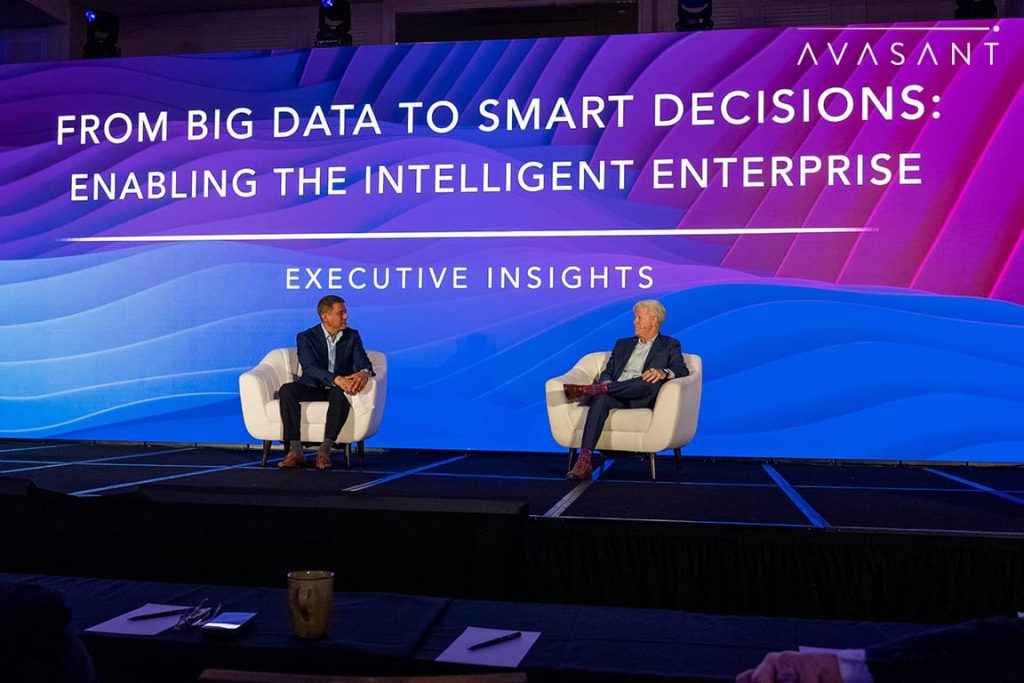
From Big Data to Smart Decisions: Enabling the Intelligent Enterprise
The utility industry is experiencing significant transformation. Traditionally characterized by carbon-intensive generation and a rigid, one-way power grid, it is now at the forefront of digital innovation. Central to this shift is Southern California Edison, a major utility embracing artificial intelligence (AI) and big data to redefine energy production, distribution, and consumption. This article examines how Southern California Edison is leading this change, based on insights from a conversation at Avasant’s Empowering Beyond event between Avasant’s Managing Partner, Henry Guapo, and Todd Inlander, Senior Vice President and Chief Information Officer of Southern California Edison. Their discussion highlights the impact of advanced analytics, intelligent infrastructure, and a dedication to decarbonization on the future of utilities.

From Field Agents to AI-Powered Advisors: How Generative AI and Agentic AI Have Redefined Insurance Distribution

Breaking the Mold: AI-Driven Change in Finance and Insurance
Artificial Intelligence (AI) is no longer a futuristic concept—it is the cornerstone of transformation in the finance and insurance sectors. As digital capabilities become baseline expectations, AI is emerging as the strategic lever that empowers organizations to not only optimize operations, but to fundamentally rearchitect them. Why this change, as AI has evolved from being a competitive advantage to foundational expectations in the finance and insurance industry as it is now deeply embedded in core processes and customer interactions, impacting everything from risk management to personalized service delivery. AI is reshaping how institutions operate, make decisions, and serve customers.

Healthcare Payor Digital Services 2025 Market Insights™
The Healthcare Payor Digital Services 2025 Market Insights™ assists organizations in identifying important demand-side trends that are expected to have a long-term impact on any digital project in the healthcare payor industry. The report also highlights key challenges that enterprises face today.
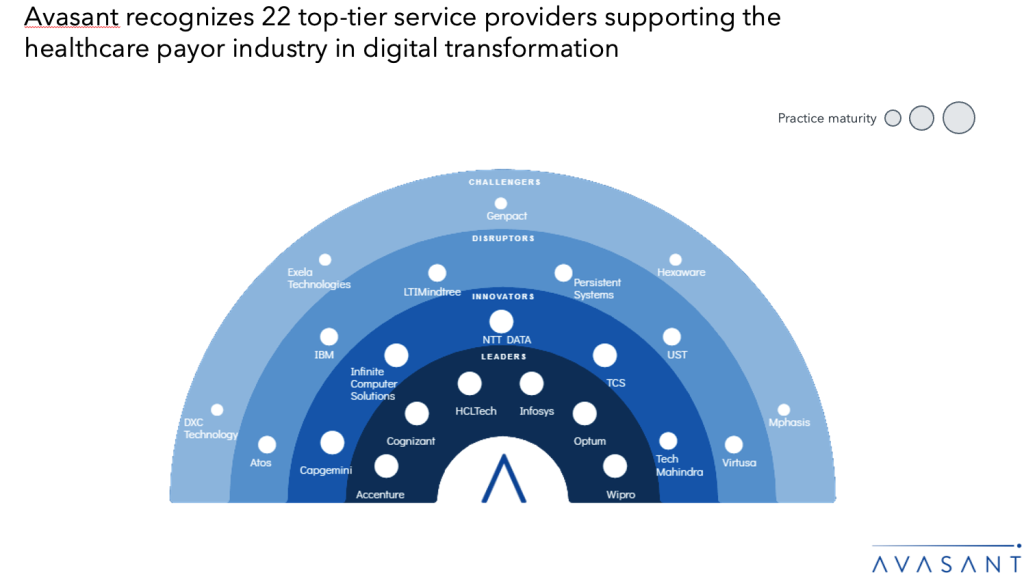
Leveraging Digital Tools to Power Value-based Care and Shared-risk Models
Healthcare payors are rapidly accelerating digital transformation in response to rising costs, regulatory pressures, talent shortage, and the industry’s shift toward value-based care. Central to this transformation is the adoption of AI, automation, and advanced analytics, which streamline administrative workflows, reduce operational costs, and enhance organizational agility. To meet growing interoperability mandates, payors are implementing API-driven architectures and adopting FHIR standards. These efforts are supported by advanced data integration platforms that ensure secure, seamless access to health data across systems. Digital tools are also improving member engagement through AI-powered chatbots, mobile apps, and unified digital portals that deliver personalized experiences and real-time support. Internally, these technologies enable workforce upskilling and foster collaboration, contributing to a more agile, future-ready organization. Meanwhile, collaboration with providers is deepening through the co-design of alternative payment models that align incentives, improve care outcomes, and share financial risk. Together, these digital strategies position payors to thrive in a more connected, value-driven healthcare ecosystem. Both demand-side and supply-side trends are covered in our Healthcare Payor Digital Services 2025 Market Insights™ and Healthcare Payor Digital Services 2025 RadarView™, respectively.