Areas of Interest
Content Type
Industries
- Aerospace and defense
- Banking, Financial Services, and Insurance
- Energy and Resources
- Federal Government
- Healthcare and life sciences
- High-tech and telecommunications
- Higher Education
- Media and entertainment
- Private equity
- Public Sector
- Retail and manufacturing
- Social Impact Institutions
- Travel and transportation
Technologies
- Artificial Intelligence
- Automation
- Blockchain
- Business and data analytics
- Cloud
- Customer relationship management (CRM)
- Cybersecurity
- Digital Services
- Enterprise resource planning (ERP)
- Human capital management (HCM)
- Internet Of Things
- Machine Learning
- Networking
- Supply chain management (SCM)
- Virtual reality/Augmented reality
Areas of Interest


Latest Reports
Residual Value Forecast June 2023
Our quarterly Residual Value Forecast (RVF) report provides forecasts for the following categories of IT equipment: desktop computers, laptops, network equipment, printers, servers, storage devices, and other IT equipment. It also includes residual values for other non-IT equipment in the following categories: copiers, material handling equipment (forklifts), mail equipment, medical equipment, test equipment, and miscellaneous equipment such as manufacturing machinery and NC machines. Residual Value Forecasts are provided for five years for end-user, wholesale, and orderly liquidation values (OLV) prices.
Cybersecurity Services: Shifting from Horizontal to Industry Vertical-Specific Approach
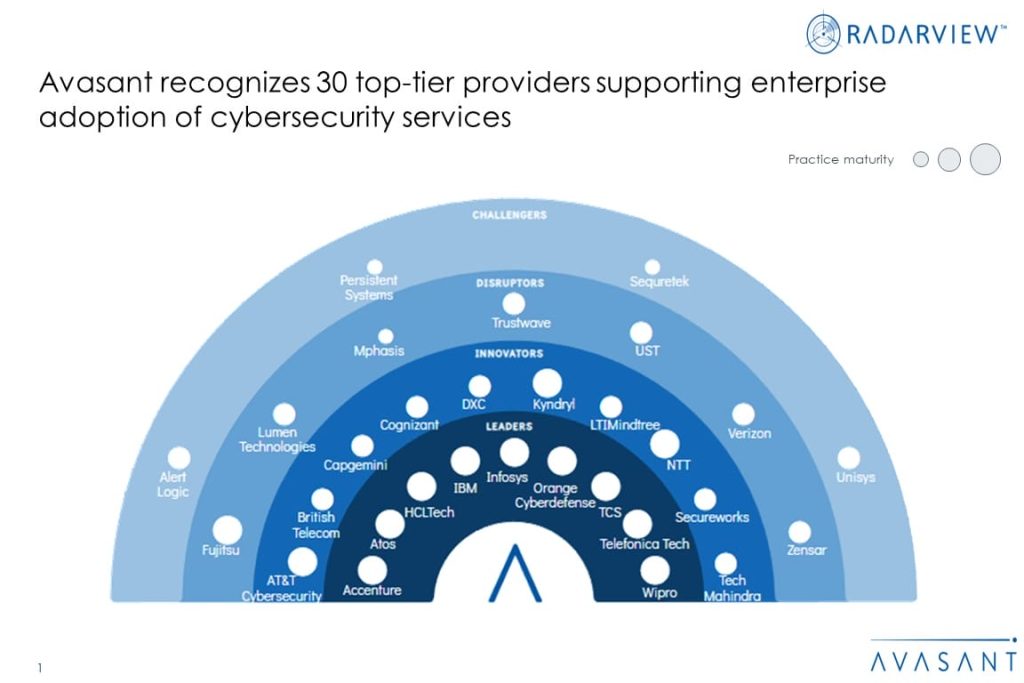
As cyber threats rise, organizations continue to secure their hybrid environments by refreshing, enabling, and standardizing security controls deployment to address trends emerging around cloudification, Industry 4.0, the convergence of 5G, and software-defined networking. This has fundamentally shifted how cybersecurity services are viewed from a general-use horizontal solution to industry vertical-specific offerings. Both demand-side and supply-side trends are covered in our Cybersecurity Services 2023 Market Insights™ and Cybersecurity Services 2023 RadarView™, respectively.

Cybersecurity Services 2023 Market Insights™
The Cybersecurity Services 2023 Market Insights™ assists organizations in identifying important demand-side trends that are expected to have a long-term impact on any cybersecurity projects. The report also highlights key implementation challenges that enterprises face today.

Cybersecurity Services 2023 RadarView™
The Cybersecurity Services 2023 RadarView™ assists organizations in identifying strategic partners for cybersecurity services by offering detailed capability and experience analyses for service providers. It provides a 360-degree view of key cybersecurity services providers across practice maturity, partner ecosystem, and investments and innovation, thereby supporting enterprises in identifying the right cybersecurity services partner. The 83-page report highlights top supply-side trends in the cybersecurity space and Avasant’s viewpoint on them.

SAP SuccessFactors Services 2023 Market Insights™
The SAP SuccessFactors Services 2023 Market Insights™ assists organizations in identifying important demand-side trends that are expected to have a long-term impact on any SAP SuccessFactors migration projects. The report also highlights key challenges that enterprises face.
IT and Apps Managed Services Market Trends: Quarterly Report for CQ1 2023
In this quarterly report (Calendar Qtr 1, 2023), Avasant provides key information on IT Services Solution and Pricing Trends. The report covers market (buyer) perspective, macro trends from service provider community and finally, the pricing, solution and staffing trends in the space. The report covers trends across services including Infrastructure and Cloud Services, Application Services, and Digital Services. The geographic coverage is global, with a larger share of data points from North America. The report builds on insights gathered through our enterprise interactions, ongoing market research and data collection, as well as AvaMark Price Benchmarking database.

SAP SuccessFactors Services 2023 RadarView™
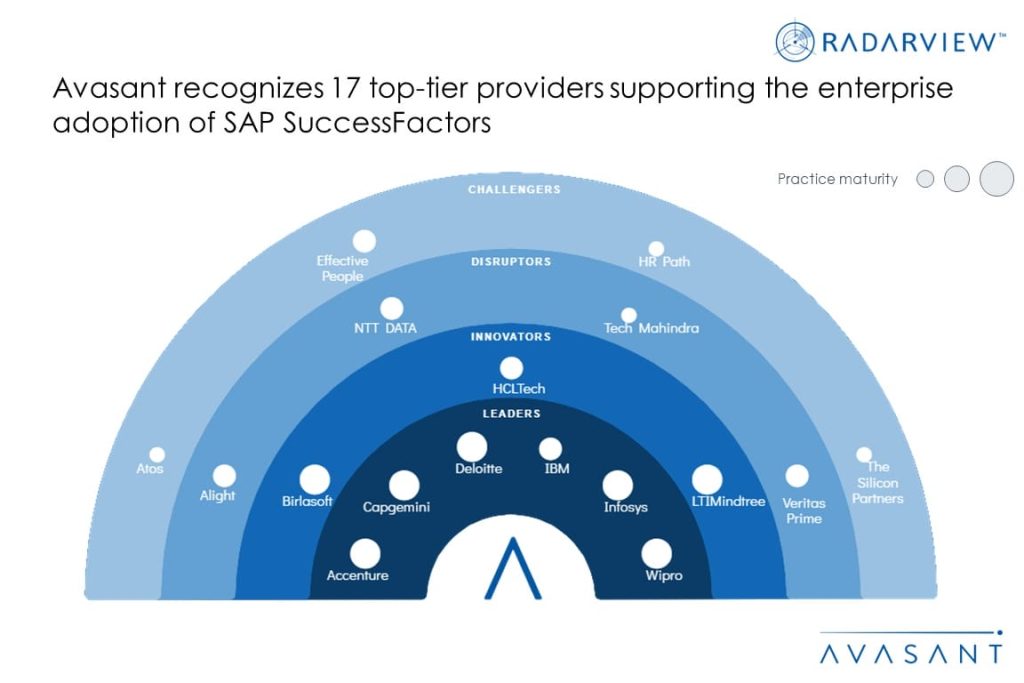
The SAP SuccessFactors Services 2023 RadarView™ assists organizations in identifying strategic partners for adopting SAP SuccessFactors by offering detailed capability and experience analyses for service providers. It provides a 360-degree view of key SAP SuccessFactors service providers across practice maturity, partner ecosystem, and investments and innovation to help enterprises identify the appropriate service partner. The 55-page report also highlights the top supply-side trends in the SAP SuccessFactors services space and Avasant’s viewpoint.
Transforming HR Operations to Improve Productivity and Accountability
Enterprises are replacing their discrete HR solutions with a unified people management platform as it helps address multiple business challenges such as workflow redundancy, data visibility issues, and process inefficiencies. Organizations leverage digital tools and accelerators with modular designs to accelerate their transition to SAP SuccessFactors and address additional use cases such as automated data migration, compliance management, and industry-specific workflow creation. Additionally, enterprises focus on improving scalability and offering employee self-service options. Companies leverage automation solutions and interactive design interfaces to optimize HR functions and improve user adoption. Both demand-side and supply-side trends are covered in our SAP SuccessFactors Services 2023 Market Insights™ and SAP SuccessFactors Services 2023 RadarView™, respectively.
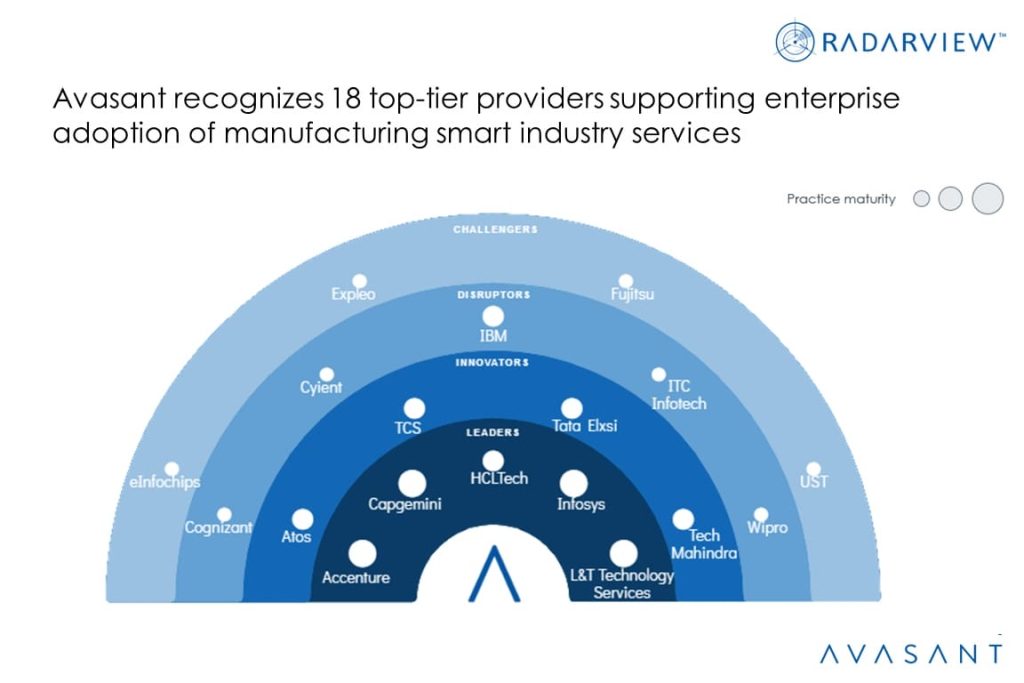
Manufacturing Smart Industry Services: Empowering ER&D Through Digitalization
Engineering and manufacturing enterprises have always had complex IT and OT environments and faced integration challenges. Concerns about security, connectivity, and customization hindered their digitalization efforts. However, due to cost pressures, changing customer demands, and rising product complexity, companies are now actively transforming their processes. This requires digitalizing IT and OT operations and investing in product and software engineering skills. To accelerate their digital transformation, enterprises are engaging with digital engineering service providers, leading to a 15% growth in manufacturing smart industry deals between December 2021 and December 2022. Both demand- and supply-side trends are covered in Avasant’s Manufacturing Smart Industry Services 2023 Market Insights™ and Manufacturing Smart Industry Services 2023 RadarView™, respectively.

Manufacturing Smart Industry Services 2023 Market Insights™
The Manufacturing Smart Industry Services 2023 Market Insights™ assists organizations in identifying important demand-side trends that are expected to have a long-term impact on any smart industry projects. The report also highlights the ER&D domain’s traditional state and its evolution.