Areas of Interest
Content Type
Industries
- Aerospace and defense
- Banking, Financial Services, and Insurance
- Energy and Resources
- Federal Government
- Healthcare and life sciences
- High-tech and telecommunications
- Higher Education
- Media and entertainment
- Private equity
- Public Sector
- Retail and manufacturing
- Social Impact Institutions
- Travel and transportation
Technologies
- Artificial Intelligence
- Automation
- Blockchain
- Business and data analytics
- Cloud
- Customer relationship management (CRM)
- Cybersecurity
- Digital Services
- Enterprise resource planning (ERP)
- Human capital management (HCM)
- Internet Of Things
- Machine Learning
- Networking
- Supply chain management (SCM)
- Virtual reality/Augmented reality
Areas of Interest


Latest Reports

Current Fair Market Values April 2023
The Computer Economics Market Value Reports provide information on the most commonly traded machines and systems at the time the report is published. The values shown are the composites of a range of quotes acquired from sources within the industry deemed reliable, accuracy of the information presented is not guaranteed. Resources are eBay, Insight, NewEgg, CDW, ETB-Tech, Amazon, Savemyserver, TheServerStore, LoadBalancer, NetworkOutlet, Netsyst-Direct, TigerDirect, and others as well as online sales companies and appraisals.
Navigating Network Transformation with the Convergence of SD-WAN and Security
The adoption of managed SD-WAN services has steadily increased in the past couple of years across geographies and industries, driven by a rise in remote work. SD-WAN managed services outsourcing grew by about 40% from 2021 to 2022. Additionally, the enterprise need for network security, effective application, and user and policy optimization is driving joint SD-WAN and SASE implementations. However, businesses still face challenges, such as migration from existing legacy networks, vendor management, and lack of skilled resources, while implementing SD-WAN. These trends, and others, are covered in Avasant’s SD-WAN Managed Services 2022–2023 RadarView™.
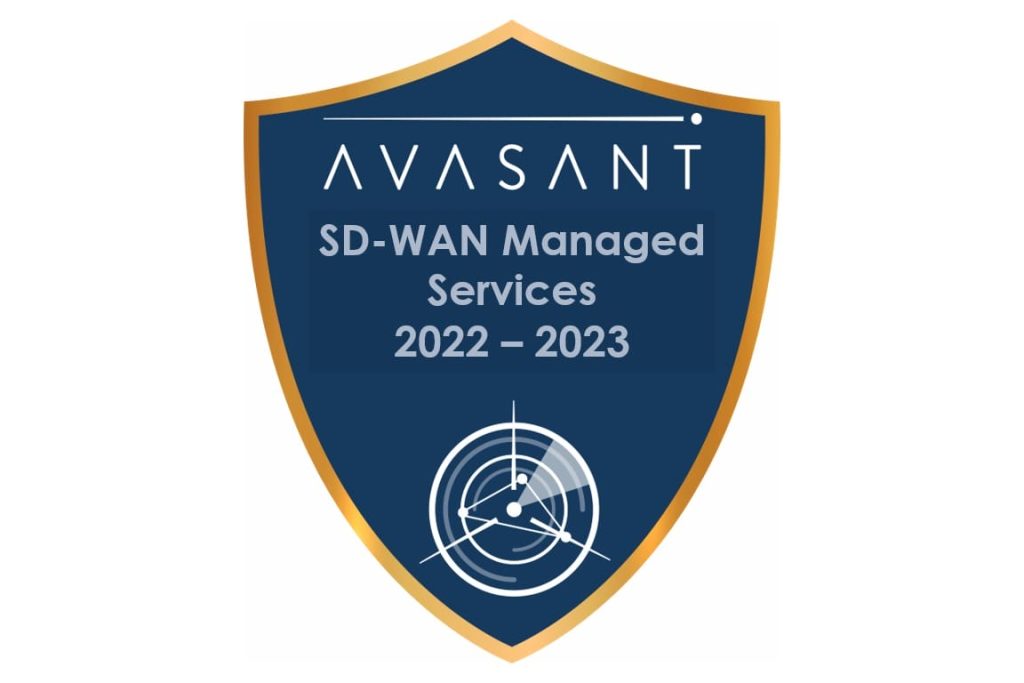
SD-WAN Managed Services 2022–2023 RadarView™
The SD-WAN Managed Services 2022–2023 RadarView™ assists organizations in identifying strategic partners for network transformation by featuring detailed capability and experience analyses of leading service providers. It provides a 360-degree view of key service providers for SD-WAN managed services across practice maturity, partner ecosystem, and investments and innovation, thus supporting enterprises in identifying the right workplace transformation partner. The 75-page report also highlights top industry trends in the SD-WAN outsourcing space and Avasant’s viewpoint on them.
Intelligent Automation Services: Intuitive Automation for Real-Time Decision-Making
Enterprises face challenges in extracting, organizing, and processing high volumes of unstructured data. However, the advancements in AI have significantly expanded the scope of automation by providing new capabilities such as deep learning and generative AI to automate complex, data-driven tasks with high accuracy. Cognitive bots can now process unstructured data, recognize patterns, and make more informed decisions regarding workflows previously considered too complex for automation. By leveraging automation technologies such as RPA, ML, process mining, and AI, organizations can unlock new levels of productivity, innovation, and growth for increasing customer satisfaction and revenue, and gaining a competitive advantage. These trends, and others, are covered in Avasant’s Intelligent Automation Services 2022–2023 RadarView™.
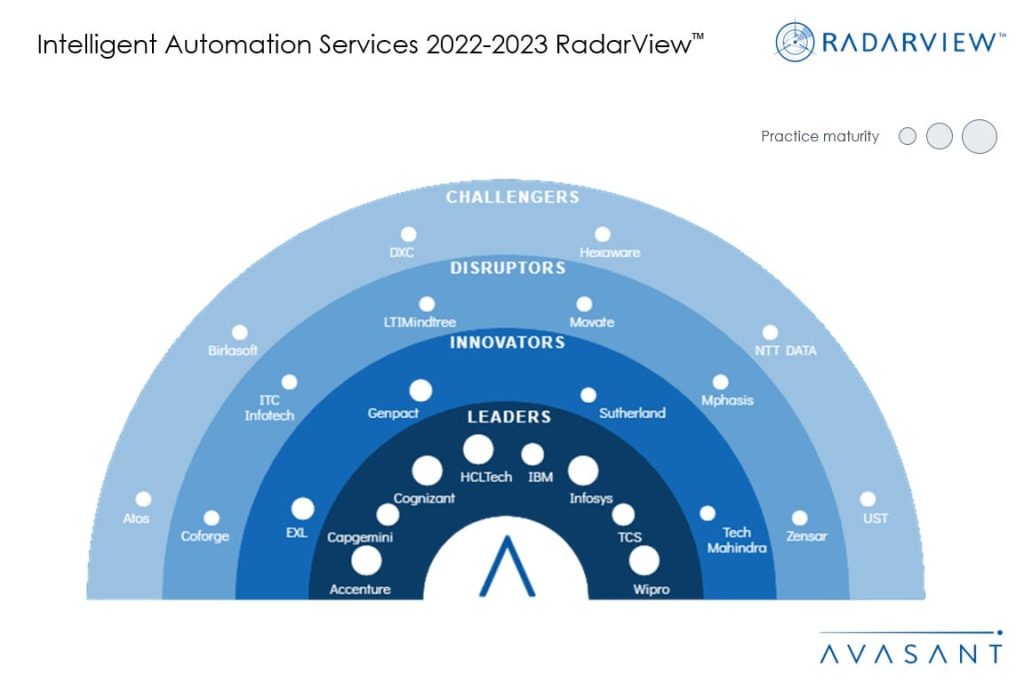
Intelligent Automation Services 2022–2023 RadarView™
The Intelligent Automation Services 2022–2023 RadarView assists organizations in identifying strategic partners for IA by featuring detailed capability and experience analyses of leading service providers. It provides a 360-degree view of key IA service providers across the dimensions of practice maturity, partner ecosystem, and investments and innovation, thus supporting businesses in finding the right IA service partner. The 77-page report also highlights top market trends in the IA space and Avasant’s viewpoint on them.
Enterprise Architecture Tops List of Most Mature Best Practices
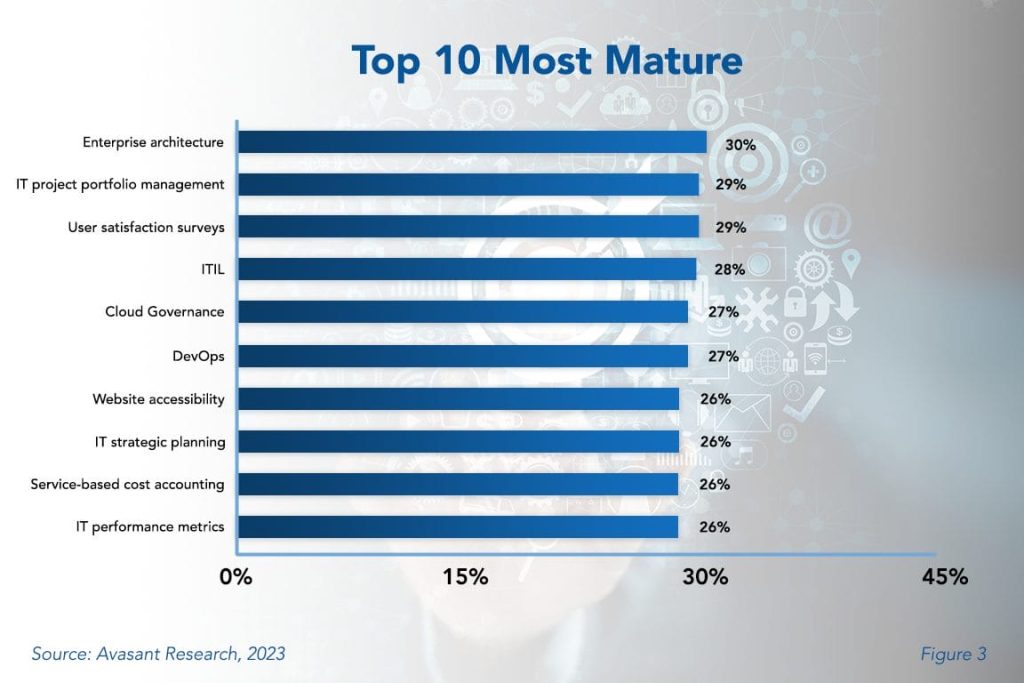
Avasant has released its major annual study on 35 IT management best practices, with enterprise architecture topping our list of most mature practices. This Research Byte highlights some of our findings on the most mature practices, along with an overview of the contents of the full study. The full study analyzes the growth and maturity of all 35 best practices, which are grouped into five major categories: IT governance, IT financial management, IT operational management, IT security and risk management, and application development.
IT Management Best Practices 2023 Sample Pages
The best-run IT organizations not only focus their process improvement efforts on those of other departments, they also seek to optimize their own IT management processes internally. In this study, we examine the growth and maturity of 35 IT management practices, which we have grouped into five major categories: IT governance practices, IT financial management practices, IT operational management practices, IT security and risk management practices, and application development practices.
IT Management Best Practices 2023
The best-run IT organizations not only focus their process improvement efforts on those of other departments, they also seek to optimize their own IT management processes internally. In this study, we examine the growth and maturity of 35 IT management practices, which we have grouped into five major categories: IT governance practices, IT financial management practices, IT operational management practices, IT security and risk management practices, and application development practices.

The Questions to Ask About Telecommuting Before Someone Else Does
Whether allowing work from home is a good idea depends on the organization, the role, how centralized your business is, the strength of your management team, and many other variables. But if you are going to allow more telecommuting, you need certain ducks in a row.

Orange Cyberdefense Reports Changing Trends in Cyber Extortion and Ransomware
Ransomware and cyber extortion are not only becoming more common but more damaging to enterprises. As cyberattacks become more sophisticated, often supported by nation-states, they are leading to high-profile and embarrassing releases of customer data. Orange Cyberdefense, which held an analyst event in Antwerp, Belgium, followed a few days later by a customer and partner event in London, England at the end of November 2022, is countering these threats by providing new managed security services offerings, including increased threat intelligence, and supporting secure access service edge (SASE).