
 Grid View
 List View
-

Empowering Sustainable Transformation with Generative AI and Digital Technologies
Tech-enabled sustainability services are advancing with AI-driven automation and intelligent insights to boost operational efficiency and customer experience. Enterprises are utilizing generative AI, cloud, and data analytics to streamline sustainability efforts, optimize resource use, and ensure regulatory compliance while enhancing transparency and customer trust. Businesses are integrating AI, IoT, and digital twins to improve supply chains to drive circular economy initiatives and increase efficiency. Intelligent energy management solutions are also being deployed across IT and operations to optimize power consumption, increase efficiency, and reduce environmental impact. Additionally, predictive analytics is being leveraged to improve resource planning, minimize waste, and strengthen sustainability performance. Furthermore, to address the climate tech skills gap, enterprises are adopting AI-driven learning modules to train employees in net-zero strategies, energy efficiency, and digital sustainability leadership.
April, 2025
-

Exploring HCLTech’s advances in medical device engineering and healthcare transformation
In the past 12 to 18 months, GenAI has transitioned from pilot projects to full product implementation across the healthcare and life sciences sectors. It is accelerating drug discovery, optimizing clinical trials, and enhancing biomarker identification for precision medicine. AI-driven genomic data platforms are facilitating breakthroughs in personalized healthcare and disease research, while Industry 4.0 technologies are revolutionizing manufacturing through real-time analytics and small-batch production. Moreover, AI is bolstering supply chain resilience with predictive forecasting, blockchain transparency, and diversified supplier networks. On the commercial side, AI-powered engagement strategies, omnichannel marketing, and telemedicine are expanding direct-to-consumer models and improving patient adherence. This shift towards a digital, AI-driven healthcare system enables remote monitoring, self-care guidance, and proactive interventions, all of which contribute to better population health and care delivery while reducing administrative burdens and enhancing workforce efficiency.
May, 2025
-

AR and VR Investment Set to Grow with Expanding Business Use Cases
Although adoption and investment in VR/AR remain relatively low, companies that have embraced these technologies are beginning to report more positive outcomes than in previous years. While widespread adoption may still be on the horizon, enterprises are actively exploring these tools, creating the potential for growing interest and broader implementation in the future. This Research Byte summarizes our full report, Virtual and Augmented Reality Adoption Trends and Customer Experience.
June, 2025
-

Global Competency Center (GCC) Services: Enhancing Control, Digital Adoption, and Driving Innovation
Over the past three years, GCCs have grown rapidly, with India offering significant untapped potential. As they mature, GCCs are becoming strategic assets for monetization, increasingly focusing on innovation and driving demand for digital and ER&D talent and hence, paving the way for innovation hubs. Additionally, collaborations between GCCs and service providers are on the rise, enabling quick scaling of operations and fostering stable partnerships. This evolution offers a clear view of the evolving GCC landscape, emerging opportunities, and the strategic value GCCs can unlock through transformation and innovation.
August, 2025
-

Networks Reimagined: Scalable, Automated, Resilient, And Sustainable
The network is increasingly being seen as a commodity service; in some cases, it is less strategic. Along with this is coming the services mindset, leveraging Network as a Service (NaaS) model to drive on-demand connectivity. Unified network operation center (NOC) and security operation center (SOC) operations are emerging to ensure proactive incident management, business continuity, and compliance across hybrid environments. Organizations are also experimenting with generative AI (Gen AI) and increasingly leveraging agentic AI to enhance monitoring, predictive maintenance, and troubleshooting, resulting in faster detection and more secure operations. Sustainability has become central, with the adoption of energy-efficient devices, renewable-powered infrastructure, and optimized designs to reduce environmental impact. In response, service providers are expanding capabilities with enterprise-wide SASE, zero-trust access, agentic AI-driven NOCs, and intent-based networks, delivering agile, intelligent, and secure networks for the future.
September, 2025
-

Scaling Operational Intelligence and Automation with Gen AI-Infused SAP S/4HANA Transformation
Enterprises are accelerating their SAP S/4HANA transformations to modernize the digital core, enhance operational resilience, and scale Gen AI across end-to-end business processes. Momentum is shifting from strategy design to execution, driven by the urgency to address legacy complexity, strengthen data foundations, and embed automation and decision intelligence where it directly enhances business performance. Sustainability and regulatory alignment are becoming integral priorities, with organizations leveraging S/4HANA to operationalize carbon tracking, ethical sourcing, and audit-ready ESG reporting. To deliver outcomes at scale, service providers play a critical role, bringing guided transformation frameworks, industry-specific assets, automation toolkits, and delivery governance to reduce risk and accelerate value realization.
December, 2025
-
Open Innovation – The Catalyst for Transforming India’s Technology Ecosystem
This report, developed in collaboration with nasscom, assesses the status of Open Innovation (OI) in India and its global context. It explores investments and initiatives by the Indian government, industry bodies, and the private sector to promote OI. The report identifies India’s potential to rank in the top 10 for global innovation, emphasizing OI’s role in addressing local needs, fostering inclusivity, and supporting innovative ventures. It provides recommendations for advancing OI and highlights opportunities for collaboration across sectors, including corporates, academia, and government agencies.
November, 2023
-
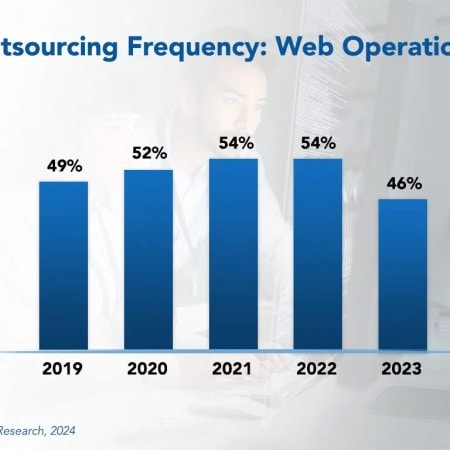
Web Operations Outsourcing Trends and Customer Experience 2024
Web operations outsourcing is one of the most popular types of managed services. Organizations of all kinds continue to expand their efforts in online marketing, website management, and e-commerce. This shift toward web-enabled business processes and e-commerce has prompted many companies to reassess their online strategies. In doing so, many have turned to managed service providers that can provide the needed expertise and a flexible, scalable infrastructure to deliver highly available and reliable web and e-commerce systems.
February, 2024
-
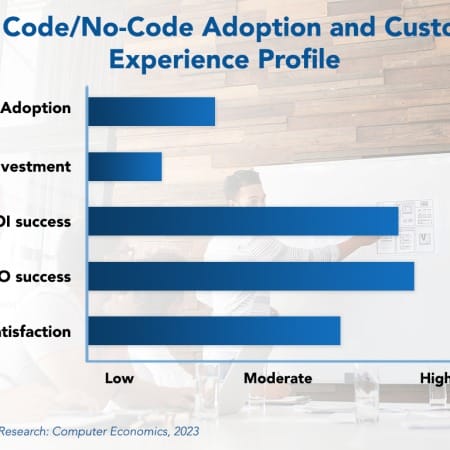
Low-Code/No-Code Adoption Trends and Customer Experience 2024
Low-Code/No-Code (LC/NC) platforms are becoming increasingly popular in enterprise software development. LC/NC enables non-technical users and citizen developers to quickly create software applications with little to no manual coding. Using a visual drag-and-drop interface, pre-built components, and templates, LC/NC platforms allow users to create applications without requiring a high level of coding knowledge. This capability is invaluable for companies of all sizes because it lowers development costs, speeds up development, and improves agility.
January, 2024
-

CRM Adoption Trends and Customer Experience 2025
Customer relationship management (CRM) systems are one of the most widely adopted categories of enterprise applications, and investment in new CRM capabilities continues to grow. Although cloud-based CRM offerings have allowed the capabilities to move down-market to smaller companies, the need to adopt a CRM system signals that a company has reached a milestone in building its application portfolio, similar to when a company first moves from spreadsheets to a real accounting system. Modern CRM systems are essential for companies looking to improve their productivity and effectiveness in sales, marketing, and customer service.
June, 2025
-
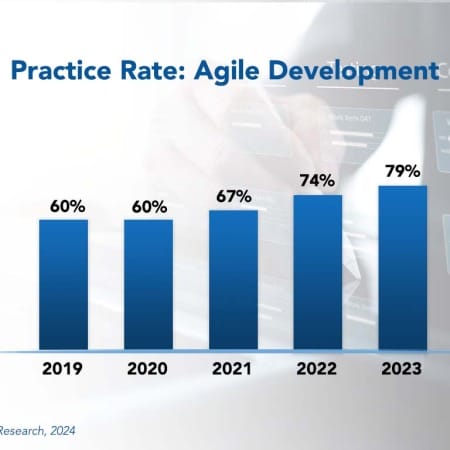
Agile Development Best Practices 2024
SaaS and packaged solutions are incredibly valuable. They help save time and resources in developing and maintaining applications for common back-office processes such as payroll, accounting, ERP, and CRM.
February, 2024
-
IT Spending and Staffing Benchmarks 2023/2024: Chapter 9: Wholesale Distribution Sector Benchmarks
Chapter 9 provides benchmarks for wholesale distributors. The category includes wholesale distributors of building products, home furnishings, home improvement products, auto parts, industrial components, fuel supply, electronics, food and beverage, and other products. The 31 respondents in the sample range in size from a minimum of about $50 million to $10 billion in revenue.
July, 2023
-
IT Spending and Staffing Benchmarks 2023/2024: Chapter 36: Government Agencies Subsector Benchmarks
Chapter 36 provides benchmarks for federal, state, and regional government agencies. The category includes public health agencies, courts and law enforcement agencies, organizations that provide IT services to government agencies, social service agencies, state parks, and other federal, state, and regional government units. The 21 respondents in the sample have operating budgets that range in size from about $62 million to about $40 billion.
July, 2023
-
IT Spending and Staffing Benchmarks 2023/2024: Chapter 33: Professional Services Subsector Benchmarks
Chapter 33 provides benchmarks for professional services organizations. The 20 respondents in the sample range in size from a minimum of about $50 million to about $2 billion in annual revenue. The sector includes firms that provide professional services, including legal, accounting, financial advice, consulting, marketing, and other services.
July, 2023
-

The Rise of Agentic AI: Salesforce Leads the Charge with Agentforce
The market for enterprise-ready, generative AI-driven CRM solutions is rapidly transforming with the emergence of agentic AI. This evolution, from predictive bots to responsive copilots, has culminated in agents that not only generate responses but also take action. At Dreamforce 2024, Salesforce introduced Agentforce, an autonomous AI agent that automates every customer interaction and integrates seamlessly across platforms such as Slack, offering an upgrade over Einstein Copilot. While Salesforce currently leads the way in agentic AI, competitors are swiftly closing the gap. As Gen AI rapidly evolves, enterprises stand to gain from the innovations and advancements made by leading platform vendors.
October, 2024
Areas of Interest
Search results for "" ( 5620 )