
 Grid View
 List View
-

Utilizing Generative AI and Intelligent Automation to Digitize the Consumer Goods Industry
Consumer packaged goods (CPG) companies are increasingly investing in AI-driven marketing technologies to enhance campaign effectiveness, establish brand differentiation, and improve ROI. They are also leveraging IoT solutions to optimize supply chain efficiency and ensure product availability while utilizing blockchain technology to guarantee product authenticity. Moreover, the use of generative AI is helping CPG companies identify new market opportunities and aid in product development. In manufacturing, companies are adopting smart practices like 3D printing, collaborative robots, and AI to reduce operational waste and minimize inventory needs. Additionally, they are rethinking product packaging to meet their ESG goals while maintaining sustainable supply chains for raw material procurement.
December, 2024
-

Despite High Adoption, HCM Systems Fail to Deliver on Satisfaction and ROI
Despite widespread adoption, disappointing satisfaction and return on investment levels plague many human capital management (HCM) implementations. HCM is a core function, but many organizations struggle to realize the full potential of these systems. Is HCM falling short of its initial promise? This Research Byte summarizes the full report, HR/HCM Adoption Trends and Customer Experience.
February, 2025
-

IT Management Staffing Making a Comeback
IT management staffing is making a notable comeback, driven by the demands of AI integration, rising cybersecurity threats, and the evolving needs of the modern workforce. At the heart of this trend lies a story of adaptation and opportunity as businesses strive to balance innovation with the growing demands of modern technology. This Research Byte delves further into current IT management and administration staffing trends.
April, 2025
-

Healthcare Payer BPT: Accelerating Value-Based Care, Digital Transformation, and Member-Centric Strategies
The healthcare payer services industry is undergoing significant transformation, propelled by mounting margin and regulatory pressures, rapid technological advances, and rising member expectations. A rise in hospital and medical expenses, claims adjustment, and administrative expenses have eroded payers’ net income, intensifying the need for operational efficiency. Members now demand integrated, personalized engagement when navigating health benefits, prompting payers and service providers to modernize claims and care management processes. These dynamics have fueled robust growth in healthcare payer business process transformation services, as reflected by a 10%–20% increase in both active clients and revenue growth among service providers during FY 2023–2024. Both demand- and supply-side trends are covered in Avasant’s Healthcare Payer Business Process Transformation 2025 Market Insights™ and Healthcare Payer Business Process Transformation 2025 RadarView™, respectively.
May, 2025
-

App Developers Make Up a Record Low Percentage of IT Staff
In just five years, the proportion of application developers within IT departments has declined sharply from nearly a quarter of the entire IT staff to just over one-tenth. But this notable shift is not necessarily a sign of mass layoffs among application developers. In fact, we have seen no evidence to suggest that fewer developers are working in IT departments. Rather, it signals a change in the overall composition of IT teams and an evolving role for application developers within the organization. This research byte summarizes our full report on application developer staffing ratios.
June, 2025
-

Transforming Engineering and Construction through Intelligent Integration and Execution
Facing rising material costs, labor shortages, supply chain disruptions, and stricter ESG demands, engineering and construction enterprises are accelerating their digital transformation. Companies are turning to modular construction, AI-powered procurement, and robotics to boost efficiency and strengthen operational control. Fragmented systems are being replaced by integrated platforms that improve data coordination and support more informed decisions. As sustainability moves from optional to essential, firms are deploying carbon tracking tools, digital twins, and life cycle assessments to meet regulatory and investor expectations. To scale these initiatives effectively, industry leaders are partnering with digital service providers to drive innovation across the value chain. Both demand-side and supply-side trends are covered in our Engineering and Construction Digital Services 2025 Market Insights™ and Engineering and Construction Digital Services 2025 RadarView™, respectively.
August, 2025
-

Enterprise-Scale AI Adoption Through Workday HCM: From Pilots to Transformation
Enterprises are accelerating the adoption of Workday HCM to standardize HR operations, strengthen compliance, and enable AI-driven workforce insights at scale. Workday’s native AI agents are gaining traction, with early pilots focused on recruiting, payroll accuracy, and employee self-service, where agentic automation delivers clear and measurable efficiency gains. Service providers are embedding AI across the Workday services life cycle, from data readiness and configuration to testing, release management, and continuous optimization. They are also driving enterprise-wide AI adoption, shifting pilots into scaled deployments that deliver sustained workforce transformation.
September, 2025
-

Intelligent Processing Mining Platforms 2024 Market Insights™
The Intelligent Processing Mining Platforms 2024 Market Insights assists organizations in identifying important demand-side trends for navigating the process mining landscape and achieving operational efficiency. The report also highlights the key challenges enterprises face today in this space.
July, 2024
-

LifeSite TokenX: Tracking Physical and Digital Assets with Confidence
When it comes to supply chains, customers have become much more demanding. Consumers want the assurance that the products they receive are genuine. They want to be sure that their luxury goods, such as Chanel purses or Rolex watches, are not knockoffs. Enterprises have the same concerns—and then some. One technology to address this need is tokenization, which refers to the process of creating a digital representation of an individual physical asset on a blockchain. LifeSite Tokenx is an interesting vendor in this space and is a Tech Innovator to watch.
February, 2024
-
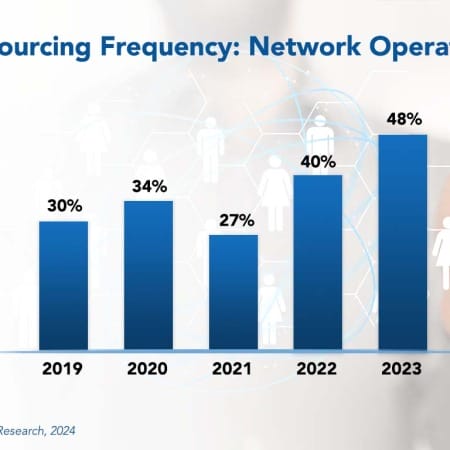
Network Operations Outsourcing Trends and Customer Experience 2024
Network operations outsourcing is an established market. Today, major IT and telecom industry service providers and even disruptive newcomers are competing with regional providers for market share. In the past, large equipment vendors only provided the hardware that serves as the network's backbone. However, these giants are beginning to recognize the potential of value-added network services. Businesses can now obtain dependable infrastructure, along with expert network design, planning, and even network support operations from a single source.
February, 2024
-
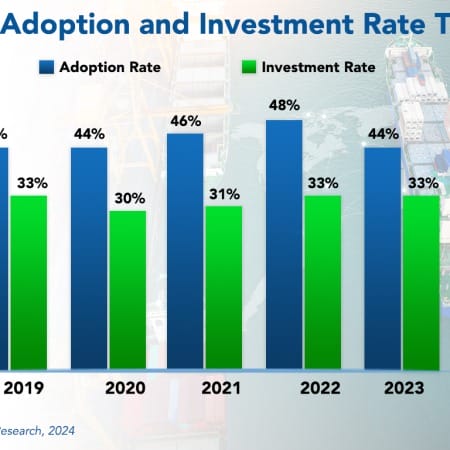
Supply Chain Management Adoption Trends and Customer Experience 2024
Supply chain management (SCM) has become a hot topic in recent years. From grocery shelves running out of toilet paper and cleaning supplies during the pandemic, to shortages of semiconductors leading to auto dealers running out of cars to sell, to cargo ships lined up at the ports of Los Angeles and Long Beach, the term “supply chain” was on everyone’s lips. But given the resolution of global supply chain issues over the past year, what does this mean for future adoption and investments of SCM systems?
February, 2024
-

Data Management and Business Intelligence Staffing Ratios 2025
Organizations are increasingly relying on data-driven strategic decisions to maintain a competitive edge, and the demand for actionable insights is skyrocketing. However, the sheer volume of data, driven by IoT, social media, and e-commerce, is overwhelming existing data management and business intelligence (DMBI) capabilities.
June, 2025
-
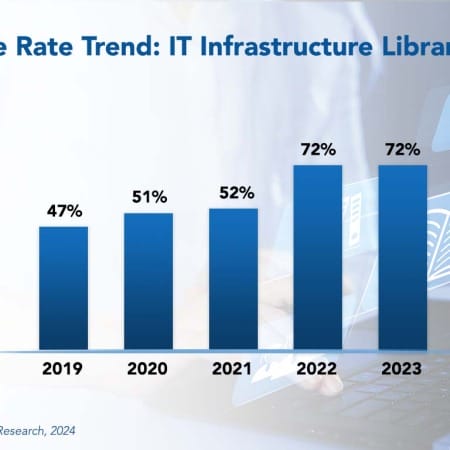
ITIL Best Practices 2024
The Information Technology Infrastructure Library (ITIL) is a framework of best practices and processes designed to assist businesses in supporting, delivering, and improving their IT services. The primary goal of ITIL is to ensure that IT services align with business objectives and customer needs. Frequently adopted ITIL processes include incident management, change management, and problem management.
March, 2024
-
IT Spending and Staffing Benchmarks 2023/2024: Chapter 12: Professional and Technical Services Sector Benchmarks
Chapter 12 provides benchmarks for professional and technical services organizations. The 48 respondents in the sample range in size from a minimum of about $50 million to about $40 billion in annual revenue. The sector includes firms that provide professional and technical services, including engineering, legal, accounting, financial advice, consulting, marketing, research, and other services.
July, 2023
-

IT Spending and Staffing Benchmarks 2023/2024: Chapter 38: Higher Education Subsector Benchmarks
Chapter 38 provides benchmarks for higher-education institutions. The sector includes public and private colleges and universities, research universities, business and medical schools, and for-profit institutions. The 20 respondents in the sample have annual revenues ranging in size from about $50 million to about $8 billion.
July, 2023
Areas of Interest
Search results for "" ( 5620 )