Areas of Interest
Content Type
Industries
- Aerospace and defense
- Banking, Financial Services, and Insurance
- Energy and Resources
- Federal Government
- Healthcare and life sciences
- High-tech and telecommunications
- Higher Education
- Media and entertainment
- Private equity
- Public Sector
- Retail and manufacturing
- Social Impact Institutions
- Travel and transportation
Technologies
- Artificial Intelligence
- Automation
- Blockchain
- Business and data analytics
- Cloud
- Customer relationship management (CRM)
- Cybersecurity
- Digital Services
- Enterprise resource planning (ERP)
- Human capital management (HCM)
- Internet Of Things
- Machine Learning
- Networking
- Supply chain management (SCM)
- Virtual reality/Augmented reality
Areas of Interest


Latest Reports
HR Process Transformation to Build an Employee-Centric Culture
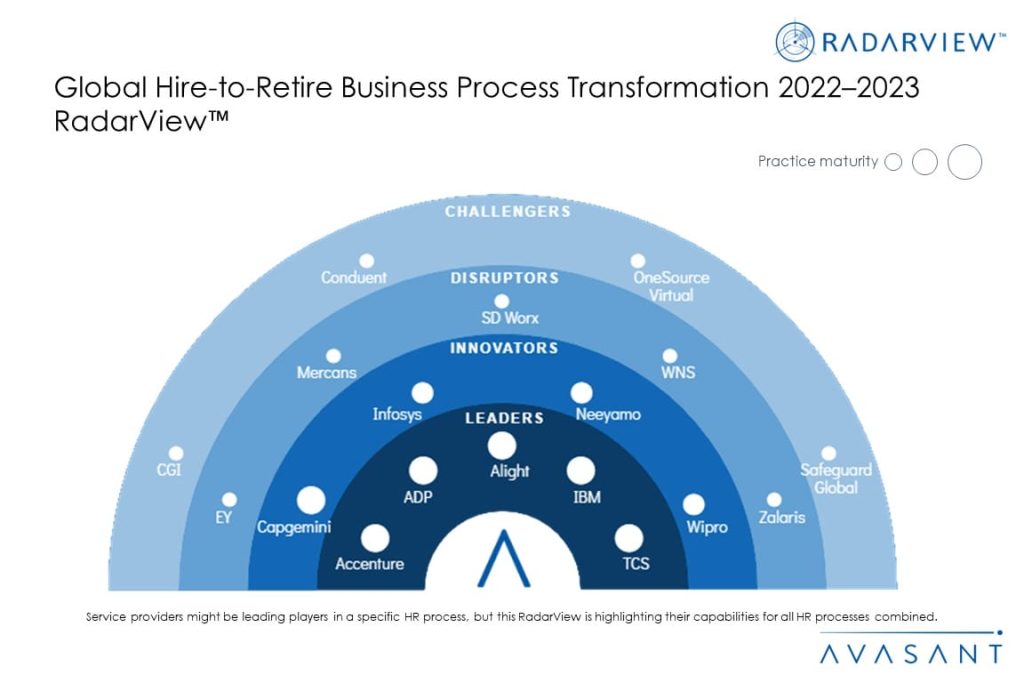
The enterprise HR function has been traditionally concerned with reducing employee costs, managing employee transactions, and complying with local labor laws. However, with competition for talent and elevated employee expectations, the enterprise HR function is becoming more strategic with a focus on engaging employees. Enterprises are transforming their people, processes, and technology to meet these demands. As a result, service provider HR transformation clients grew by over 30% between September 2021 and September 2022. These trends, and others, are covered in our new Global Hire-to-Retire Business Process Transformation 2022–2023 RadarView™.
Global Hire-to-Retire Business Process Transformation 2022–2023 RadarView™
The Global Hire-to-Retire Business Process Transformation 2022–2023 RadarView™ assists enterprises in identifying strategic partners for their hire-to-retire business process transformation by featuring detailed capability and experience analyses of leading service providers. It provides a 360-degree view of key HR service providers across practice maturity, domain ecosystem, and investments and innovation, helping enterprises in evaluating leading players in the HR business process transformation space. The 70-page report also highlights top market trends in the HR business process transformation space and Avasant’s viewpoint on them.

Cybersecurity in Connected Aircraft: Risk Mitigation for Airlines, Passengers, Airports, and Service Providers
The aviation industry is embracing a connected environment by digitizing its operations. This involves leveraging IoT devices, 5G networks, applied AI, advanced analytics, and SaaS-based applications to streamline maintenance, repair, and overhaul. A connected aircraft generates three types of information: aircraft control and navigation data, cabin-based in-flight entertainment data, and operations-based flight movement data. However, interconnected systems have greatly widened the risk perimeter. These demands call for applying security measures, including zero-trust security and secure by design principles, and collaborating with a technology partner who offers services such as threat detection, incident response, governance, risk and compliance, red teaming, 24×7 monitoring, and threat intelligence.
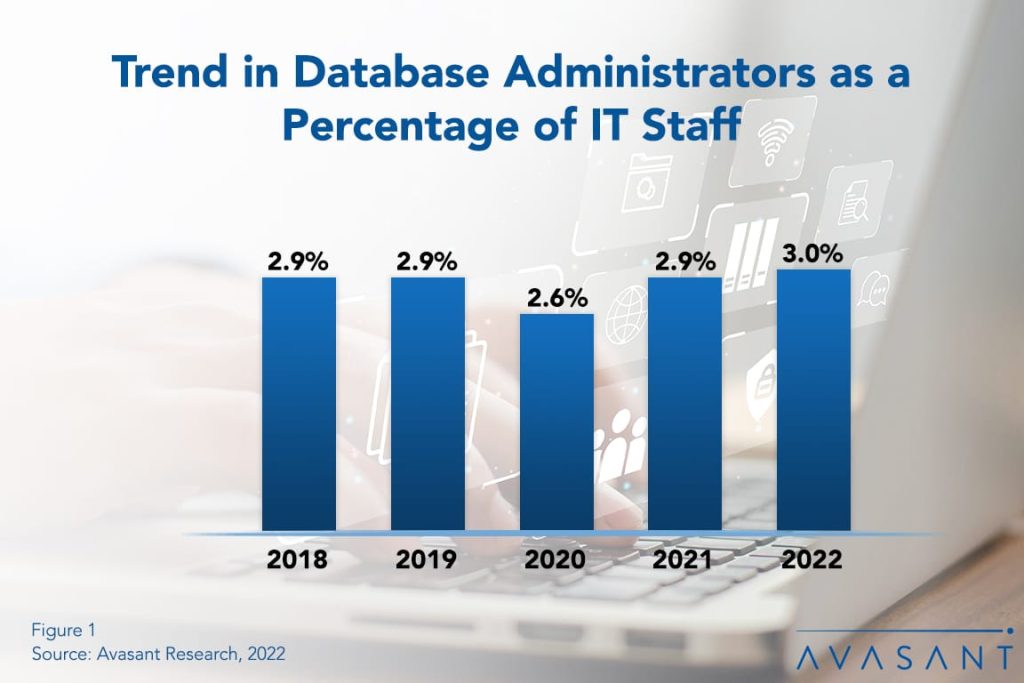
Factors Affecting DBA Staffing Ratios
Database administration (DBA) staffing remained steady in 2022, even though organizations are capturing and analyzing greater amounts of data. One reason DBA staffing levels are not rising is technology, specifically AI/ML, which is assisting DBAs in collecting, sorting, managing, and controlling ever-larger volumes of data. This Research Byte summarizes our full report on database administration staffing ratios.
Database Administration Staffing Ratios 2022
Database administration (DBA) staffing remained steady in 2022, even though organizations are capturing and analyzing greater amounts of data. One reason DBA staffing levels are not rising is technology, specifically AI/ML, which is assisting DBAs in collecting, sorting, managing, and controlling ever-larger volumes of data. The Research Byte summarizes this full report on database administration staffing ratios.
Intelligent ITOps Services: Simplifying the complexity in IT Operations
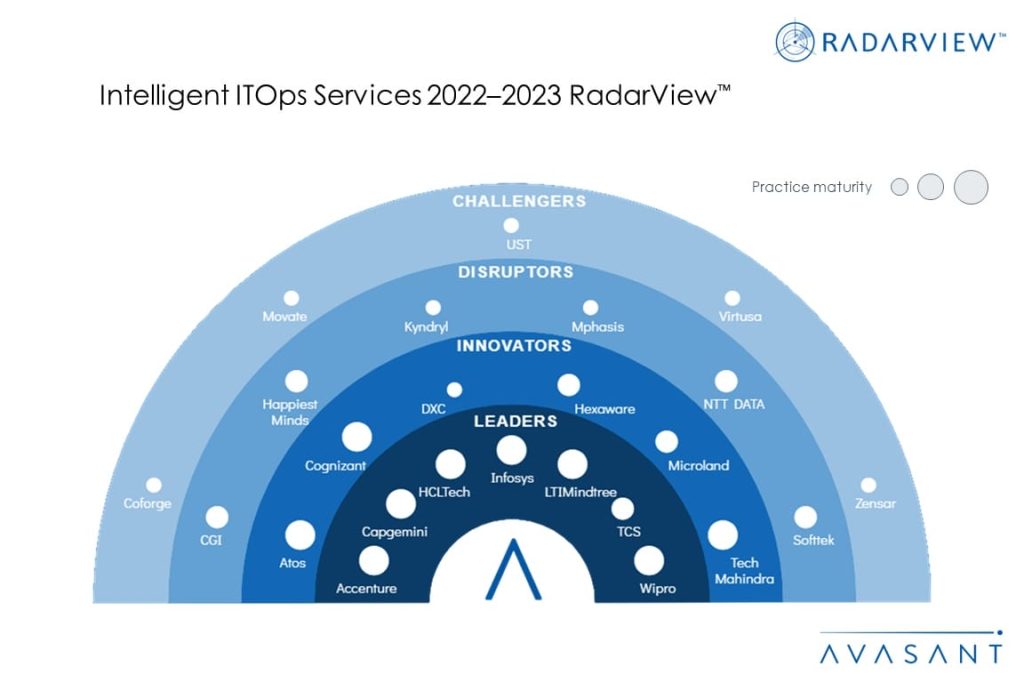
The rising complexity of the hybrid IT landscape has increased enterprise demand for centralized IT infrastructure visibility, predictive event management, and multicloud governance. However, existing SaaS-based ITOps offerings too often only address specific IT operational issues such as network monitoring and service desk. This has resulted in increased business adoption of integrated ITOps platforms, using a best-of-breed approach for faster deployment times, unified monitoring, and reduced platform costs. These trends, and others, are covered in Avasant’s Intelligent ITOps Services 2022–2023 RadarView™.
Intelligent ITOps Services 2022–2023 RadarView™
The Intelligent ITOps Services 2022–2023 RadarViewTM assists organizations in identifying strategic partners for IT operations by featuring detailed capability and experience analyses of leading service providers. It provides a 360-degree view of key intelligent ITOps service providers across practice maturity, partner ecosystem, and investments and innovation, thus supporting enterprises in finding the right intelligent ITOps service partner. The 80-page report also highlights top market trends in the intelligent ITOps space and Avasant’s viewpoint.
IT and Apps Managed Services Market Trends: Quarterly Report for Q3 2022
In this quarterly report (Calendar Qtr 3, 2022), Avasant provides key information on IT Services Solution and Pricing Trends. The report covers market (buyer) perspective, macro trends from service provider community and finally, the pricing, solution and staffing trends in the space. The report covers trends across services including Infrastructure and Cloud Services, Application Services, and Digital Services. The geographic coverage is global, with a larger share of data points from North America. The report builds on insights gathered through our enterprise interactions, ongoing market research and data collection, as well as AvaMark Price Benchmarking database.
What’s Keeping Chief Procurement Officers Awake at Night?
The risk of supply chain disruptions is in addition to the objective of the chief procurement officer (CPO) to deliver value, improve cash flow, develop functional capabilities, manage the risk in an ever-evolving supply base, and reduce the carbon footprint of the supply chain.
Finance and Accounting Outsourcing Driving Long-Term Business Value
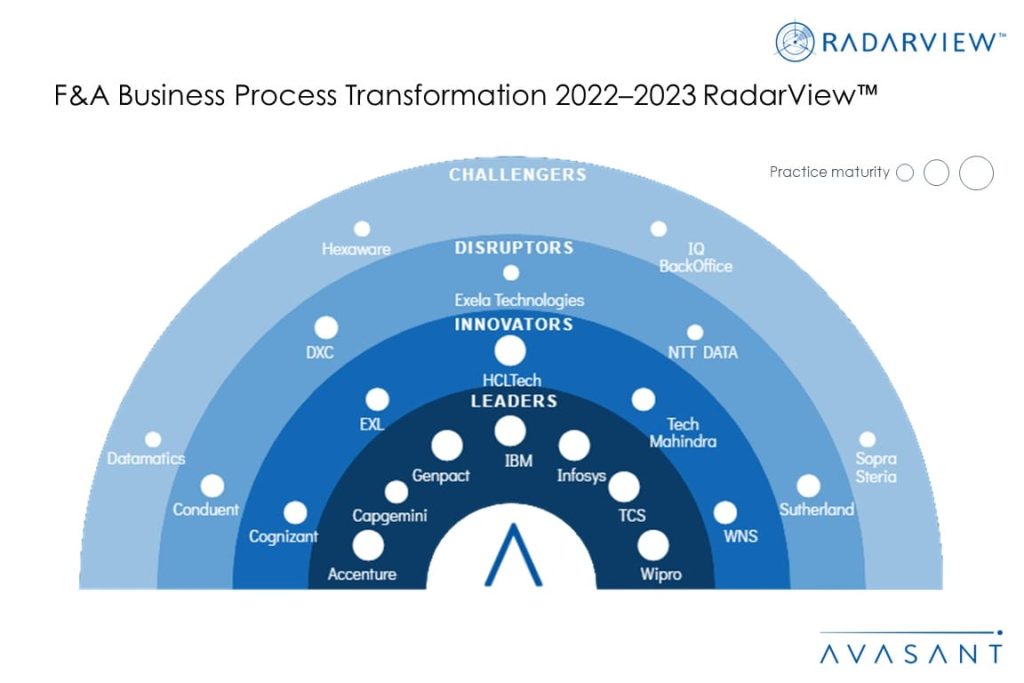
Finance and accounting (F&A) outsourcing grew between 13% and 17% from June 2021 to June 2022. F&A outsourcing is expanding as enterprises entrust service providers with more strategic processes, such as tax and treasury. Additionally, companies want to deal with fewer service providers, leading to an increase in the number of multitower deals. For F&A outsourcing service providers combined, 50%–75% of their F&A revenue comes from providing end-to-end services, compared to function-specific projects. These trends are covered in Avasant’s F&A Business Process Transformation 2022–2023 RadarView™.