Areas of Interest
Content Type
Industries
- Aerospace and defense
- Banking, Financial Services, and Insurance
- Energy and Resources
- Federal Government
- Healthcare and life sciences
- High-tech and telecommunications
- Higher Education
- Media and entertainment
- Private equity
- Public Sector
- Retail and manufacturing
- Social Impact Institutions
- Travel and transportation
Technologies
- Artificial Intelligence
- Automation
- Blockchain
- Business and data analytics
- Cloud
- Customer relationship management (CRM)
- Cybersecurity
- Digital Services
- Enterprise resource planning (ERP)
- Human capital management (HCM)
- Internet Of Things
- Machine Learning
- Networking
- Supply chain management (SCM)
- Virtual reality/Augmented reality
Areas of Interest


Latest Reports
European IT Spending and Staffing Benchmarks 2025/2026: Chapter 20: Life Sciences
Chapter 20 provides benchmarks for life sciences companies. This category includes pharmaceutical makers, biotechnology product companies, and medical device manufacturers. The 16 respondents in this sample range in size from a minimum of about €75 million to over €40 billion in revenue.
European IT Spending and Staffing Benchmarks 2025/2026: Chapter 19: High-Tech Manufacturing

GCCs in Europe: Trends, Challenges, and Strategic Outlook 2025
This paper explores the evolving landscape of global competency centers (GCCs) in Europe in 2025, focusing on their strategic shift from being traditional cost centers to becoming AI-driven innovation hubs. It examines key industry adoption trends, talent management strategies, geographic hotspots attracting investments, government policies and incentives, including specific initiatives and programs, and examples of GCCs set up by leading European enterprises. The analysis draws on the latest industry reports and market insights to provide a comprehensive overview of GCC dynamics in the European region and their implications for businesses and policymakers.

Property and Casualty (P&C) Insurance Business Process Transformation 2025 Market Insights™
The Property and Casualty (P&C) Insurance Business Process Transformation 2025 Market Insights™ assists enterprises in identifying important demand-side trends that are expected to have a long-term impact on any P&C insurance process transformation engagement. The report also highlights key challenges that P&C insurance entities face today.
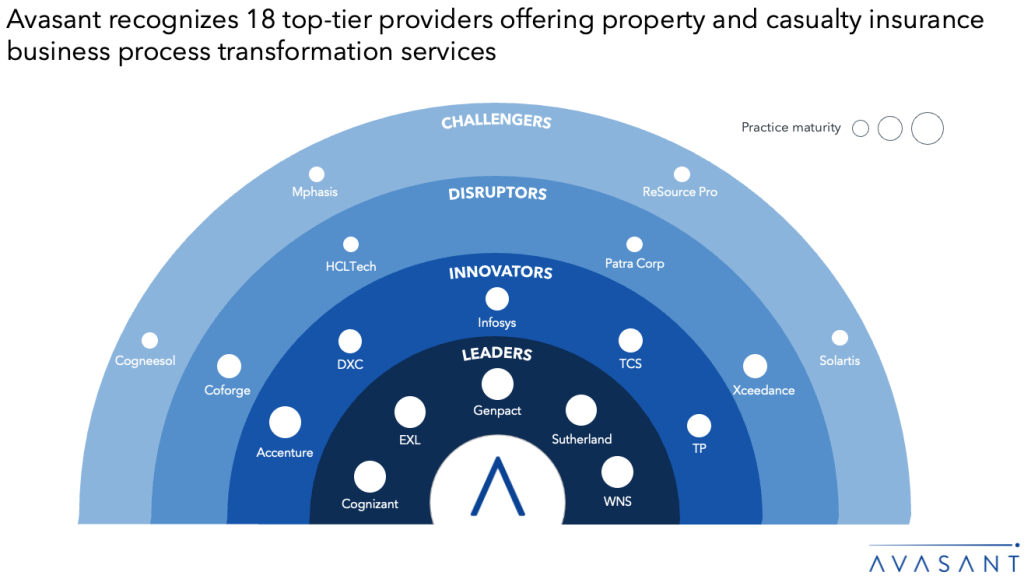
Navigating the Climatic Uncertainties with Outcome-driven Collaborations and Technology Adoption
The property and casualty (P&C) insurance process transformation market is undergoing rapid change as insurers adapt to rising regulatory complexity, climate-related risks, and evolving customer expectations. Advanced technologies such as AI, machine learning, and IoT are increasingly being deployed to strengthen underwriting accuracy, accelerate claims processing, and enhance fraud detection. The growing frequency of natural catastrophes is pushing insurers to invest in predictive analytics and scenario modeling for better risk management.

Property and Casualty (P&C) Insurance Business Process Transformation 2025 RadarView™
The Property and Casualty Insurance Business Process Transformation 2025 RadarView™ provides information to assist enterprises in building a P&C insurance outsourcing service strategy and charting an action plan for P&C insurance process service transformation. It identifies key global P&C insurance outsourcing service providers that can help expedite this transformation. It also brings out detailed capability and experience analyses of leading providers to assist businesses in identifying the right strategic partners. The 57-page report highlights key industry trends in the P&C insurance process transformation space and Avasant’s viewpoint.

Solving the Security Puzzle in Enterprise AI: Insights from Google Cloud Security Summit 2025
The paper captures key insights from the Google Cloud Security Summit 2025, highlighting how enterprises can unlock AI’s full potential securely. It explores Google’s “Secure by Design” approach, focusing on two pillars: AI for Security—empowering security operation centers (SOCs) with intelligent automation for faster, smarter defense—and Security for AI—protecting models, agents, and ecosystems from emerging threats. It also outlines practical strategies to balance innovation with compliance, resilience, and trust, enabling organizations to confidently scale AI initiatives and accelerate digital transformation.

Power is the New Procurement: Buying Compute + Kilowatts Together
As AI workloads scale, the true cost of compute is no longer measured in tokens or instances; it is measured in kilowatts, carbon intensity, and latency thresholds. This shift demands a new commercial playbook where energy becomes a first-class contract term. Enterprises must now co-price compute with power, embed energy-indexed clauses, and negotiate for sustainability-linked incentives. Avasant’s AI Contract Intelligence framework helps organizations future-proof their sourcing strategies by integrating energy terms across the compute stack, from hardware to application. The result: predictable costs, assured capacity, and measurable ESG impact.

Clinical Data Management Business Process Transformation 2025 Market Insights™
The Clinical Data Management Business Process Transformation 2025 Market Insights™ assists enterprises in identifying important demand-side trends that are expected to have a long-term impact on any clinical data management services transformation engagement. The report also highlights key challenges that enterprises face today.
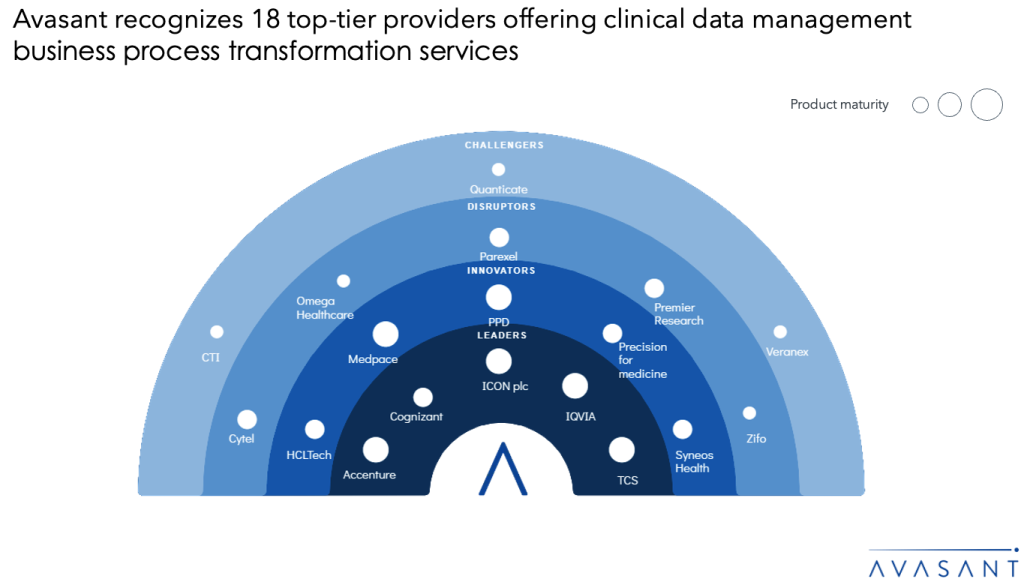
Driving Excellence in Clinical Data Management: Integrating AI, RBQM, and Global Data Ecosystems
Clinical data management (CDM) is evolving from manual, siloed processes to intelligent, automated, and patient-centric data pipelines. Decentralized trial models and integration of real-world data sources, —such as wearables, eSource,, and electronic health records, are enabling richer datasets and improving patient recruitment and retention. Advanced technologies, including AI-driven automation and risk-based quality management (RBQM), streamline validation, query handling, and anomaly detection, reducing manual effort and accelerating study timelines. Cloud-native enterprise platforms consolidate systems and support interoperability across trial ecosystems. Regulatory compliance remains central, with rapid SDTM/ADaM conversions and adherence to global standards (21 CFR Part 11, GCP, and CDISC). To address sponsor demand for scalability and auditability, providers are expanding global delivery networks and strengthening capabilities through partnerships and acquisitions. Both demand- and supply-side trends are covered in Clinical Data Management Business Process Transformation 2025 Market Insights™ and Clinical Data Management Business Process Transformation 2025 RadarView™, respectively.