Areas of Interest
Content Type
Industries
- Aerospace and defense
- Banking, Financial Services, and Insurance
- Energy and Resources
- Federal Government
- Healthcare and life sciences
- High-tech and telecommunications
- Higher Education
- Media and entertainment
- Private equity
- Public Sector
- Retail and manufacturing
- Social Impact Institutions
- Travel and transportation
Technologies
- Artificial Intelligence
- Automation
- Blockchain
- Business and data analytics
- Cloud
- Customer relationship management (CRM)
- Cybersecurity
- Digital Services
- Enterprise resource planning (ERP)
- Human capital management (HCM)
- Internet Of Things
- Machine Learning
- Networking
- Supply chain management (SCM)
- Virtual reality/Augmented reality
Areas of Interest


Latest Reports
F&A Business Process Transformation 2023–2024 RadarView™
The F&A Business Process Transformation 2023–2024 RadarView™ assists organizations in identifying strategic partners for F&A outsourcing services by offering detailed capability and experience analyses of service providers in this space. It provides a 360-degree view of the service providers across practice maturity, domain ecosystem, and investments and innovation, thereby supporting enterprises in identifying the right F&A outsourcing partner. The 67-page report highlights top supply-side trends in the F&A outsourcing space and Avasant’s viewpoint on them.
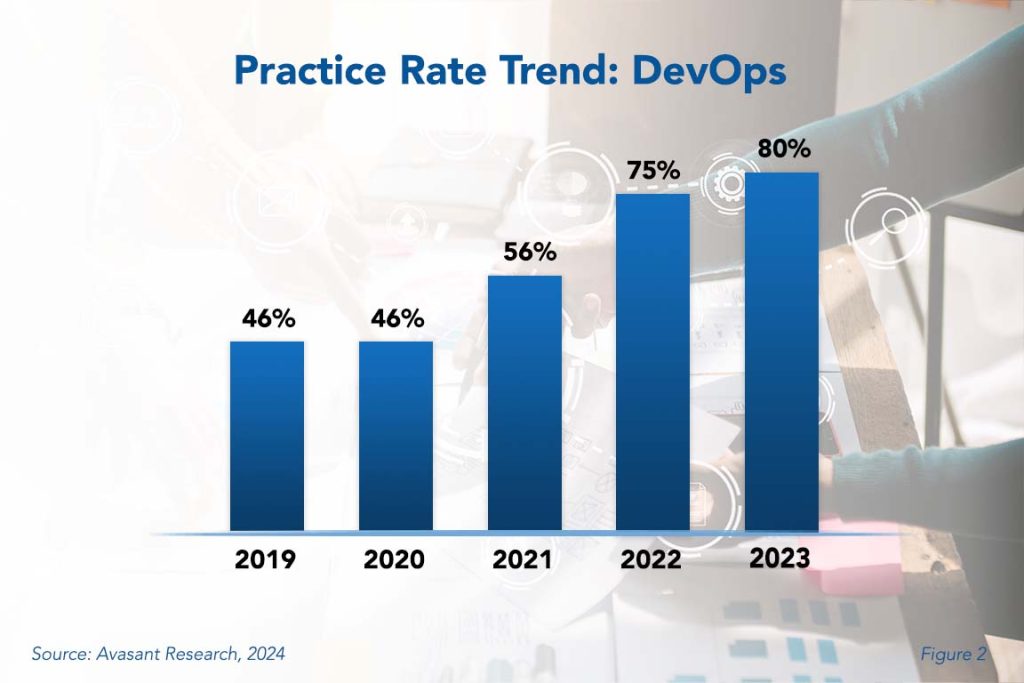
DevOps For Everyone
DevOps has been a way of life for big tech and software companies. But now, it is gaining notable traction among corporate IT organizations. Organizations need to adapt to the rapidly changing landscape of software development and IT operations. Once believed to only be useful for large development teams, DevOps can provide increased speed and efficiency, flexibility, adaptability, security integration, and customer satisfaction for enterprises of all sizes. This Research Byte provides a summary of our full report on DevOps Best Practices.
DevOps Best Practices 2024
Development operations (DevOps) is an organizational model that promotes collaboration between software developers and IT operations. The model allows for frequent deployment of systemic changes and includes a use for automation. DevOps is a natural extension of agile development into the deployment and operational phases of the systems life cycle. Just as agile development builds software in small, iterative build cycles, DevOps applies enhancements as small incremental changes committed daily, hourly, or even moment-by-moment into the production system.
Residual Value Forecast February 2024
Our quarterly Residual Value Forecast (RVF) report provides forecasts for the following categories of IT equipment: desktop computers, laptops, network equipment, printers, servers, storage devices, and other IT equipment. It also includes residual values for other non-IT equipment in the following categories: copiers, material handling equipment (forklifts), mail equipment, medical equipment, test equipment, and miscellaneous equipment such as manufacturing machinery and NC machines. Residual Value Forecasts are provided for five years for end-user, wholesale, and orderly liquidation values (OLV) prices.
Oracle Cloud ERP Services: Accelerating the Adoption of Oracle Cloud ERP Using Automation and AI
Enterprises are migrating to Oracle Cloud ERP to consolidate their business processes, especially following mergers, acquisitions, or divestitures. This facilitates the streamlining of operations across the restructured entity, leading to improved accuracy in financial reporting, enhanced governance capabilities, and increased scalability. The adoption of Oracle Cloud ERP also empowers organizations to attain deeper insights into their customers and operations, enhance operational efficiency, and expedite financial management. In response to the growing demand for the Oracle Cloud ERP system, service providers are actively channeling investments into AI-driven automation solutions, aiming to expedite implementation, optimize service costs, and automate support activities.

Oracle Cloud ERP Services 2023–2024 Market Insights™
The Oracle Cloud ERP Services 2023–2024 Market Insights™ assists organizations in identifying important demand-side trends that are expected to have a long-term impact on any Oracle Cloud ERP implementation or maintenance project. The report also highlights key challenges that enterprises face today in this space.
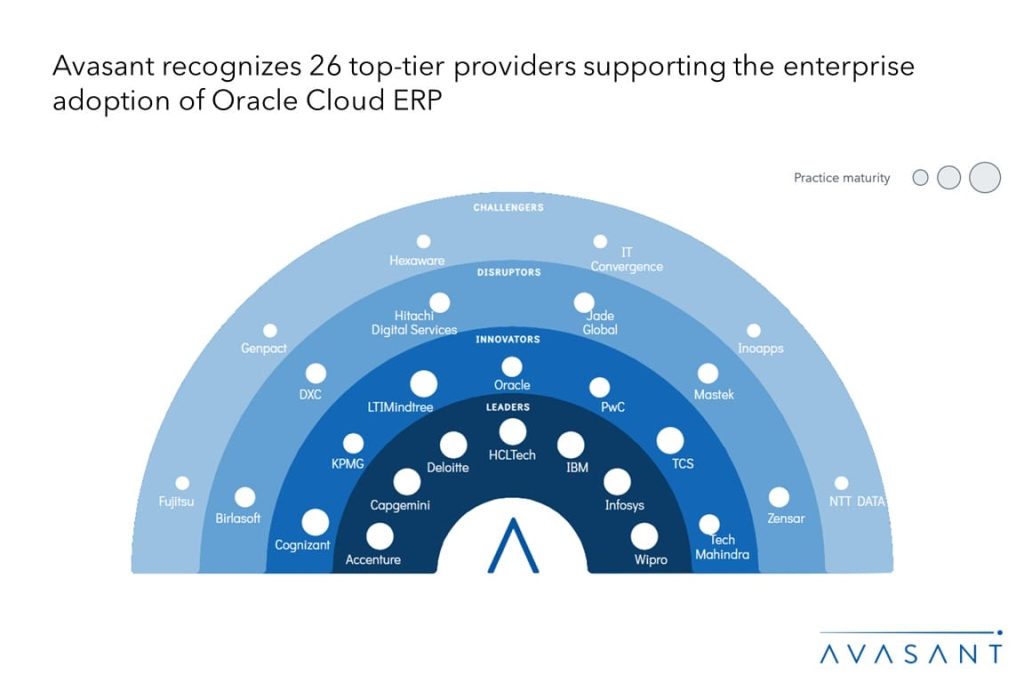
Oracle Cloud ERP Services 2023–2024 RadarView™
The Oracle Cloud ERP Services 2023–2024 RadarView™ assists organizations in identifying strategic partners for adopting Oracle Cloud ERP by offering detailed capability and experience analyses for service providers. It provides a 360-degree view of key Oracle Cloud ERP service providers across practice maturity, partner ecosystem, and investments and innovation to help enterprises identify the appropriate service partner. The 75-page report also highlights the top supply-side trends in the Oracle Cloud ERP services space and Avasant’s viewpoint on them.

Acumatica Builds Success with Growing Construction Edition
The construction industry faces many challenges—tight margins, complex projects, stressed supply chains, and labor shortages. Furthermore, the construction industry is made up of thousands of small and midsize subcontractors, which have historically been underserved by technology solutions and have historically found it challenging to share data in an effective way. Into that breach have stepped cloud-based ERP vendors, and one of the leaders is Acumatica. The company touted recent enhancements to its solutions at its annual customer conference in Las Vegas last month.

Empowering Connectivity: Why Switching to Private LTE Networks Is the Smart Move?
The demand for private wireless solutions is increasing in response to the expanding IoT landscape and the scaling of industrial operations. Manufacturing enterprises are acknowledging the imperative to transition to private wireless networks, recognizing their distinct advantages. This research byte outlines how private wireless differs from traditional Wi-Fi, highlighting key benefits and essential factors for consideration. Additionally, it sheds light on the pivotal stakeholders driving the implementation across the private LTE ecosystem, with a focus on the role of service providers. It emphasizes the necessity of private wireless for sectors prioritizing digital transformation.

AWS Bets on Model Flexibility and Hardware Efficiency for a Distinctive Generative AI Advantage
Major hyperscalers, including Microsoft, Google, and AWS, have embraced generative AI, offering foundation models and proprietary software and hardware accelerators. However, as the generative AI landscape continues to evolve, establishing a unique selling proposition has become challenging. Customers, too, are facing a dilemma in choosing generative AI vendors. AWS stands out strategically in this landscape where differentiation is becoming increasingly elusive, offering Amazon Bedrock’s extensive flexibility in model selection and making substantial investments in purpose-specific AI hardware such as AWS Trainium and AWS Graviton.