Areas of Interest
Content Type
Industries
- Aerospace and defense
- Banking, Financial Services, and Insurance
- Energy and Resources
- Federal Government
- Healthcare and life sciences
- High-tech and telecommunications
- Higher Education
- Media and entertainment
- Private equity
- Public Sector
- Retail and manufacturing
- Social Impact Institutions
- Travel and transportation
Technologies
- Artificial Intelligence
- Automation
- Blockchain
- Business and data analytics
- Cloud
- Customer relationship management (CRM)
- Cybersecurity
- Digital Services
- Enterprise resource planning (ERP)
- Human capital management (HCM)
- Internet Of Things
- Machine Learning
- Networking
- Supply chain management (SCM)
- Virtual reality/Augmented reality
Areas of Interest


Latest Reports
Transforming Hybrid Cloud for AI Acceleration, Sovereign Control, and Cost Optimization
Enterprises are entering a new phase of cloud transformation shaped by four key trends. Rising VMware pricing and licensing changes are accelerating platform diversification as organizations explore alternative hypervisors, containers, and public cloud platforms to manage costs and improve flexibility. At the same time, geopolitical dynamics and regulatory mandates are driving the adoption of digital sovereignty strategies and investments in sovereign cloud and AI infrastructure. Rapid growth in AI training, inference, and high-performance analytics is also fueling demand for GPU as a service. Meanwhile, FinOps platforms are evolving with generative and agentic AI to enable intelligent forecasting and autonomous cloud cost optimization.
In response, service providers and platform vendors are expanding AI-led automation, sovereign cloud services, GPU-led infrastructure, and industry-specific capabilities.
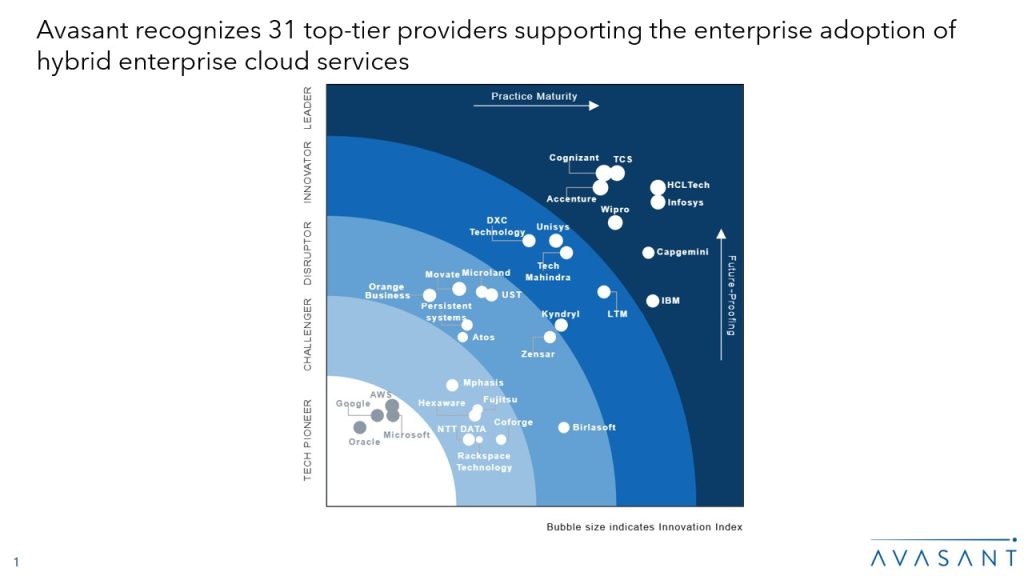
Both demand-side enterprise adoption trends and supply-side provider capabilities are analyzed in our Hybrid Enterprise Cloud Services 2026 Market Insights™ and Hybrid Enterprise Cloud Services 2026 RadarView™, respectively.
Hybrid Enterprise Cloud Services 2026 RadarView™
The Hybrid Enterprise Cloud Services RadarView™ assists organizations in identifying strategic partners for hybrid cloud services by offering detailed capability and experience analyses for service providers. It provides a 360-degree view of key hybrid cloud service providers across practice maturity and future-proofing, thereby helping enterprises identify the right hybrid cloud services partner. The 82-page report highlights top supply-side trends in the hybrid cloud space and Avasant’s viewpoint on them.

Advanced Voice AI Platforms 2026 Market Insights™
The Advanced Voice AI Platforms 2026 Market Insights™ assists organizations in identifying important demand-side trends that are expected to have a long-term impact on any voice AI projects. The report also highlights key challenges that enterprises face today.
Advanced Voice AI Platforms: Vendors Advance Industry-Focused, Agentic Voice AI Ecosystems
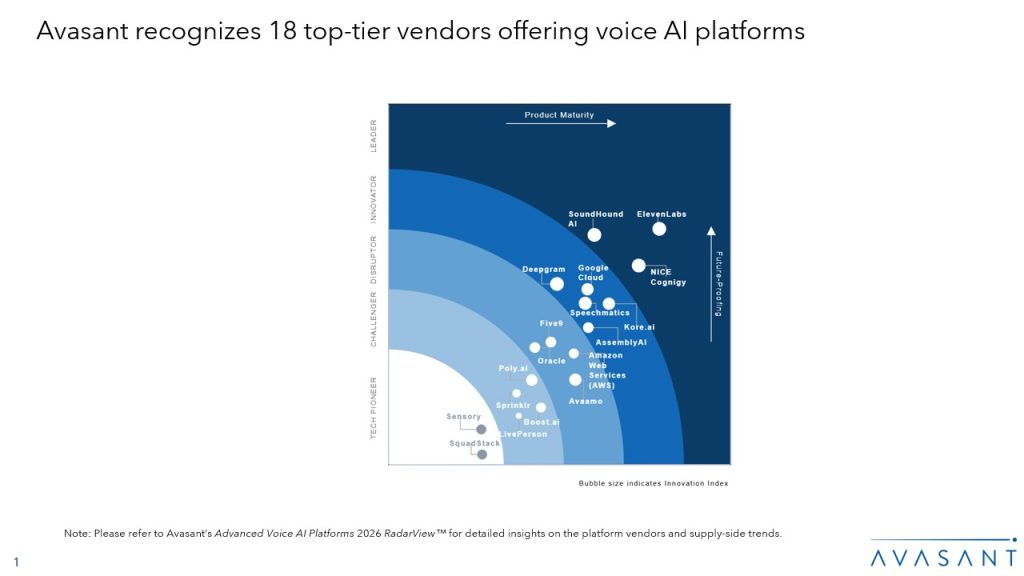
Voice AI platforms are reshaping enterprise interactions by spanning the full speech processing value chain. These platforms integrate natural language understanding (NLU), voice language models, and agentic AI to enable adaptive, autonomous, and multimodal conversational experiences. Enterprise voice AI adoption is accelerating as improved speech processing and real-time interaction handling reduce live interaction failures, with banking and financial services and retail leading deployments to automate high-frequency customer service and transaction-related interactions. At the same time, challenges around accent diversity, legacy system integration, and voice data governance continue to constrain rollouts. Both demand- and supply-side trends are covered in Avasant’s Advanced Voice AI Platforms 2026 Market Insights™ and Advanced Voice AI Platforms 2026 RadarView™, respectively.
Advanced Voice AI Platforms 2026 RadarView™
The Advanced Voice AI Platforms 2026 RadarView™ assists organizations in identifying strategic partners for voice AI by offering detailed capability and experience analyses of platform vendors. It provides a 360-degree view of key voice AI platform vendors across product maturity and future-proofing, thereby supporting enterprises in identifying the right voice AI platform vendor. The 56-page report also highlights top market trends in the voice AI space and Avasant’s viewpoint on them.
Fair Market Value Report March 2026
The Computer Economics Market Value Reports provide information on the most commonly traded machines and systems at the time the report is published. The values shown are the composites of a range of quotes acquired from sources within the industry deemed reliable, accuracy of the information presented is not guaranteed. Resources are eBay, Insight, NewEgg, CDW, ETB-Tech, Amazon, Savemyserver, TheServerStore, LoadBalancer, NetworkOutlet, Netsyst-Direct, TigerDirect, and others as well as online sales companies and appraisals.
Agentic AI Platforms 2026 Product Assessment™
This product assessment provides key insights into select vendors offering agentic AI platforms. The report begins with the definition and scope of the agentic AI platforms, followed by detailed profiles of leading vendors in this space. It highlights the capabilities of 16 vendors that provide agentic AI platforms for enterprise use.
Each profile includes an overview of the vendor, its core solutions and capabilities, the key enterprise challenges its platform addresses, and notable developments related to its agentic AI offerings.

The Chief AI Officer Era: Driving Strategy, Scale, and Stewardship
Avasant’s Chief AI Officer (CAIO) study analyzes data from more than 370 CAIOs worldwide, complemented by in-depth interviews with senior AI leaders, to examine how the role is rapidly taking shape across enterprises. The report provides insights into core responsibilities, success metrics, execution challenges, evolving hiring patterns, and the CAIO’s intersection with other C-suite functions. It highlights industry and geographic adoption trends and offers practical recommendations, including a structured 30-60-90-day road map, to help CAIOs operationalize their charter and scale AI with confidence and governance rigor.
Residual Value Forecast March 2026
Our quarterly Residual Value Forecast (RVF) report provides forecasts for the following categories of IT equipment: desktop computers, laptops, network equipment, printers, servers, storage devices, and other IT equipment. It also includes residual values for other non-IT equipment in the following categories: copiers, material handling equipment (forklifts), mail equipment, medical equipment, test equipment, and miscellaneous equipment such as manufacturing machinery and NC machines. Residual Value Forecasts are provided for five years for end-user, wholesale, and orderly liquidation values (OLV) prices.
IT and Apps Managed Services Provider Trends: Quarterly Report for CQ4 2025
In this quarterly report (calendar quarter 4, 2025), Avasant provides key information on IT and apps managed services provider trends. The report covers key information on the IT services industry and the provider ecosystem. It covers the service provider facts and figures (including revenue and resource trends) and executive sentiment from the service provider community. The report covers trends across a gamut of IT services, including but not limited to IT infrastructure, application, and end-user services. The geographic coverage for the report is global. It builds on insights gathered through ongoing market research, data collection, and proprietary databases. It includes market data from providers accessed through multiple sources such as public disclosures, market interactions, and deals data.