Areas of Interest
Content Type
Industries
- Aerospace and defense
- Banking, Financial Services, and Insurance
- Energy and Resources
- Federal Government
- Healthcare and life sciences
- High-tech and telecommunications
- Higher Education
- Media and entertainment
- Private equity
- Public Sector
- Retail and manufacturing
- Social Impact Institutions
- Travel and transportation
Technologies
- Artificial Intelligence
- Automation
- Blockchain
- Business and data analytics
- Cloud
- Customer relationship management (CRM)
- Cybersecurity
- Digital Services
- Enterprise resource planning (ERP)
- Human capital management (HCM)
- Internet Of Things
- Machine Learning
- Networking
- Supply chain management (SCM)
- Virtual reality/Augmented reality
Areas of Interest


Latest Reports

IT and Apps Managed Services Pricing and Solution Trends: H2 2024
In this report, Avasant provides key information on solutions and pricing trends for the IT and apps managed services industry within the past 6–12 months. The report covers several aspects, including market trends, pricing model trends, and pricing and staffing trends in the space. The geographical scope of the report is global, although there is an emphasis on data points from North America. The report leverages valuable insights from our enterprise interactions, ongoing market research, data collection through primary research, and the AvaMark™ Price Benchmarking database.

Gulf Cooperation Council (GCC) Region Digital Services 2025 Market Insights™
The Gulf Cooperation Council (GCC) Region Digital Services 2025 Market Insights assists organizations in identifying important demand-side trends that are expected to have a long-term impact on any digital projects in the GCC region. The report also highlights key challenges that enterprises face today.
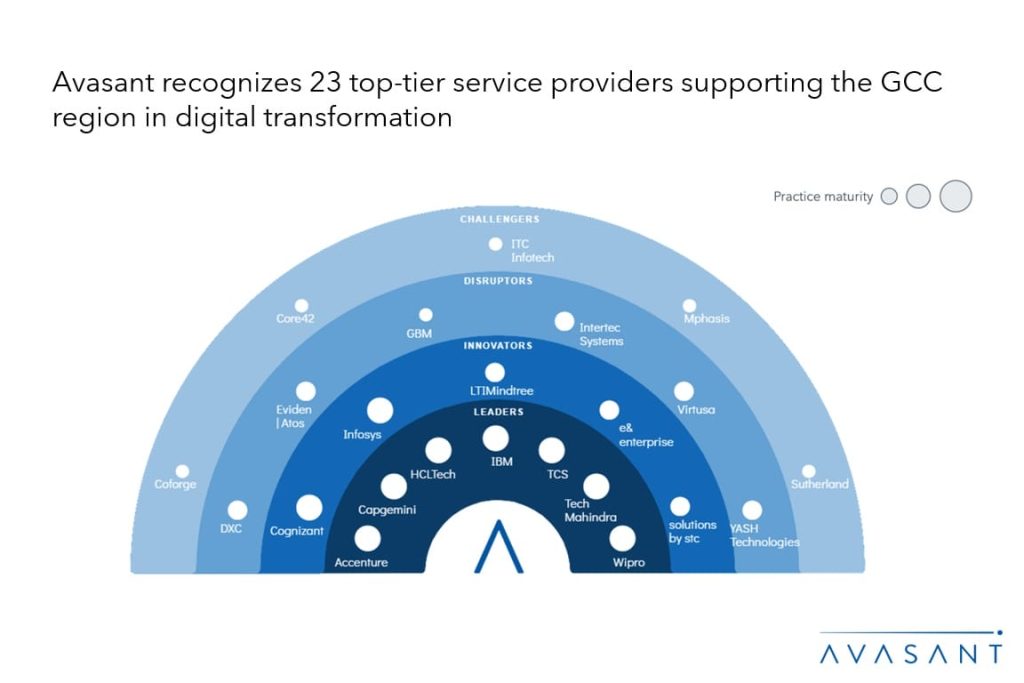
GCC Region: Advancing the GCC Region with Emerging Technologies for the Next Era
The GCC region is undergoing a dynamic economic transformation driven by strategic reforms, digital upskilling, and foreign direct investment (FDI). Regional governments are addressing talent gaps by fostering local expertise, while regulatory relaxations attract global technology enterprises and fuel growth. AI adoption, backed by Saudi Arabia and the UAE, is accelerating, positioning the region as a global leader. With rapid advancements in digital finance, while having sustainability at the core, regional firms are actively collaborating with service providers to develop innovative digital solutions, enhance efficiency, and manage costs.

Gulf Cooperation Council (GCC) Region Digital Services 2025 RadarView™
The Gulf Cooperation Council (GCC) Region Digital Services 2025 RadarView™ can help enterprises based in the GCC craft a robust strategy based on regional outlook, best practices, and digital transformation. The report can also aid them in identifying the right partners and service providers to accelerate their digital transformation. The 94-page report also highlights top market trends in the GCC region and Avasant’s viewpoint on them.

The Open-Source Gambit: Did DeepSeek Ignite an AI Arms Race?
On January 20, 2025, DeepSeek stunned the industry with the release of DeepSeek-R1, an open-source, cost-efficient AI model that rivaled OpenAI’s GPT-4 on multiple benchmarks. DeepSeek did not just disrupt the AI industry; it sparked a geopolitical AI arms race. The battle for AI sovereignty has begun. While multiple governments have banned DeepSeek over data security concerns, its impact on AI’s trajectory is definite. Just as Sputnik’s launch in 1957 ignited the space race, DeepSeek has triggered a reckoning in AI strategy, forcing the world to reconsider the balance between accessibility, security, and sovereignty.

DBA Staffing Continues to March Onward
After years of remaining steady, there has been a notable increase in the proportion of database administrators (DBAs) within IT departments, particularly in small organizations. New data-driven initiatives, including generative AI, omnichannel communication, and real-time analytics, are inspiring enterprises to make their data lakes deeper and deeper, while data security concerns and regulatory requirements intensify. DBAs’ expertise in maintaining and safeguarding sensitive information is paramount. This Research Byte summarizes our full report on database administration staffing ratios.
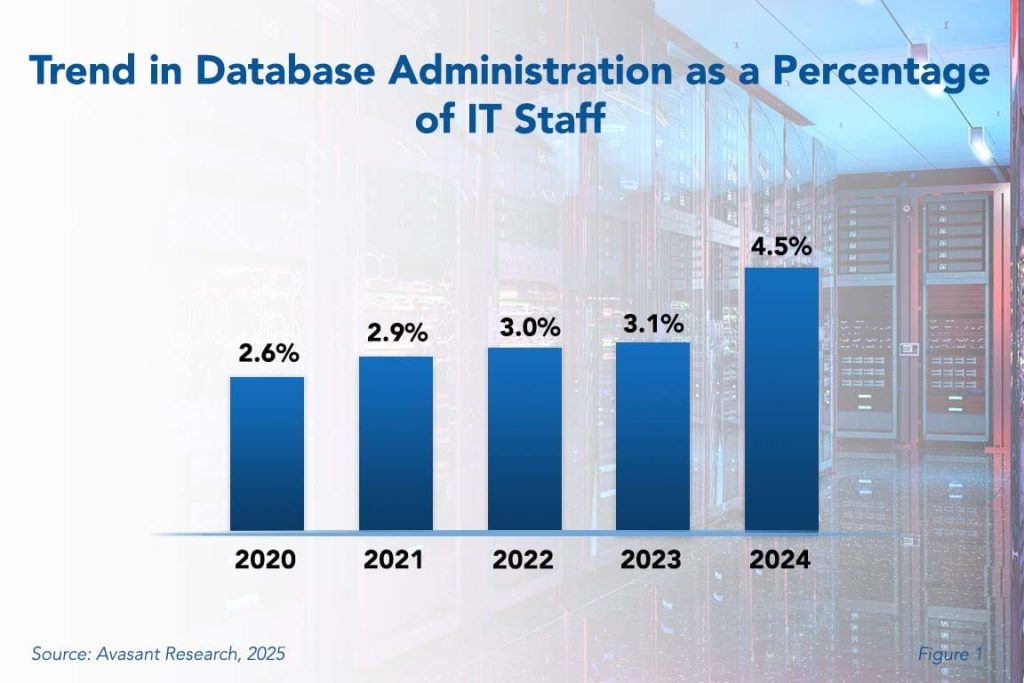
Database Administration Staffing Ratios 2025
As businesses continue to expand their digital footprints, they are collecting more data and connecting more applications than ever before. This exponential growth in data volume and application integration presents both opportunities and challenges. To harness the full potential of this data, organizations must ensure that it is not only secure but also readily accessible.
Current Fair Market Values February 2025
The Computer Economics Market Value Reports provide information on the most commonly traded machines and systems at the time the report is published. The values shown are the composites of a range of quotes acquired from sources within the industry deemed reliable, accuracy of the information presented is not guaranteed. Resources are eBay, Insight, NewEgg, CDW, ETB-Tech, Amazon, Savemyserver, TheServerStore, LoadBalancer, NetworkOutlet, Netsyst-Direct, TigerDirect, and others as well as online sales companies and appraisals.
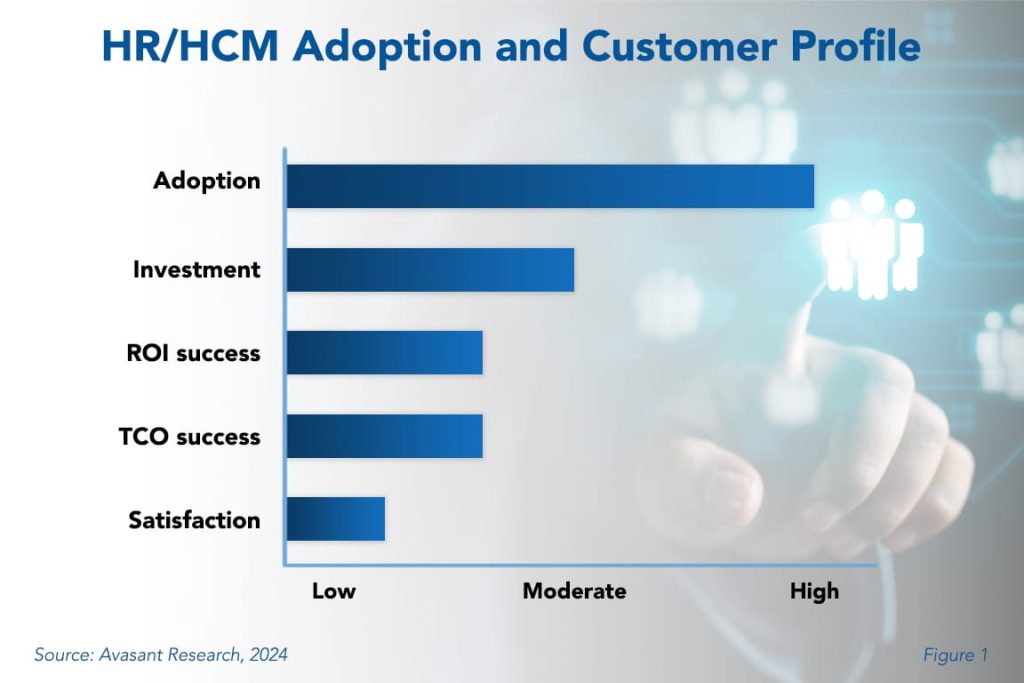
HR/HCM Adoption Trends and Customer Experience 2024
In the past, human resources (HR) departments were typically seen as cost centers, but there is a growing appreciation for the strategic value that HR can bring to an organization. By embracing HR’s strategic role, organizations may realize the full potential of the function as a value-add that propels business success.

Despite High Adoption, HCM Systems Fail to Deliver on Satisfaction and ROI
Despite widespread adoption, disappointing satisfaction and return on investment levels plague many human capital management (HCM) implementations. HCM is a core function, but many organizations struggle to realize the full potential of these systems. Is HCM falling short of its initial promise? This Research Byte summarizes the full report, HR/HCM Adoption Trends and Customer Experience.