
 Grid View
 List View
-
HCM Systems Popular but Challenges Remain
Human capital management (HCM) systems are one of the most widely-adopted technologies in business. But despite HCM’s popularity, implementation challenges remain, and the ROI experience and overall satisfaction rating are well below those of other technologies.
July, 2017
-
HCM Adoption Trends and Customer Experience 2017
Organizational success depends on people. Therefore, recruiting, developing, and retaining the best people creates a sustainable, competitive advantage, and human capital management (HCM) systems can play an important role in achieving this goal. This report quantifies the current adoption and investment trends for HCM technology as well as the benefits driving companies to expand their HCM implementations. We assess these trends by organization size, sector, and geography as well as the ROI and TCO experiences of adopters. We conclude with practical advice for planning new investments in HCM systems. (21 pp., 9 fig.) [Research Byte]
July, 2017
-

Managing Collaborative Supply Chains for the Digital Enterprise
Adrian Quayle, Fellow Partner, Avasant Collaboration Lunched Forum keynote session titled "Managing Collaborative Supply Chains for the Digital Enterprise"
July, 2017
-

The New Economic Development Model for the Digital World – EBS DC 2017 Thought Leadership Panel
Empowering Beyond Summit Washington, DC 2017 Thought Leadership Panel titled "The New Economic Development Model for the Digital World"included guest speakers:- Fabrizio Opertti, Chief of Trade & Investment, Inter-American Development Bank- Nilkanth Avhad, Counsellor (Economic), Embassy of India- Samia Melhem, Global Lead of Digital Development, World Bank.
June, 2017
-
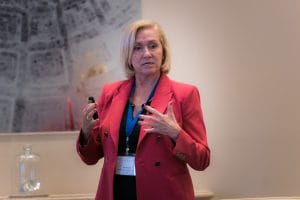
Harnessing Digital Innovation to Drive Organizational and Societal Change – EBS DC 2017, Nuria Simo
Empowering Beyond Summit Washington, DC 2017 keynote speaker, Nuria Simo, CIO at IDB shared a presentation "Harnessing Digital Innovation to Drive Organizational and Societal Change". IDB operates in over 26 country offices offering loans, grants, technical corporations and knowledge creation and dissemination. Their strengths include understanding of the region, technical expertise and knowledge and flexibility.
June, 2017
-
FinancialForce Turns to ADP to Supersede Its Own HCM Offering
FinancialForce, a cloud ERP provider on the Salesforce platform, announced a new strategic partnership with ADP, a behemoth in the payroll and human capital management (HCM) space, to replace its own HCM offering over the long term.
June, 2017
-
IT Staffing Levels Flat as Cloud Shifts Focus to Higher-Level Skills
IT operational budgets in 2017 are growing modestly, but that growth is not being mirrored in IT staffing levels, which are essentially flat at the median. According to Computer Economics, fewer than half (49%) of all companies in its newly released IT Spending and Staffing Benchmarks 2017/2018 study are planning to increase IT headcount.
June, 2017
-
Security, Privacy, Cloud Apps Top Priorities for 2017 IT Spending
When it comes to new spending, IT departments have two rather clear priorities—secure their data and continue the transition to the cloud, according to the Computer Economics annual IT Spending and Staffing Benchmarks study for 2017/2018. Given the constant array of new threats facing IT departments every day, it is no surprise that security is a major priority. At the same time, the rise of cloud applications has been going on for many years, but it continues to accelerate.
June, 2017
-
Cloud Shows Positive Impact on IT Budgets, New Survey Finds
IT organizations continue on a path of steady but modest growth in operational budgets, while capital budgets and hiring are essentially flat, according to the Computer Economics annual IT Spending and Staffing Benchmarks study for 2017/2018. These trends are tangible evidence of the effects of cloud computing on corporate IT budgets.
June, 2017
-
IT Spending and Staffing Benchmarks 2017/2018: Chapter 1: Executive Summary
Chapter 1 of our 2017/2018 IT Spending and Staffing Benchmarks study provides a detailed analysis of the major findings from this year's study. It also describes the contents of the subsequent chapters, and gives detailed information about the demographics of the study participants and the survey methodology. [Full Study Description]
June, 2017
-
IT Spending and Staffing Benchmarks 2017/2018: Chapter 2: Composite Benchmarks
This chapter provides composite metrics for all organizations in the survey across all sectors and organization sizes. The sample is stratified by size and sector as described in the section on survey methodology. Respondents must have at least $50 million in annual revenue or IT spending in excess of $2 million and maintain operations in the U.S. or Canada. For a complete description of all metrics, please see the full study description. [Full Study Description]
June, 2017
-
IT Spending and Staffing Benchmarks 2017/2018: Chapter 3A: Small Organizations Benchmarks
Chapter 3A provides benchmarks for small organizations, across all sectors. Small organizations are defined as organizations having IT operational budgets of less than $5 million. For a complete description of all metrics, please see the full study description. There are 76 respondents in the small-company sample. [Full Study Description]
June, 2017
-
IT Spending and Staffing Benchmarks 2017/2018: Chapter 3B: Midsize Organizations Benchmarks
Chapter 3B provides benchmarks for midsize organizations, across all sectors. Midsize organizations are defined as organizations having IT operational budgets of greater than $5 million to $20 million. For a complete description of all metrics, please see the full study description. There are 61 respondents in the midsize-company sample. [Full Study Description]
June, 2017
-
IT Spending and Staffing Benchmarks 2017/2018: Chapter 3C: Large Organizations Benchmarks
Chapter 3C provides benchmarks for large organizations, across all sectors. large organizations are defined as organizations having IT operational budgets of greater than $20 million. For a complete description of all metrics, please see the full study description. There are 65 respondents in the large-company sample. [Full Study Description]
June, 2017
-
IT Spending and Staffing Benchmarks 2017/2018: Chapter 4: Process Manufacturing Benchmarks Sector Benchmarks
Chapter 4 provides benchmarks for process manufacturers. Process manufacturers are defined as those where the production process adds value by mixing, separating, forming, or chemical reaction. The sector includes manufacturers of chemicals, semiconductors, pharmaceuticals, food, building materials, packaging materials, steel, glass, and paper products, and other process-manufactured goods. The 42 respondents in the sample range in size from a minimum of $50 million to a maximum $32.7 billion in annual revenue. [Full Study Description]
June, 2017
Areas of Interest
Search results for "" ( 5626 )