
 Grid View
 List View
-
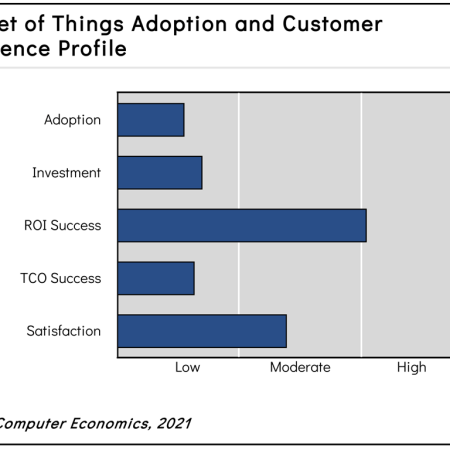
IoT Adoption Trends and Customer Experience 2021
The Internet of Things (IoT) is a maturing technology, and for many years it has promised benefits such as lower labor costs and better tracking of assets. But investments in IoT projects are stuck at a relatively low rate. This report provides an overview of IoT adoption and investment trends, providing data on how many organizations have the technology in place, how many are in the process of implementation, and how many are expanding implementations. We also look at the return on investment experience, total cost of ownership experience, and considered or planned uses for new IoT investment. We conclude with important principles to apply in planning and implementing IoT systems.
March, 2021
-
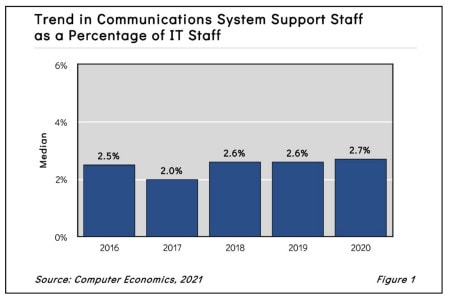
Communications System Support Staffing Ratios 2021
Corporate communications systems have become more complex, although the number of IT specialists who support these systems has stabilized in the past few years. Because of the COVID-19 pandemic and other factors, IT organizations can benefit from a periodic assessment of their communications system support staffing levels. This study uses three metrics to make that assessment: support staff as a percentage of the IT staff, percentage of support staff in relation to organization size, and support staff spending per user. We provide benchmarks for the composite sample, by organization size, and by sector.
January, 2021
-
Communications Staffing Still on Mute
Corporate communications systems have become more complex, particularly during the coronavirus pandemic, as companies struggle to make it possible for large chunks of the workforce to work remotely. Nevertheless, despite the growing complexity, the number of IT specialists who support communications systems has stabilized in the past few years. This Research Byte provides a summary of our full report on communications support staffing ratios.
January, 2021
-
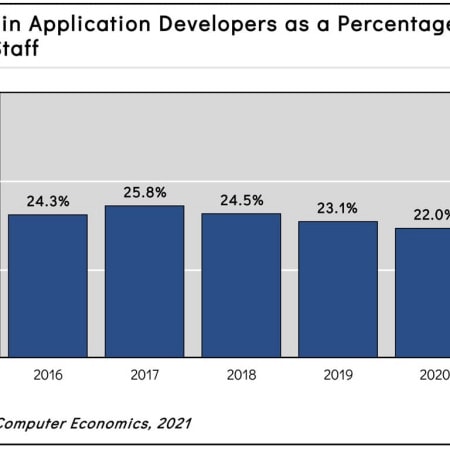
Factors Behind the Decline in Application Development Staffing
The way that enterprise applications are internally developed and maintained has changed, causing the ratio of application developers to dip again for the third straight year. App developers are some of the highest-paid IT personnel, so it is vital that IT leaders periodically assess this staffing ratio. This research byte summarizes our full report, Application Developer Staffing Ratios.
February, 2021
-
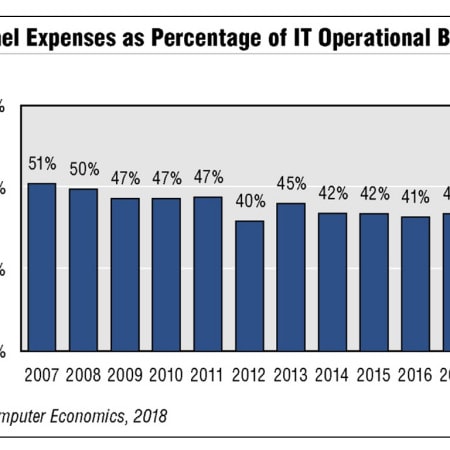
Long-Term Trends in IT Spending and the Impact of the Cloud
Corporate IT spending varies from year to year as the economy expands and contracts: these are the cyclical trends. But over longer periods, IT spending also changes based on shifts in technology: these are secular trends. What are the secular trends that are currently affecting IT spending, especially those brought about by greatest recent shift in technology: cloud computing? This report examines the 11-year trend in spending for application software, IT personnel, data centers, networking, and other categories, and how cloud computing is changing that mix.
March, 2018
-
Application Developer Staffing Ratios 2021
The way that enterprise applications are internally developed and maintained has changed. With these changes, the need for application developers is in flux, and IT organizations can benefit from a periodic assessment of their staffing levels. This report uses three metrics to make that assessment: developers as a percentage of the IT staff, users per developer, and applications per developer. We provide benchmarks for the composite sample, by organization size and by sector. We also provide a benchmark for the larger Application Group, which includes personnel engaged in web development and support, quality assurance, data management, and business systems analysis.
February, 2021
-
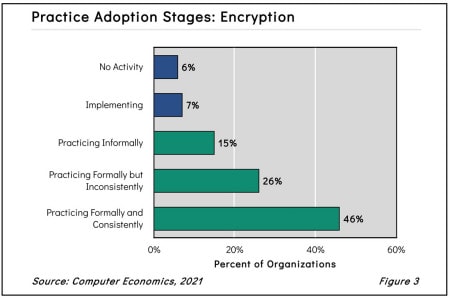
Encryption Adoption and Best Practices 2021
Encryption is a best practice for protecting sensitive or confidential information, both in storage and in transit. Data encryption software and algorithms translate data into another form, or code, so that only someone with access to a secret key—a decryption key—can read it. It has a high maturity rating, but there is ample room for improvement. This report begins with a definition of encryption. We next study the adoption and practice levels and examine those by organization size and sector. We conclude with best-practice recommendations.
February, 2021
-
Neglect of Encryption a Prescription for Disaster
Encryption is a best practice for protecting sensitive or confidential information, and it has long since moved into the IT mainstream. Yet our research shows that there are still many companies practicing encryption informally or inconsistently, which can have serious consequences. This research byte summarizes our full report, Encryption Adoption and Best Practices.
February, 2021
-
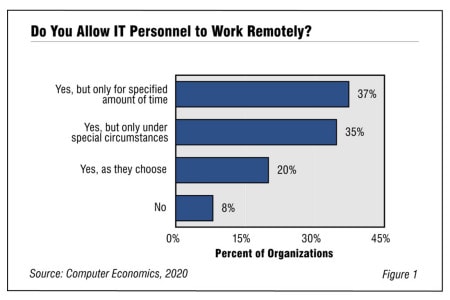
Working From Home Was Already Surging Before Pandemic
The practice of working remotely has skyrocketed over the past 11 years for many reasons, and in early 2020 it got a huge boost with the COVID-19 pandemic. Untold millions of workers around the world started working from home in March 2020, after thousands of companies and governments instructed them to do so. This Research Byte summarizes the findings in our full report.
March, 2020
-
Trends in Telecommuting in the IT Workforce 2020
The practice of working remotely has skyrocketed over the past 11 years for many reasons, and in early 2020 it got a huge boost with growing concerns about the COVID-19 coronavirus. This report examines the reasons for the rise in telecommuting, how often IT workers do so, and what benefits companies and employees are enjoying—while also being mindful of possible disadvantages. We conclude with best-practice recommendations for a sound telecommuting policy. (10 pp., 4 fig.)
March, 2020
-
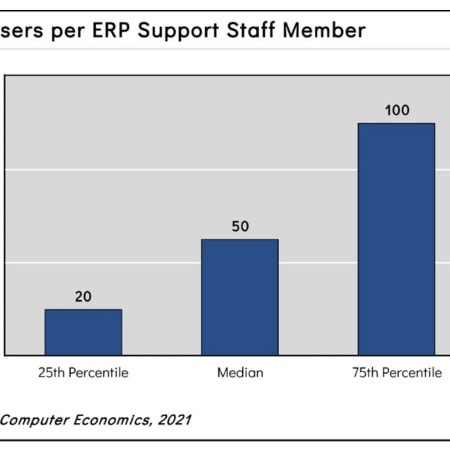
The ERP Support Staffing Puzzle
Right-sizing the support staff for an ERP system can be complicated. This is there are many factors that affect the support staffing ratio. These include the type of ERP system, its age, the extent of modification, industry sector, and more. Nevertheless, understanding support requirements for ERP systems is vital for IT leaders. This research byte provides a summary of our full report on ERP support staffing ratios.
January, 2021
-
ERP Support Staffing Ratios 2021
For many IT organizations, enterprise resource planning (ERP) systems are at the center of the application portfolio. In this report, we analyze ERP support requirements in several ways. First, we look at the ERP support staffing ratio, which is the number of ERP users divided by the number of ERP support personnel. We then assess this ratio by the size of the ERP installation. We also examine the data to determine the ratios by vendor. We examine the ratio by sector, age of installation, years since last upgrade, extent of modification, and type of deployment (on-premises, cloud, or hosted) as well. Finally, we provide recommendations on optimizing ERP staffing levels. (20 pp., 10 fig.)
January, 2021
-

IT Spending as a Percentage of Revenue by Industry, Company Size, and Region
This Research Byte analyzes IT spending as a percentage by industry, IT costs as a percentage of revenue by company size, and IT budgets as a percentage of revenue by region. We discuss why it is better to evaluate percentiles rather than average IT spending. Finally, we outline other key metrics for IT budget analysis, such as IT spending per employee, IT spending per user, and IT spending per desktop.
January, 2021
-

Very Small Organizations Struggling for IT Budget
For the first time, Computer Economics has conducted a study on the IT spending habits of organizations in the U.S. and Canada that are too small to qualify for our annual benchmarks survey. We decided to examine the IT spending habits of these “very small organizations” with a dedicated survey to determine their spending habits and priorities, and to provide some metrics that can be used to benchmark their spending. This Research Byte provides a summary and description of our full report on IT spending and staffing in very small organizations.
November, 2019
-
IT Spending Benchmarks for Very Small Organizations 2019-2020
For the first time, Computer Economics has conducted a study on the IT spending habits of “very small” organizations in the U.S. and Canada, a population that is beneath the size threshold for our annual IT spending and staffing benchmark study. This report examines high-level IT spending, staffing metrics and trends for such very small IT organizations. We further break down the high-level metrics by three sectors: manufacturing, retail and wholesale distribution; professional and technical services; and financial services. To qualify as very small for the purposes of this study, a company has to be either under $50 million in revenue or under $1 million in IT operational spending. (36 pp., 17 fig.)
November, 2019
CE Report
Search results for "" ( 5626 )