Areas of Interest
Content Type
Industries
- Aerospace and defense
- Banking, Financial Services, and Insurance
- Energy and Resources
- Federal Government
- Healthcare and life sciences
- High-tech and telecommunications
- Higher Education
- Media and entertainment
- Private equity
- Public Sector
- Retail and manufacturing
- Social Impact Institutions
- Travel and transportation
Technologies
- Artificial Intelligence
- Automation
- Blockchain
- Business and data analytics
- Cloud
- Customer relationship management (CRM)
- Cybersecurity
- Digital Services
- Enterprise resource planning (ERP)
- Human capital management (HCM)
- Internet Of Things
- Machine Learning
- Networking
- Supply chain management (SCM)
- Virtual reality/Augmented reality
Areas of Interest


Latest Reports
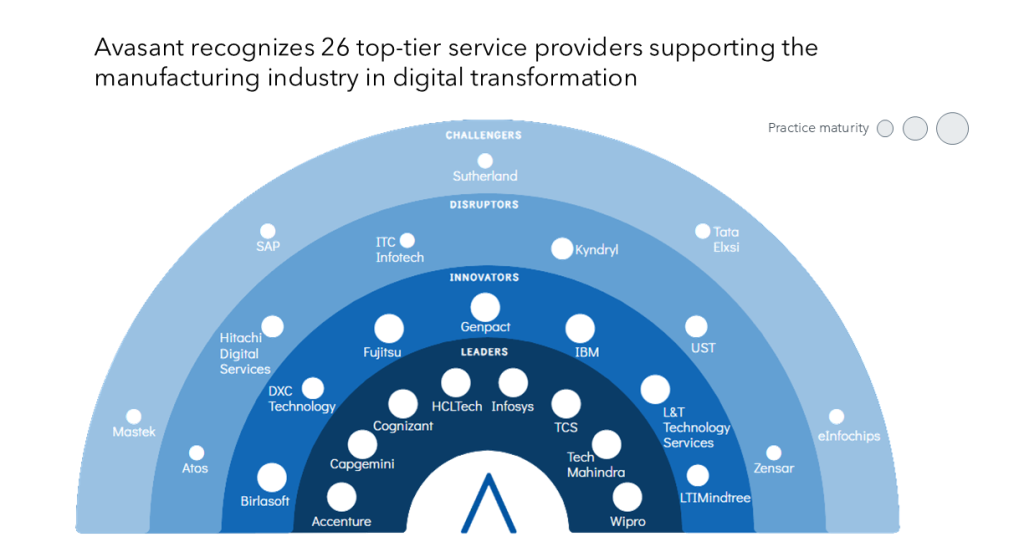
Unlocking New Horizons in Manufacturing Through Digital Resilience and Intelligent Operations
Manufacturing enterprises are accelerating digital transformation by embedding agentic and predictive AI across production lines for quality control, maintenance, and R&D optimization. To enhance resilience and operational planning, they are adopting digital twins, immersive simulations, and AR/VR-enabled digital threads across design and service stages. Platform-led modernization is gaining traction through low-code industrial IoT (IIoT) platforms, AI-powered edge, and cloud-based manufacturing execution systems (MES) for real-time visibility and centralized decision-making. Human-machine collaboration is also expanding, with investments in Industry 5.0 technologies such as wearables, voice AI, and collaborative robotics to improve safety and productivity. In parallel, enterprises are strengthening supply chain resilience and sustainability using blockchain, AI, micro factories, and circular manufacturing practices to meet traceability and ESG goals. Manufacturing companies collaborate with service providers for this digital transformation, which requires strong technological expertise and delivery capabilities. Both demand-side and supply-side trends are covered in our Manufacturing Digital Services 2025 Market Insights™ and Manufacturing Digital Services 2025 RadarView™, respectively.
Manufacturing Digital Services 2025 RadarView™
The Manufacturing Digital Services 2025 RadarView™ can help manufacturing enterprises craft a robust strategy based on industry outlook, best practices, and digital transformation. The report can also aid these enterprises in identifying the right partners and service providers to accelerate their digital transformation in this space. The 98-page report also highlights top market trends in the manufacturing industry and Avasant’s viewpoint.

State and Local Government Digital Services 2025 Market Insights™
The State and Local Government Digital Services 2025 Market Insights™ assists organizations in identifying important demand-side trends that are expected to have a long-term impact on any digital project in the state and local government space. The report also highlights key challenges that enterprises face today.
State and Local Government Digital Services 2025 RadarView™
The State and Local Government Digital Services 2025 RadarView™ can help state and local governments craft a robust strategy based on industry outlook, best practices, and digital transformation. The report can also aid them in identifying the right partners and service providers to accelerate their digital transformation in this space. The 67-page report also highlights top market trends in the state and local government space and Avasant’s viewpoint.

Navigating SAP S/4HANA Modernization: Evaluating RISE with SAP versus Private Cloud
As SAP phases out mainstream support for SAP ERP 6.0 by 2027, enterprises are confronted with a strategic decision with regard to modernizing to SAP S/4HANA. This article compares two key transformation paths: RISE with SAP, a bundled, SAP-managed offering, and self-managed deployments on hyperscaler clouds. It explores trade-offs in control, complexity, cost transparency, and customization, supported by real-world examples such as embecta’s rapid ERP separation. While RISE with SAP simplifies operations and accelerates time to value, private cloud offers greater flexibility. The analysis helps CIOs assess which model aligns best with their digital maturity, operational priorities, and long-term transformation goals.

SAP Sapphire 2025: A Turning Point for AI-driven Enterprise Operations
At SAP Sapphire 2025, SAP unveiled a cohesive strategy to transform enterprise operations through embedded AI and unified data infrastructure. Central to this is the SAP Flywheel model, which allows applications, data, and AI to reinforce each other, enabling context-aware automation via Joule, SAP’s AI copilot. Joule extends across SAP and non-SAP systems, improving decision-making in users’ daily workflows. Supporting this is the Business Data Cloud, a unified, open data platform designed to eliminate fragmentation and fuel intelligent applications. With partnerships including Palantir and Adobe, SAP is aligning its architecture for the AI era, turning siloed data into real-time, cross-functional intelligence.

The Illusion of AI Sovereignty: Washington and Beijing Still Pull the Strings
A new wave of digital nationalism is sweeping through public policy and enterprise boardrooms. Countries including France, Saudi Arabia, the UAE, Singapore, and India are doubling down on sovereign AI. They are investing in localized data ecosystems, region-specific LLMs, national AI clouds, and stricter compliance regimes. No nation today enjoys absolute, full-stack AI sovereignty. Rather than chasing total independence, the trend is toward layered sovereignty: choosing which parts of the stack to control, influence, outsource, or codevelop. The sovereign AI game is not binary; it is composable. In the coming decade, national AI strategies will be defined not by what a country builds alone but by what it chooses to own, protect, and shape on its own terms.

Application Management Services 2025 Market Insights™
This report identifies key demand-side trends in the application management services space, helping enterprises fine-tune their application management strategies. It provides an overview of top implementation challenges, industry-specific adoption, diverse use cases driving implementation, and the integration of agentic AI across key stages of application management based on Avasant’s assessment.
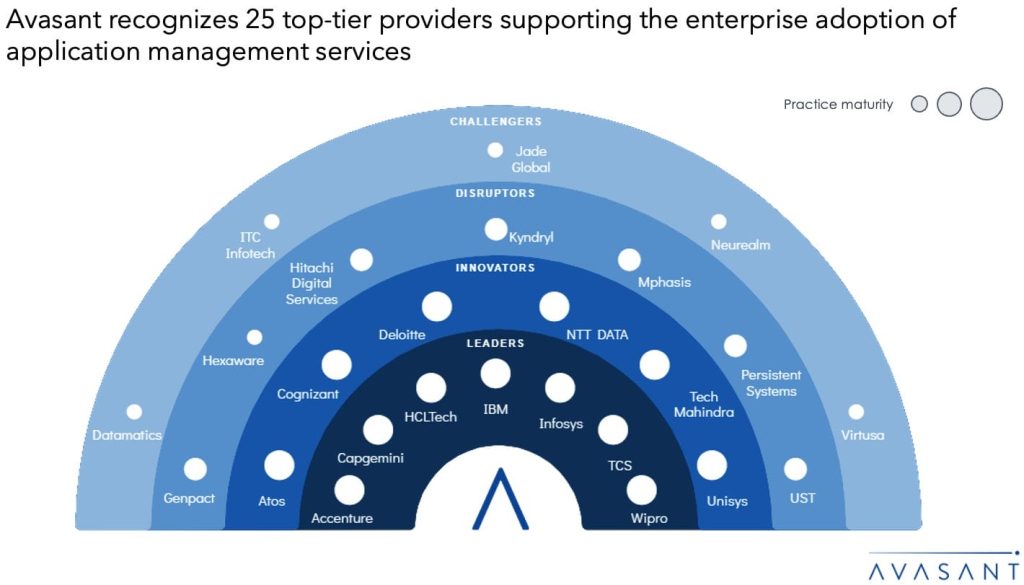
Application Management Services: Streamlining Application Modernization and Support with Agentic AI
Organizations are facing significant challenges in their application management journeys, including legacy systems, decentralized strategies, resistance to change, skills shortage, workflow automation, and integration barriers. To address these complexities, enterprises are increasingly collaborating with application management service providers to modernize legacy systems, integrate disparate systems, develop cloud-native applications, enhance performance monitoring, and facilitate change management. Additionally, they are integrating agentic AI solutions to accelerate legacy modernization, enhance DevOps efficiency, and optimize IT operations. Meanwhile, service providers are leveraging agentic AI for application portfolio assessment, modernization, deployment, and support services. Both demand-side and supply-side trends are covered in our Application Management Services 2025 Market Insights™ and Application Management Services 2025 RadarView™, respectively
Application Management Services 2025 RadarView™
The Application Management Services 2025 RadarView™ assists organizations in identifying strategic partners for application management services by offering detailed capability and experience analyses for service providers. It provides a 360-degree view of key application management service providers across practice maturity, partner ecosystem, and investments and innovation, thereby supporting enterprises in identifying the right application management services partner. The 72-page report highlights top supply-side trends in the application management services space and Avasant’s viewpoint on them.